

Is This Species Right for You?
The crested gecko is frequently sold as an easy first reptile, and the quick-facts label of beginner-friendly is fair as far as survival goes — this species tolerates room-temperature housing without supplemental heat in most homes and does not strictly require UVB. But easy to keep alive is not the same as easy to keep well, and the difficulty rating here is intermediate for a reason: getting the humidity cycle, feeding routine and enclosure size right takes more ongoing attention than the marketing suggests.
Space is the first honest cost. A single adult needs a minimum 18 x 18 x 24 in (45 x 45 x 60 cm) front-opening enclosure — a floor-to-ceiling commitment in a bedroom, not a shoebox on a shelf. Ongoing cost is modest, $15–$35 a month for diet powder, feeder insects and supplies, but the first setup runs $250–$500 once a correctly sized enclosure, lighting and live planting are accounted for.
This is also a 15–20 year commitment when housed and fed correctly, worth planning for before purchase, whether through browsing available animals or reading further in the wider care guide library.
Handling tolerance is moderate, not high: most individuals settle, but they are fast, jumpy, and drop their tails under stress — a tail that does not regrow. That makes this a poor first reptile for a young child to handle unsupervised, though it is a fine household pet once an adult manages handling sessions and sets the rules for children.
Natural History and Wild Behaviour
Correlophus ciliatus is native to New Caledonia, a South Pacific island group, where it occupies humid forest habitat on Grande Terre and the Isle of Pines. It was believed extinct until its rediscovery in 1994, and wild population data remain poorly quantified even now — a rare case where a staple of the reptile hobby is still barely studied in its native range.
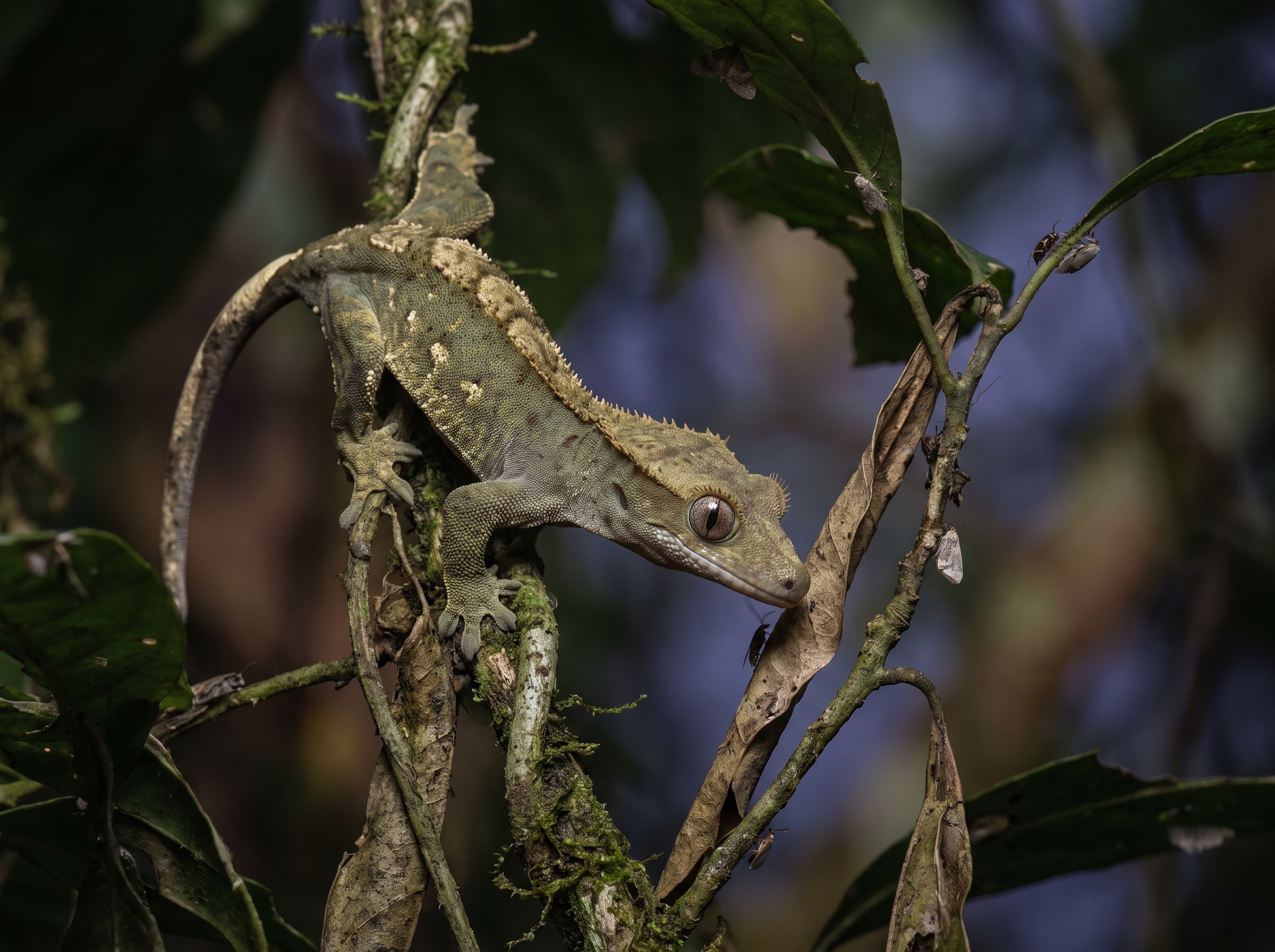
In the wild this is a crepuscular-to-nocturnal species, most active at dusk, dawn and after dark, and it is arboreal by habit — it spends the majority of its time climbing through forest canopy and understory foliage rather than moving across the ground. That single behavioural fact should shape every enclosure decision that follows: this is a species furnished for height and horizontal branch coverage, not floor space. Diet in the wild leans omnivorous and frugivorous, taking fruit, nectar and small invertebrates opportunistically rather than hunting as a dedicated predator, which is why a manufactured, nutritionally complete diet works so well as a captive staple.
Conservation status is not reassuring: the species is assessed as Vulnerable on the IUCN Red List, and wild collection from New Caledonia has been banned by the New Caledonian government since the mid-2000s, so any wild-caught animal in trade today would be there illegally. It is listed on CITES Appendix II following the CoP19 listing of New Caledonian geckos, which affects international shipment paperwork rather than domestic keeping or sale. Every crested gecko sold through reputable channels, including sellers on ReptileAds, is captive-bred — the species is now one of the most commonly bred reptiles in the hobby.
Enclosure Size and Setup
Enclosure dimensions in this guide are minimums, not targets — bigger is genuinely better for an animal that spends its life climbing, and a keeper with the space should exceed every figure below. A hatchling or juvenile needs a minimum 12 x 12 x 18 in (30 x 30 x 45 cm) enclosure with dense fine-mesh cover and several climbing and hiding points to keep a small animal from feeling exposed. As growth approaches subadult size, upgrade to the adult minimum: 18 x 18 x 24 in (45 x 45 x 60 cm), roughly 33–40 gallons (125–150 L) equivalent, oriented taller than wide. A recommended setup gives meaningfully more height and horizontal branch runs than the minimum footprint; an excellent setup is a large, densely planted vertical enclosure with multiple basking and retreat zones so an animal is never forced to choose between thermoregulating and hiding.
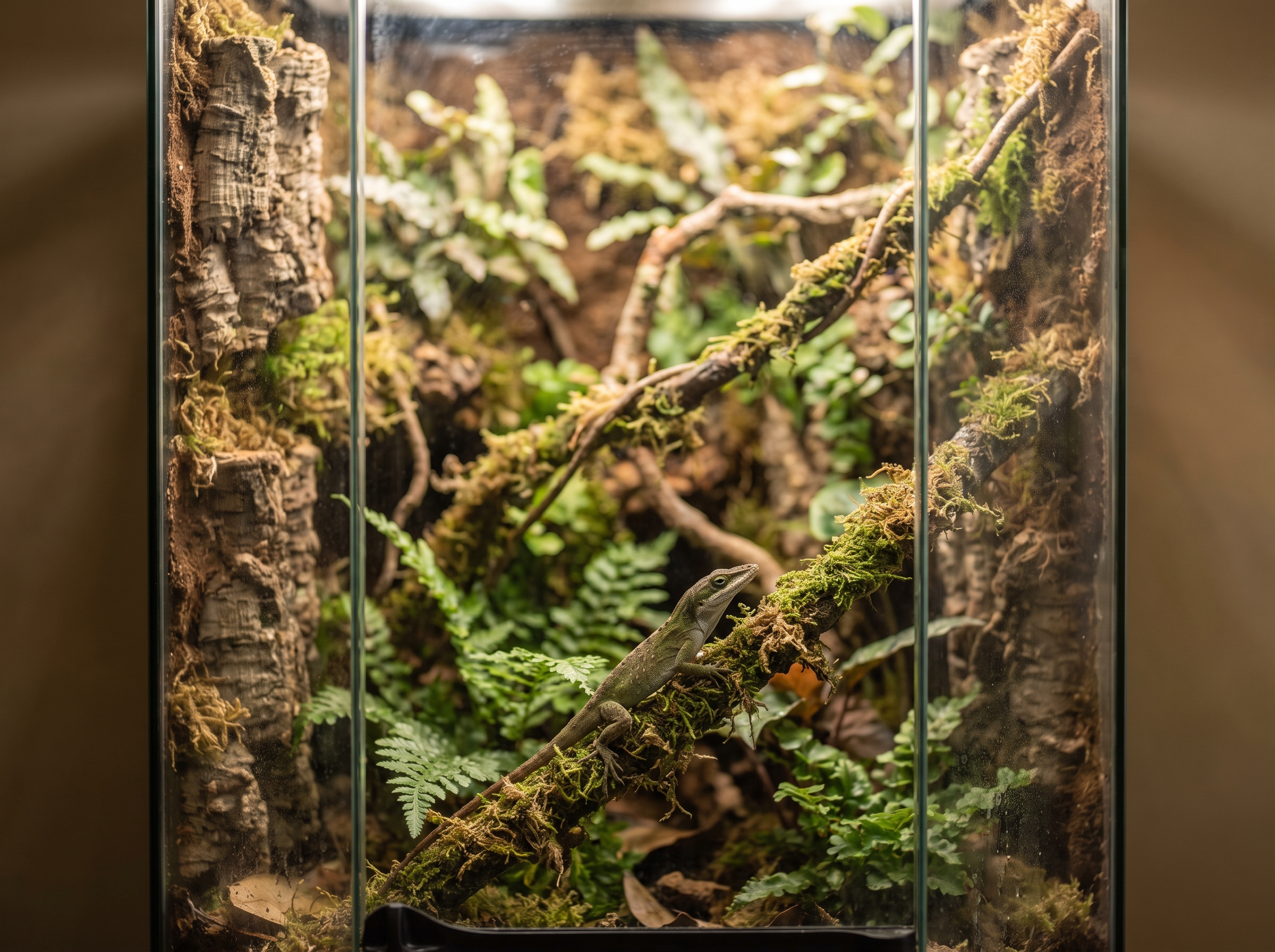
Front-opening glass or PVC enclosures are strongly preferred over top-opening tanks for an arboreal, jumpy species — reaching in from above startles the animal and increases fall and tail-drop risk. Ventilation needs to be adequate without collapsing humidity retention entirely; mesh panels or vents sized for cross-flow, rather than a fully mesh top, work better for maintaining the nightly humidity spike.
Provide at least two full hides — one on the warm side, one on the cool side — plus a dedicated humid hide, and enough horizontal and diagonal climbing surfaces (cork rounds, branches) that the animal is never left standing on the substrate for lack of an alternative. Cohabitation is conditional: single housing is safest for guaranteeing feeding and injury monitoring, and while same-sex or mixed-sex groups can work in large, heavily planted enclosures with multiple feeding and hide stations, males must never be housed together and an unplanned mixed-sex group carries a real breeding risk. A new animal, or one returning from a show or vet visit, belongs in a simple separate quarantine enclosure — bare-bottomed or paper-substrate, with its own hide and dishes, away from established collections.
Heating, Lighting and Humidity
Target a basking surface temperature of 80–83°F (27–28°C) directly under a low-output basking bulb or high-output LED, measured with an infrared temperature gun or a probe thermometer resting on the actual perch surface, not the surrounding air, and never let any point in the enclosure exceed 85°F (29°C). This species survives without a basking source, but providing one supports natural thermoregulatory behaviour and lets UVB do its job. Air temperature is a separate measurement and should be taken with a digital thermometer or thermostat probe positioned at the animal's level: warm-side air should read 74–78°F (23–26°C), cool-side air 68–72°F (20–22°C). A night drop in air temperature to as low as 65°F (18°C) is safely tolerated and is beneficial rather than merely acceptable — it mimics the natural diel cycle and does not need extra heating to prevent it in most homes.
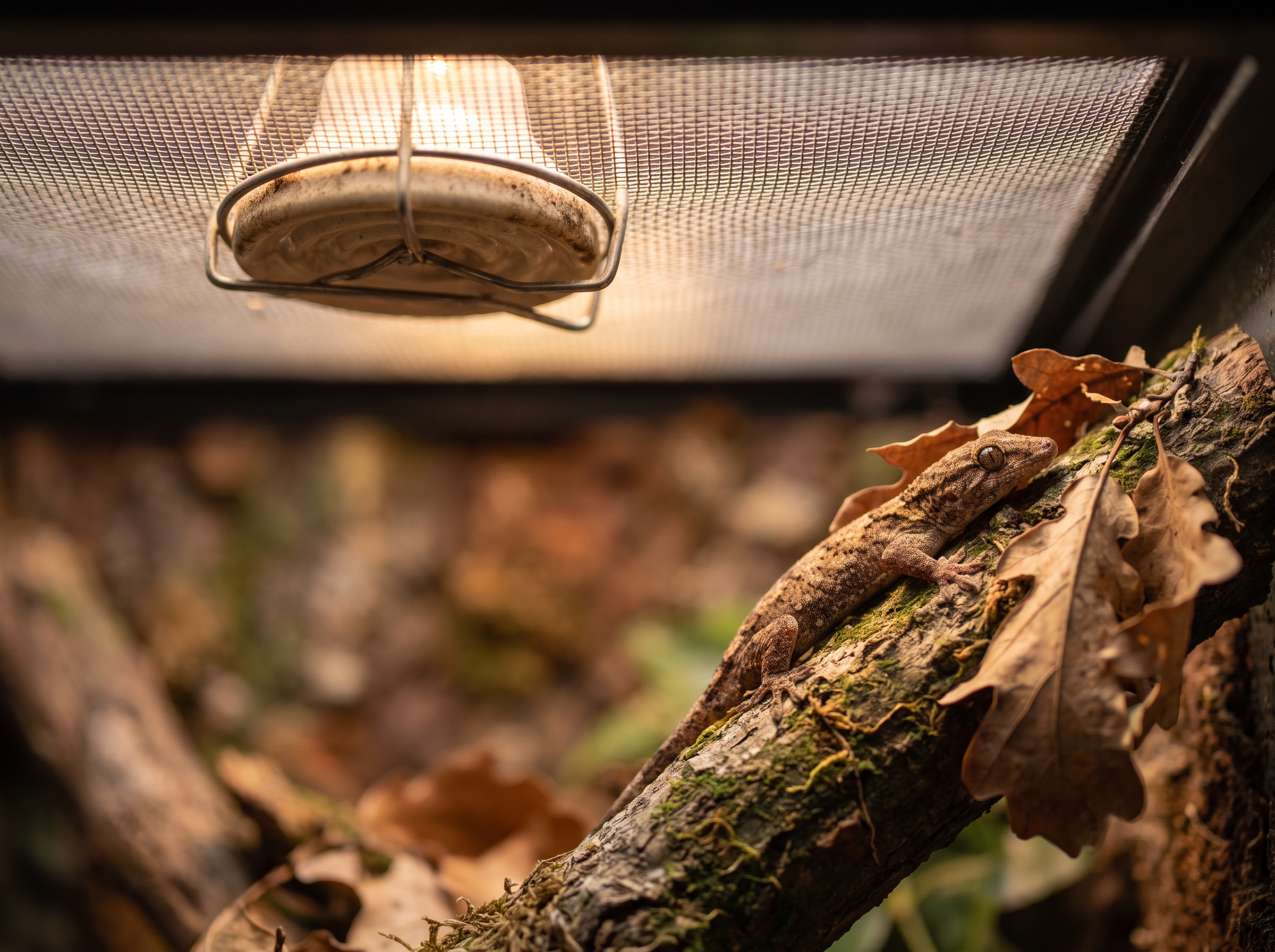
Any heat source strong enough to reach the basking figure above should run on its own thermostat, with the probe taped to the basking surface itself, not floating in the air or against the heat emitter, so the controller regulates what the animal actually contacts.
UVB Provision
UVB is increasingly recommended for this species even though it is not required for survival if dietary D3 is provided through supplementation. The target is 0.5–1.0 UVI at the basking site — low-end Ferguson Zone 1 — delivered by a low-percentage T5 tube (2.0–5.0 UVB output). Achieving that index depends on lamp distance and any mesh between the lamp and the animal, both of which attenuate output substantially; measure the actual UVI at the basking perch with a properly calibrated UV meter and adjust distance rather than assuming a bulb's rated percentage translates directly to the reading at the perch. A 12-hour photoperiod on a timer, shortened modestly in winter and lengthened in summer, is a reasonable default in the absence of species-specific photoperiod research.
Humidity Cycling
Daytime humidity should sit at 50–60%, with a nightly spike to 70–80% driven by an evening misting, then allowed to dry back down before the next misting rather than kept permanently saturated. Measure it with a digital hygrometer placed at mid-height in the enclosure, not pressed against the glass where condensation skews the reading. Misting by hand or an automated system both work; the failure mode to watch for is a substrate that never dries between mistings, which invites mould and bacterial growth rather than helping the shed cycle it is meant to support.
Substrate, Decor and Enrichment
A coco-fibre or coco-fibre/sphagnum moss blend, or a bioactive mix with a live clean-up crew, both hold the daytime-to-nighttime humidity swing well and support the digging a gravid female needs for a lay-box — provide at least 4 in (10 cm) of moist substrate depth in a dedicated lay area for a breeding or gravid female. Paper towel is an acceptable, if unattractive, alternative for a quarantine or hospital setup where humidity control and easy waste-spotting matter more than aesthetics.
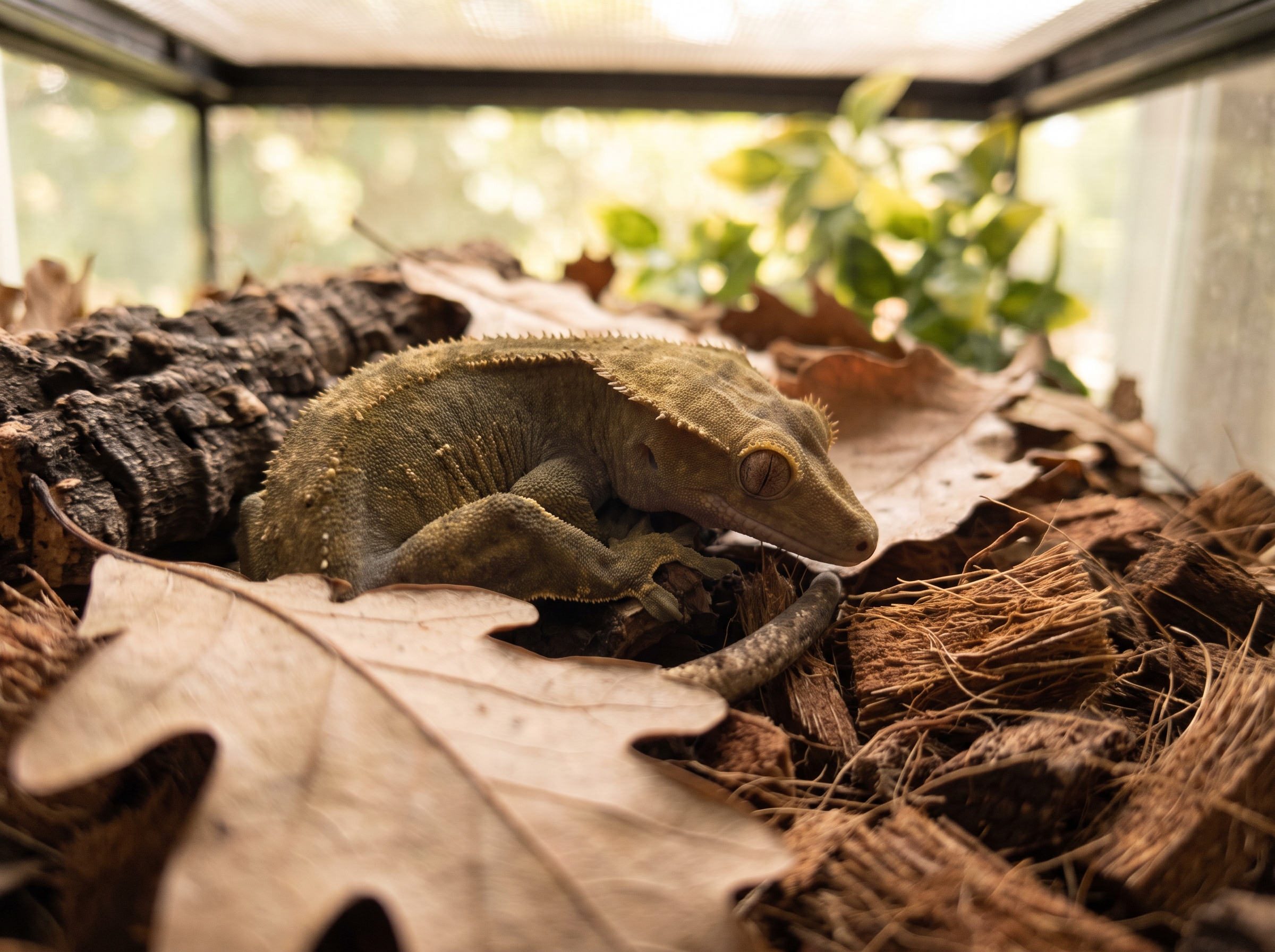
Loose substrates marketed as sand or fine calcium-sand blends are not recommended: ingested particles picked up while licking food or drinking off the substrate surface can accumulate in the gut over time, and there is no husbandry advantage a safer substrate does not already provide. Undiluted garden soil or unrinsed bark chips carry a pesticide or mould risk not worth taking with a captive-bred, readily available species.
Because this is an arboreal animal, decor should be vertical-first: cork bark rounds and flats, sturdy branches set on the diagonal, and dense artificial or live foliage (pothos, ficus and sansevieria all tolerate the enclosure conditions this species needs) to create visual barriers the animal can retreat behind. Bioactive setups suit this species well given the humidity range it already needs and the relatively light bioload of a single gecko. Rotate enrichment modestly — repositioning branches, adding a new climbing route, varying feeding location — every few weeks; a habitat that a keeper can rearrange gives an active climbing species more of its natural repertoire to use.
Feeding, Supplements and Hydration
Commercial crested gecko diet (CGD) powder mixed with water is the staple and is nutritionally complete on its own — it does not need a separate calcium or vitamin dusting the way feeder insects do. Gut-loaded crickets and dubia roach nymphs, offered as an occasional rotation rather than the staple, add valuable enrichment and protein diversity; insects should be sized no wider than the gap between the animal's eyes at minimum, scaling up with age, so an oversized cricket never becomes a regurgitation or impaction risk.
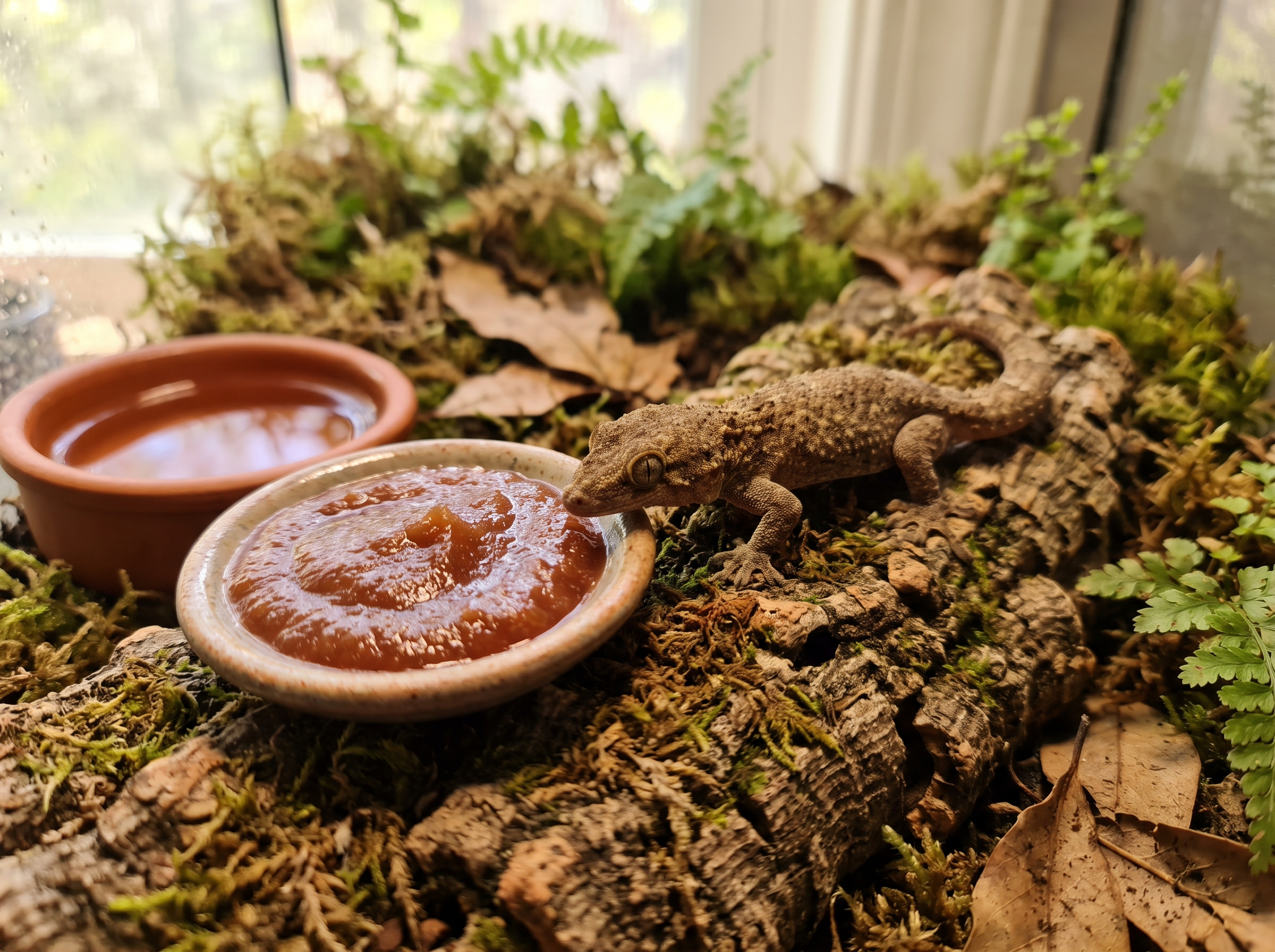
Every feeder insect should be gut-loaded in the 24 hours before feeding and then dusted with calcium and D3, on the frequency set out by life stage; a plain calcium dusting on off-insect weeks and an occasional multivitamin dusting cover any gap left by a diet that is not exclusively CGD-based. A shallow water dish should always be available even though most hydration in practice comes from misting droplets on leaves and enclosure surfaces, which this species is adapted to drink from rather than a still dish.
Body condition is judged at the tail base and hips: a healthy adult carries a full, rounded tail base with the hip bones present but not sharply visible under the skin. An overweight crested gecko shows a tail base wider than the body directly in front of it and a visibly rounded, saggy abdomen even at rest — reduce insect frequency and portion size, and check that CGD is not being left available continuously, before assuming anything more serious.
Daily, Weekly and Monthly Care
Realistic daily care for one crested gecko in a correctly set-up enclosure takes five to ten minutes: a misting session, a quick food check, and a glance at both thermometers and the animal itself. The habit most likely to slip is removing uneaten CGD before it sours rather than topping fresh food onto old — stale diet powder left in place for days is the single most common daily-care shortcut that quietly damages appetite and hygiene.
Weekly tasks add up to closer to twenty minutes and are the ones most often skipped under time pressure: a live insect feeding, a wipe-down of glass or PVC panels, and a body-condition check are all easy to defer by a day or two, but deferring the insect feeding repeatedly is how a calcium-D3 shortfall builds silently over months. Monthly care — a substrate deep-clean, checking UVB bulb age against its replacement schedule, and reviewing feeding and weight records — is the layer keepers most often forget, because nothing looks visibly wrong day to day; a UVB tube can lose most of its usable output well before it visibly dims, which is exactly why tracking install date rather than appearance matters.
Handling and Behaviour
Give a newly acquired crested gecko a settling-in period of undisturbed husbandry-only contact before any handling begins — feeding, misting and cleaning around the animal without picking it up lets it learn the enclosure and the keeper's presence are not threats. Once handling starts, pick the animal up by letting it walk onto an open, flat hand or a low, soft surface rather than grasping from above or around the body, which reads as a predator strike to a prey species.
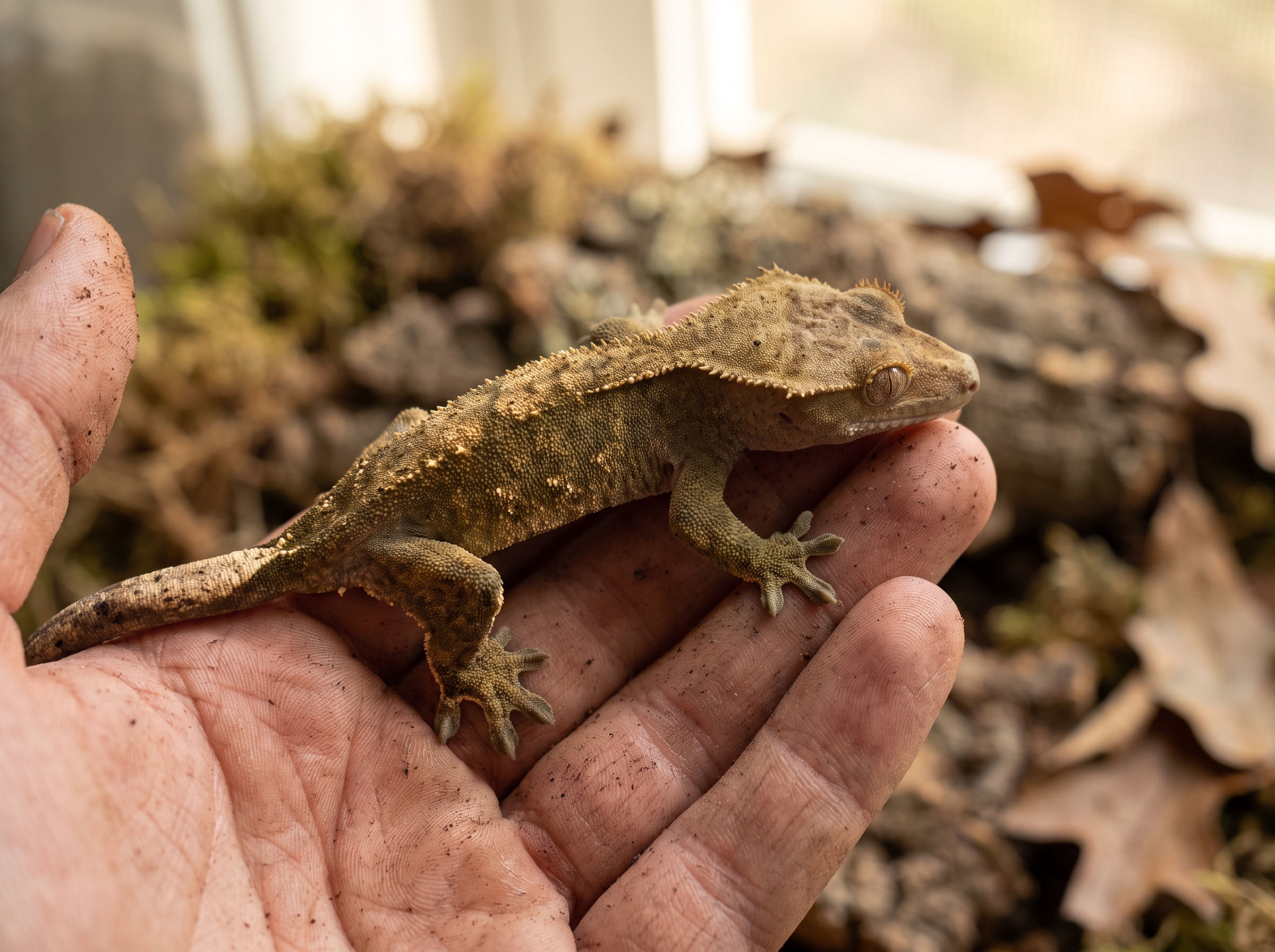
Ten to fifteen minutes is a realistic session length, and daily handling is unnecessary — a few sessions a week is enough to keep an animal comfortable with contact without adding chronic stress. Normal body language is calm, deliberate movement and a relaxed, level tail; stress signals include rapid darting, tail-waving or vocalising squeaks, and a hunched, tucked-in posture. A defensive bite from this species is rarely more than a pinch and does not typically break skin; the behaviour to actually protect against is the jump-and-drop response under sudden movement or a tight grip, since a dropped tail does not regrow.
Sessions with children should be seated, over a low surface, and directly supervised throughout — not because the animal is aggressive, but because a startled crested gecko moves faster than most children can react to, and an open doorway or gap in enclosure furniture is all it takes for an escape. Keep enclosure doors, vents and any access point secured with a functioning latch, since this species is a capable climber and an efficient escape artist given any opportunity.
Health and Veterinary Care
Any newly acquired animal warrants a hands-on check before it goes anywhere near an established collection: clear, fully open eyes, an even gait with no dragging limb, a straight jawline, and a body with visible but not sharp hip bones. A quarantine period in a separate, simply furnished enclosure — commonly run for several weeks to a few months in general reptile-keeping practice — lets a keeper watch for problems that were not obvious at the point of sale before any shared airspace or equipment is introduced.
Normal droppings are a firm, dark, formed stool alongside a white-to-cream urate portion; watery stool, a green or unusually pale urate, or a sudden change in frequency are all worth tracking against feeding and temperature records rather than dismissed as one-off. Sheds should come away in reasonably large pieces given adequate nightly humidity; small, retained fragments around the toes or tail tip point to a humidity shortfall rather than a health problem in themselves. Weighing a juvenile or breeding female periodically and logging the number is a more reliable early-warning system than eyeballing body shape from memory.
The husbandry-linked conditions actually seen in this species trace back to a short list of causes: metabolic bone disease from inadequate calcium and D3 relative to UVB provision, respiratory infection from chronically cool, damp, poorly ventilated enclosures, and retained shed from humidity that never reaches the nightly target. None of these are treated at home — a soft or rubbery jaw, bowed limbs, open-mouth breathing or audible clicking, unexplained weight loss, or any sign of prolapse all warrant an exotics vet, not a home remedy. A seller's store page or the general care guide index are useful for husbandry review beforehand, not for the medical question itself.
Buying This Species
Every crested gecko reasonably available for purchase today is captive-bred; wild collection from New Caledonia has been prohibited for close to two decades, and a genuine wild-caught animal would be both exceptionally rare and illegal to have exported. That makes lineage a straightforward question to ask a seller rather than a grey area to navigate, and it is worth asking regardless — a seller who can speak plainly about a hatch date and parentage is a good early signal.
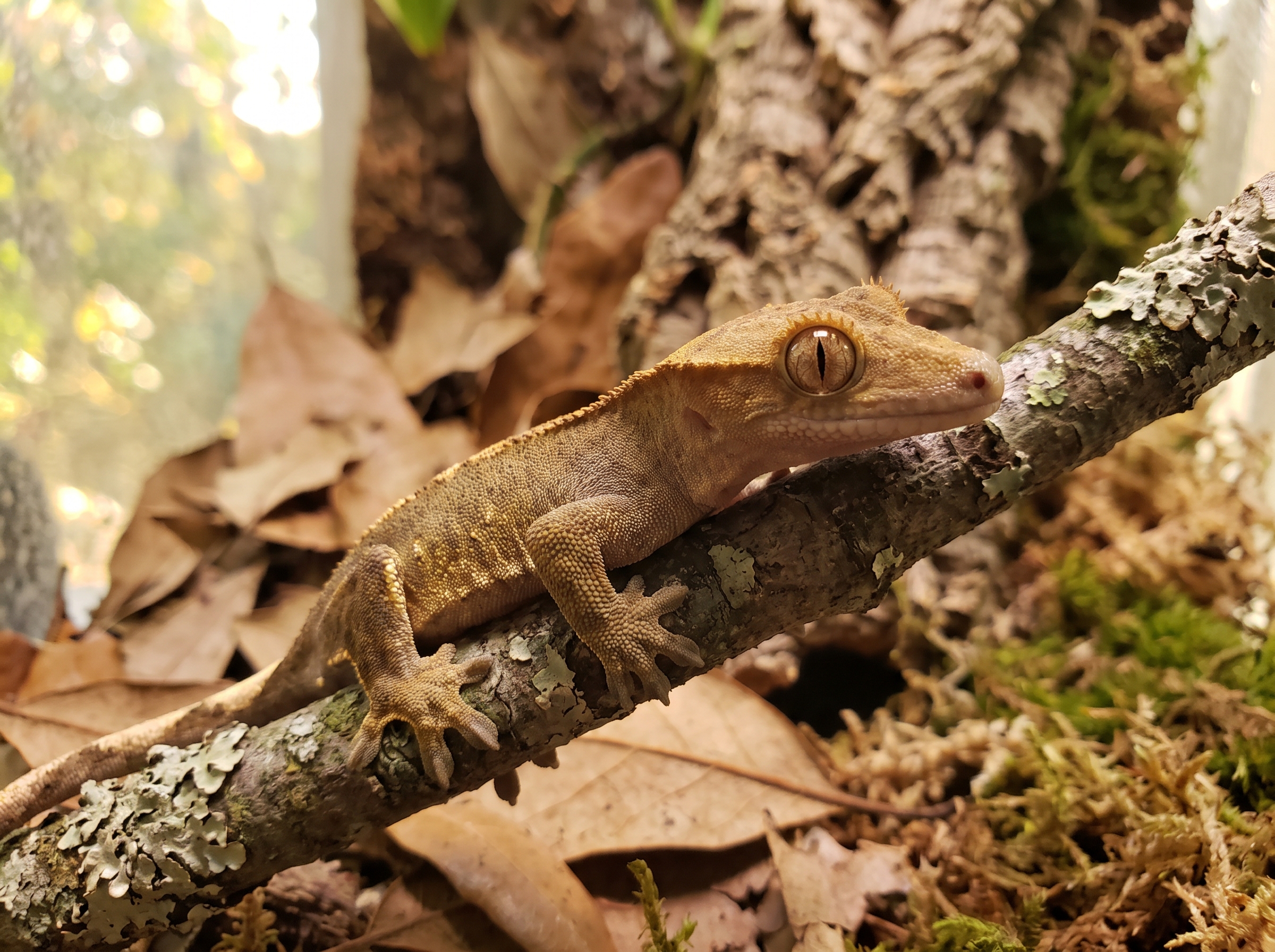
A healthy animal photographs with clear, fully domed eyes, an even skin tone with no retained shed patches, and a tail base proportionate to the body — avoid anything shown with a visibly kinked spine, a lopsided jaw, or a tail base disproportionately thin against the hips. In hand, a healthy crested gecko grips firmly, moves with intent rather than dragging, and reacts to a light touch with normal alertness. One line-specific concern worth naming honestly: some lily white bloodlines have a reported association with neurological head-tilt and imbalance issues; this is not universal to the line and the evidence is more anecdotal than formally studied, but it is worth asking a breeder about directly rather than assuming every animal marketed under that name is unaffected.
Arrange transport for the cooler part of the day where possible, and have the enclosure fully set up and stable at target temperature and humidity before the animal arrives, so it goes straight into a working environment rather than a construction site. Use the seller's health checklist and any records offered — hatch date, feeding history, prior shed dates — as a starting reference for the quarantine log rather than a one-time formality. Sellers with an established track record are easiest to find by browsing verified stores directly, and current availability for the species can be checked any time through the crested gecko listings on the marketplace.
- IUCN Red List
- Assessed as Vulnerable on the IUCN Red List; historically believed extinct in the wild until its rediscovery in 1994, with remaining wild populations pressured by habitat loss, fire and introduced predators such as the little fire ant and rats.
- CITES
- Listed on CITES Appendix II — New Caledonian geckos, including Correlophus ciliatus, were added at CoP19 with the listing in force from 2023, so international movement requires CITES documentation; domestic keeping and sale within a country are unaffected.
- Ownership restrictions
- Widely legal to keep in most US states and many countries with no permit required, but buyers should verify local/state and municipal exotic-pet ordinances, as some cities or HOAs restrict reptile ownership generally.
- Wild-caught in trade
- Effectively absent from trade — wild collection from New Caledonia has been banned by the New Caledonian government since the mid-2000s, so any wild-caught specimen would be illegal to have exported.
- Captive-bred availability
- Extremely abundant in captive-bred form; one of the most commonly bred reptiles in the hobby, with huge morph/pattern diversity (lily white, harlequin, pinstripe, dalmatian, etc.) available from breeders and marketplaces like ReptileAds.
Ownership rules vary by country, state and even city, and they change. Check what applies where you live before you buy.
Feeding by Life Stage
What changes as the animal grows. Portions are measurable rules, not estimates.
- Food
- Commercial crested gecko diet (CGD) powder mixed with water as the staple; optional small gut-loaded insects (small crickets, small dubia roach nymphs)
- Portion
- CGD portion roughly the size of a dime; feeder insects (if offered) no wider than the gap between the eyes
- Frequency
- CGD offered nightly; insects offered 2–3 times per week
- Supplements
- Plain calcium without D3 dusted on insects at each insect feeding, with calcium plus D3 substituted no more than once weekly because the CGD staple already supplies D3; CGD is nutritionally complete and does not need separate dusting
- Enclosure
- Minimum 12 x 12 x 18 in (30 x 30 x 45 cm) enclosure with dense fine-mesh cover and multiple climbing/hiding points to reduce stress
- Food
- CGD powder mixed with water as the staple, plus gut-loaded crickets or dubia roach nymphs as a rotation
- Portion
- CGD portion roughly a nickel-to-quarter size per feeding; insects no wider than the space between the eyes
- Frequency
- CGD every other night; insects 2 times per week
- Supplements
- Plain calcium without D3 on insects at each insect feeding, with calcium plus D3 substituted no more than once weekly while a complete CGD remains the staple
- Enclosure
- Minimum 12 x 12 x 18 in (30 x 30 x 45 cm), upgrading to 18 x 18 x 24 in (45 x 45 x 60 cm) as growth approaches subadult size
- Food
- CGD powder mixed with water as the staple, plus gut-loaded crickets or dubia roach nymphs as a rotation
- Portion
- CGD portion about a quarter-to-half-dollar size; insects no wider than the width of the head
- Frequency
- CGD every other day; insects 1–2 times per week
- Supplements
- Calcium with D3 on insects weekly; a plain calcium dusting on off-insect weeks
- Enclosure
- Minimum 18 x 18 x 24 in (45 x 45 x 60 cm)
- Food
- CGD powder mixed with water as the staple, plus gut-loaded crickets or dubia roach nymphs as an occasional rotation
- Portion
- CGD portion sized for what is fully consumed within a few hours (leftover removed and discarded); insects no wider than the width of the head
- Frequency
- CGD every other day (or nightly in smaller amounts); insects 1–2 times per week
- Supplements
- Calcium with D3 dusted on insects weekly; multivitamin dusting every 2 weeks if not using a complete CGD as the staple
- Enclosure
- Minimum 18 x 18 x 24 in (45 x 45 x 60 cm)
- Food
- CGD powder mixed with water offered generously as the staple, plus gut-loaded crickets and dubia roach nymphs for the added protein and calcium demand of egg production
- Portion
- CGD offered generously — as much as consumed nightly; increase insect feedings for extra protein and calcium demand
- Frequency
- CGD nightly; insects 2–3 times per week during gravidity
- Supplements
- Plain calcium without D3 on insects at every insect feeding, with calcium plus D3 substituted once weekly; ensure a dedicated dish of plain calcium without D3 is available at all times for self-regulation
- Enclosure
- Minimum 18 x 18 x 24 in (45 x 45 x 60 cm) with an added lay-box of moist substrate at least 4 in (10 cm) deep
Daily, Weekly and Monthly Care
What keeping this animal actually costs you in time, week to week.
- Mist the enclosure in the evening to bring humidity to 70–80%, then allow it to dry back down before the next misting
- Offer or refresh the CGD portion and remove any uneaten food older than 24 hours
- Check that both the warm-side and cool-side air temperatures are within range using a digital thermometer or thermostat probe readout
- Visually check the gecko is alert, has clear eyes, and moves normally around the enclosure
- Offer live gut-loaded feeder insects dusted with calcium/D3
- Wipe down glass/PVC panels and spot-clean any waste or shed skin from the substrate and décor
- Check UVB bulb output age/schedule and confirm the fixture is on its intended photoperiod timer
- Weigh or visually assess body condition, especially in juveniles and breeding females
- Deep-clean and replace substrate fully, disinfecting the enclosure floor and décor
- Replace or rotate UVB bulb per manufacturer's stated lifespan schedule (track install date)
- Inspect misting system, humidity/temperature gauges, and thermostat probes for accuracy against a separate handheld thermometer
- Review feeding and weight records to catch any slow decline in appetite or body condition
When to Call a Vet
What you can see, and how quickly it needs acting on.
| What you see | Urgency | What to do |
|---|---|---|
| Loss of tail (autotomy) after a startle or fall | Normal | This is a normal defense mechanism and crested geckos do not regrow tails; keep the stump clean and dry and watch for signs of infection over the following days |
| Dull, greyish skin with an intact eye cap for a few days before a full-body shed | Normal | This is a normal pre-shed color change; ensure humidity is adequate at night to support a clean shed |
| Skipping a single night's feeding once in a while | Normal | Occasional appetite variation is normal, especially around shedding or minor environmental changes; continue offering food on schedule |
| Retained shed on toes, tail tip or around the eyes | Check the setup | Raise humidity and provide a moist hide; gently soak on a damp paper towel to help the shed release without pulling it |
| Consistent refusal of food for over a week with no other signs | Check the setup | Re-check temperatures, humidity, and photoperiod against target ranges and try a fresh or different-flavored CGD before assuming illness |
| Soft or rubbery lower jaw, or bowed limbs in a juvenile | See a vet | See an exotics vet — likely metabolic bone disease from inadequate calcium/D3 or UVB; in the meantime ensure calcium with D3 is being dusted correctly and stop unsupplemented feeder insects |
| Visible mite specks around eyes/vent, or excessive scratching against décor | See a vet | See an exotics vet or experienced breeder for species-safe mite treatment; isolate the animal and remove porous décor in the meantime |
| Progressive weight loss despite normal or increased feeding | See a vet | See an exotics vet for a fecal exam and general workup; keep detailed feeding and weight records to bring to the appointment |
| Sudden lethargy, closed eyes during normal active hours, and unresponsiveness to handling | Urgent | Seek urgent veterinary care — keep the animal warm during transport and do not attempt to feed |
| Prolapse of tissue from the vent or hemipenal area | Urgent | Seek urgent veterinary care immediately — keep the prolapsed tissue moist with a damp clean cloth and transport promptly, do not attempt to push tissue back in |
| Open-mouth breathing, audible clicking, or thick mucus around the nose/mouth | Urgent | Seek urgent veterinary care for a suspected respiratory infection — raise ambient warmth slightly during transport but do not delay the visit |
| Visible bone fracture, dangling limb, or inability to grip surfaces after a fall | Urgent | Seek urgent veterinary care — transport in a padded, secure container to minimize further movement |
This guide does not diagnose and does not replace a veterinarian. Nothing here is a treatment or a dose. If you are unsure, an exotics vet is always the right call.
Buying Checklist
What to check, what to ask, and what to have ready.
Quarantine every new arrival for a minimum of 30–60 days before it shares airspace, equipment or a room with an established collection. Quarantine means a separate, simply furnished enclosure (paper towel substrate, one hide, water and food dishes, its own misting bottle and tools), serviced last in the routine with hand-washing between animals, plus weekly weight, appetite, shed and dropping records and a vet fecal exam before release from quarantine.
$430–$920 for the first year: a $250–$500 initial setup plus $15–$35 a month ($180–$420) for CGD powder, feeder insects, supplements and substrate, plus one replacement UVB tube and an optional first exotics-vet check.
Frequently Asked Questions
Do crested geckos need UVB?
Not to survive — the species can be kept long-term with dietary calcium and D3 supplementation alone. UVB is nonetheless increasingly recommended, targeting 0.5–1.0 UVI at the basking site (low Ferguson Zone 1) using a low-percentage 2.0–5.0 T5 tube. Providing it supports more natural behaviour and reduces reliance on getting oral supplementation exactly right.
How big of an enclosure do crested geckos need?
An adult crested gecko needs a minimum 18 x 18 x 24 in (45 x 45 x 60 cm) front-opening enclosure, oriented taller than wide to support climbing — roughly 33–40 gallons (125–150 L) equivalent. This is a floor, not a target; more height and horizontal climbing space is always better for this arboreal species.
How long do crested geckos live?
Crested geckos typically live 15–20 years in captivity when fed and housed correctly. Lifespan drops noticeably, to around 8–12 years, in animals that are chronically underfed or kept too warm, making temperature and feeding consistency more important to longevity than any single dramatic husbandry decision.
Do crested gecko tails grow back?
No. Crested geckos drop their tails as a defense mechanism when startled or grabbed, and unlike many other gecko species they do not regrow it. The stump should be kept clean and dry and watched for infection, but the animal adapts well and tail loss is not a medical emergency on its own.
What humidity do crested geckos need?
Daytime humidity should sit at 50–60%, raised nightly to 70–80% via an evening misting and then allowed to dry back down before the next misting rather than kept constantly saturated. Measure with a digital hygrometer at mid-enclosure height; a substrate that never dries between mistings risks mould rather than helping shed quality.
Can two crested geckos live together?
Cohabitation is conditional rather than simply yes or no. Single housing is safest for monitoring feeding and preventing tail injuries, but same-sex or mixed groups can work in large, heavily planted enclosures with multiple feeding and hide stations. Males must never be housed together, and any mixed-sex group carries a real, unplanned breeding risk.
What do crested geckos eat?
The staple diet is a commercial crested gecko diet (CGD) powder mixed with water, which is nutritionally complete on its own. Occasional gut-loaded feeder insects such as crickets or dubia roach nymphs add enrichment and protein variety, dusted with calcium and D3, but they supplement CGD rather than replace it.
Do crested geckos need a heat lamp?
Not strictly — crested geckos tolerate room-temperature housing in most homes without supplemental heat. Where a basking option is provided, it should reach 80–83°F (27–28°C) at the surface, with no point in the enclosure above 85°F (29°C), with warm-side air at 74–78°F (23–26°C) and cool-side air at 68–72°F (20–22°C), controlled by a thermostat with its probe on the basking surface.
References and Revision History
Dr. Riley Moss
September 29, 2026
- 1.
Crested Gecko (Correlophus ciliatus) Care Sheet
Supports: The 50–60% daytime / 70–80% nightly humidity cycle, CGD-every-other-day feeding frequency, the 18 x 18 x 24 in (45 x 45 x 60 cm) adult enclosure minimum, the 74–78°F (23–26°C) warm-side and 68–72°F (20–22°C) cool-side air ranges, and the 15–20 year captive lifespan
- 2.
New Caledonian Gecko Conservation and Export Regulation documentation
Supports: Wild-caught trade status and the CITES Appendix II listing of New Caledonian geckos
- 3.
IUCN Red List species search portal
Supports: IUCN Red List Vulnerable status
- 4.
Supports: The metabolic bone disease sign and calcium/D3 supplementation recommendation
- 5.
Association of Reptilian and Amphibian Veterinarians (ARAV) client education resources
Supports: Health triage urgency categorization and quarantine recommendation length
- 6.
Supports: The 0.5–1.0 UVI / low Ferguson Zone 1 basking-site target
- September 25, 2026First draft generated and reviewed.
Was this guide helpful?
Rate this guide
Questions & Answers
1 question from the community
What is GCD
I see this said alot. what does it mean?
CGD= Crested Gecko Diet
Comments
2 comments
Seems legit. I like it!
Me too!