
Is This Species Right for You?
Bearded dragons are marketed heavily as a first reptile, and the food motivation, tolerance for handling, and general hardiness back that up. But the animal is formally an intermediate-difficulty keep for a reason: it needs a correctly measured basking surface, a UVI target at the basking site, and a real thermal gradient maintained every single day, not just at setup. Get the gradient wrong for months rather than days and the consequence is metabolic bone disease, not a shrug-off mistake.
Budget realistically. A correct first setup — large enough enclosure, a quality T5 HO UVB fixture, and a dual-thermostat system — runs $350–$900, and ongoing costs of $40–$80 a month cover feeder insects, greens, supplements, substrate, and electricity, with UVB bulb replacement every 6–12 months spiking some months. This is an 8 to 12 year commitment, sometimes 14–15, so it outlasts a lot of life changes: moving house, changing jobs, having children.
On children: handling tolerance is high, and most captive-bred individuals accept 15–30 minute sessions once acclimated, which makes this a genuinely good family reptile under supervision. It is not a good match for anyone wanting a pair or group — house bearded dragons alone. Adults are territorial, and resource guarding, stress and injury are common even in pairings hobbyists insist are “compatible.” If you want to browse currently available animals before committing to a setup, the bearded dragons currently listed for sale give a realistic sense of size and price at different ages.
Natural History and Wild Behaviour
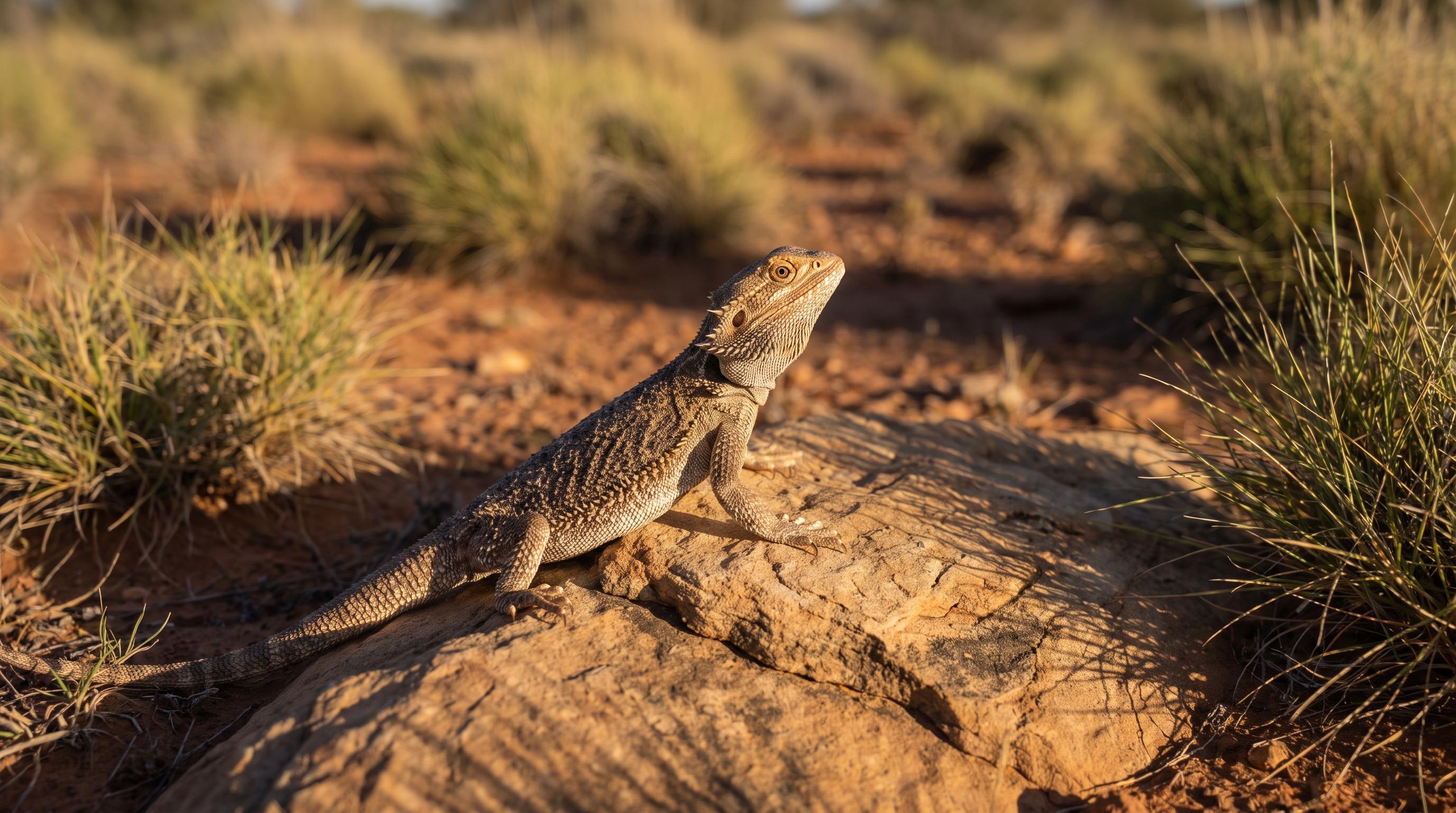
Pogona vitticeps is native to the arid and semi-arid woodland, scrubland and desert margins of central Australia, where it experiences a strongly seasonal climate with hot days, cool nights, and low humidity for most of the year. It is diurnal, active through the day and inactive at night, which is the basis for the photoperiod and night-drop guidance later in this guide. In the wild it is an opportunistic omnivore, taking insects, small vertebrates, flowers, fruit and foliage as available — the same juvenile-insectivore-to-adult-more-herbivore shift shows up in captive diet planning.
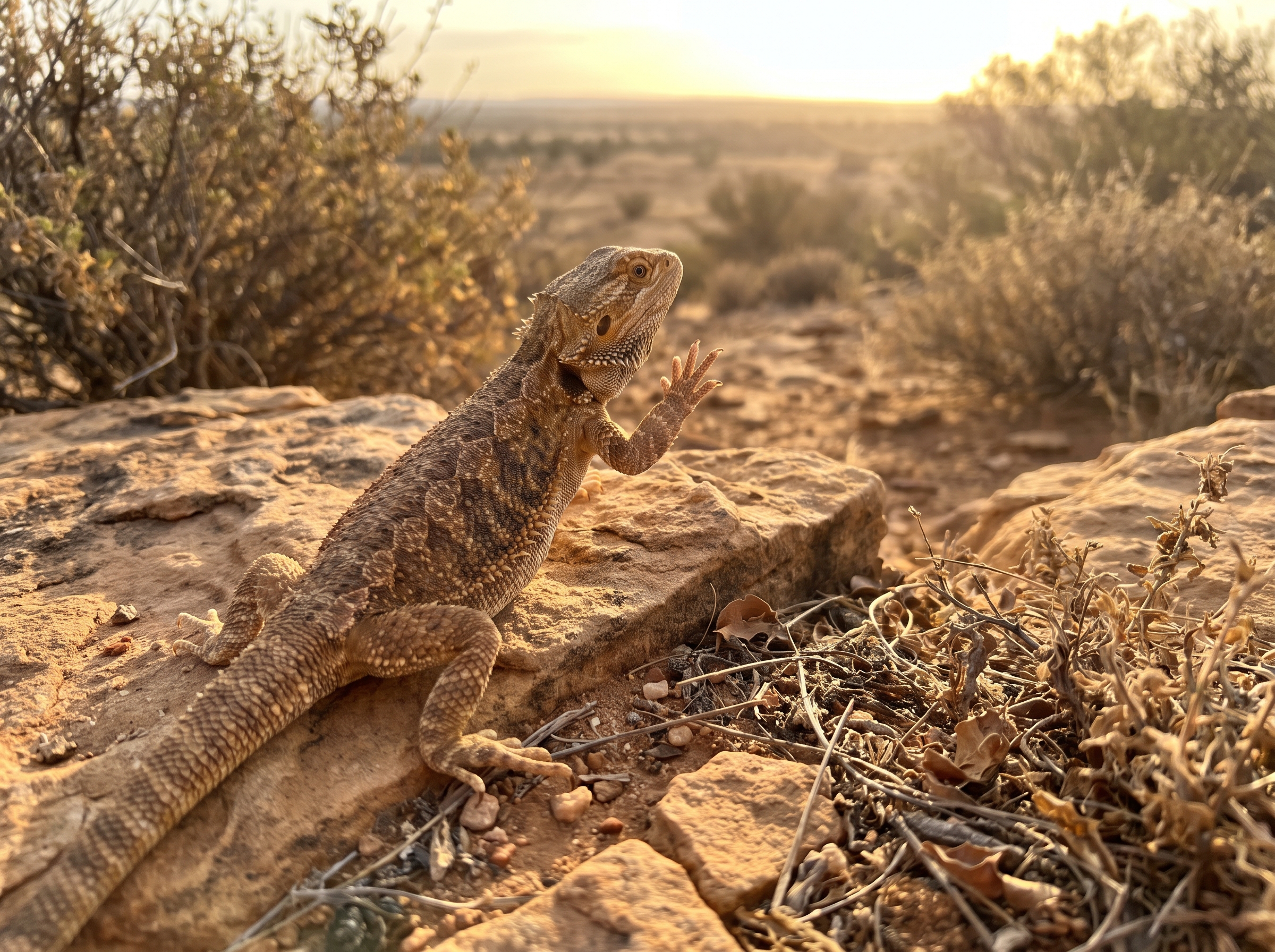
Behaviourally, wild bearded dragons bask prominently on elevated branches, fence posts and rocks to raise body temperature quickly, then retreat to shade or shallow burrows to cool down or shelter from extreme heat — a semi-arboreal, basking-driven lifestyle rather than a fossorial one, which is why captive furnishing prioritises basking platforms over deep burrowing substrate, with the exception of digging behaviour tied specifically to egg-laying.
Wild-caught animals are essentially absent from the pet trade, since Australia has banned reptile export since the 1960s; every Pogona vitticeps kept outside Australia descends from earlier captive lines, and the species is now extremely widely captive bred with a large range of morphs available from hobbyist breeders. On conservation status: Pogona vitticeps has not been evaluated as a distinct assessment on the IUCN Red List and the genus Pogona has no full modern IUCN assessment on record, and the species is not listed in the CITES Appendices as of the latest published appendices — both should be verified against the current IUCN and CITES databases before relying on them, since listings can change.
Enclosure Size and Setup
Enclosure minimums scale with the life-stage table alongside this guide, from a 20 × 10 × 12 in (50 × 25 × 30 cm) hatchling grow-out tub up to the 48 × 24 × 24 in (120 × 60 × 60 cm) minimum required from the subadult stage onward, roughly a 120–150 gallon (450–570 L) footprint equivalent. Every one of those figures is a floor, not a target — a bigger footprint is always better for an animal this active and basking-driven, and horizontal floor space matters more than height because bearded dragons are ground-dwelling baskers first and climbers second.
Orientation and Material
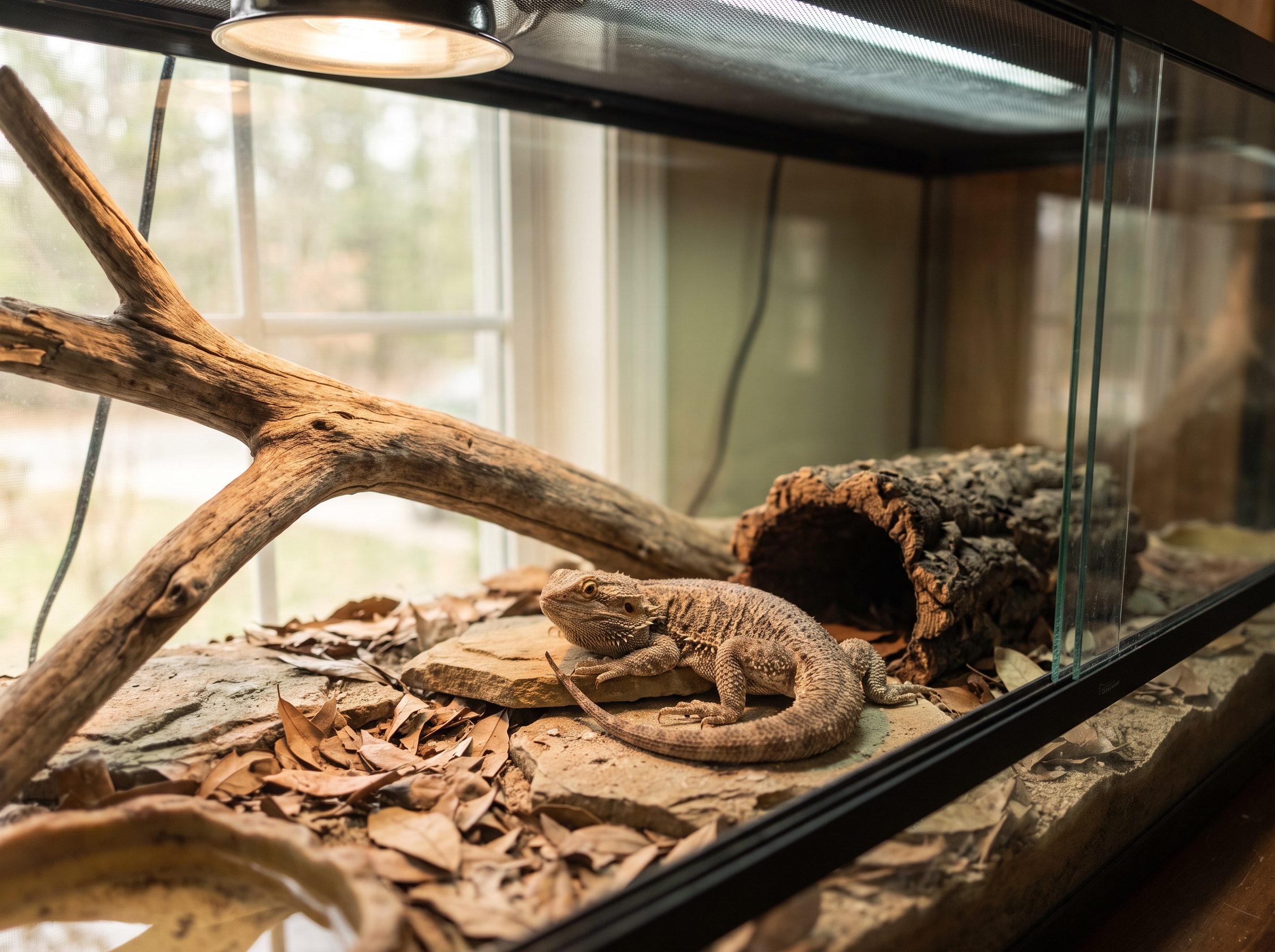
A front-opening horizontal enclosure oriented wider than it is tall suits the species better than a tall vertical terrarium. Wood-panel or PVC construction retains heat more efficiently than all-glass, which matters for hitting warm-side air targets without overdriving the basking lamp; a full or substantial mesh top is needed for ventilation and to prevent heat and humidity from building past the target ranges, but be aware that mesh attenuates UVB output, which is addressed directly in the lighting section.
Hides, Cohabitation and Quarantine
Provide at least two hides — one on the warm side and one on the cool side — so the dragon is never forced to choose between thermoregulation and security. A sturdy water dish large enough to soak in is useful even though bearded dragons drink relatively little standing water. House bearded dragons alone: adults are territorial and intolerant of cage-mates even when kept in visually spacious enclosures. Any newly acquired animal should go into a separate quarantine enclosure — its own thermostat, hide, dishes and tools, serviced last and with hands washed afterwards, away from any existing collection — for a minimum of 60 days, during which it should feed normally, hold or gain weight, and pass normal formed stool, and ideally be checked by an exotics vet with a fecal screen before it joins the room with an existing collection.
Heating, Lighting and Humidity
The four temperature targets in the at-a-glance table divide into two kinds of reading, and confusing them is the most common way a setup that looks correct on paper fails in practice. Surface readings are taken with a temp gun or probe placed directly on the basking rock or branch the animal lies on; air readings are taken at the animal's body height, away from the direct beam of the basking lamp. A thermometer stuck to the glass at substrate level reports neither.
A night drop into this range is beneficial and mimics the natural desert cycle; supplemental night heat is usually unnecessary above 65°F (18°C). Basking heat should come from an overhead halogen or similar heat-emitting bulb on a dimming or proportional thermostat, with the probe positioned at the basking surface itself, not floating in the air — a probe placed elsewhere will let the actual basking spot run hotter or colder than the thermostat display suggests.
UVB
Target UVI 3.0–6.0 at the basking site, which places the species in Ferguson Zone 3, with a gradient falling toward near 0 at the cool end so the animal can behaviourally regulate its own dose by moving through the enclosure. Do not specify UVB by bulb wattage — wattage says nothing reliable about delivered UV index once you account for room temperature, enclosure material, ventilation, mounting height and lamp age. Instead, set lamp distance and mesh coverage by measurement: check the actual UVI at the basking surface with a UV index meter after installation, and again periodically, because mesh between the lamp and the basking spot measurably reduces UVB reaching the animal and a lamp that reads correctly through open air can under-deliver once mesh is added back.
Photoperiod and Humidity
Run lighting on a timer that lengthens the photoperiod in warmer months and shortens it in cooler months, reflecting the seasonal daylight this diurnal species evolved under. Humidity should sit at 30–40% during the day and no higher than about 40% at night, checked with a hygrometer placed away from direct misting or the water dish — this is an arid-adapted species, and chronic high humidity is a direct driver of respiratory infection, not a minor comfort issue. Raise humidity briefly with a shallow soak or a light misting of the humid hide medium if a shed is due; lower it by improving ventilation and avoiding oversized water features rather than by changing substrate alone.
Substrate, Decor and Enrichment
Non-particulate substrates — reptile carpet, paper towel, newspaper, or tile — are the lowest-risk option, particularly for hatchlings and juveniles that still investigate their environment mouth-first. Loose substrates such as fine, well-compacted play sand or commercial clay-based desert blends are used successfully by many experienced adult keepers and support natural digging behaviour, but this is a genuinely contested area of husbandry: impaction risk from loose substrate is real, especially in young or unwell animals, and the hobby has not settled on a single answer. If using a loose substrate, it is safest reserved for adults fed away from the substrate surface (in a dish or feeding tub) rather than for hatchlings or juveniles.
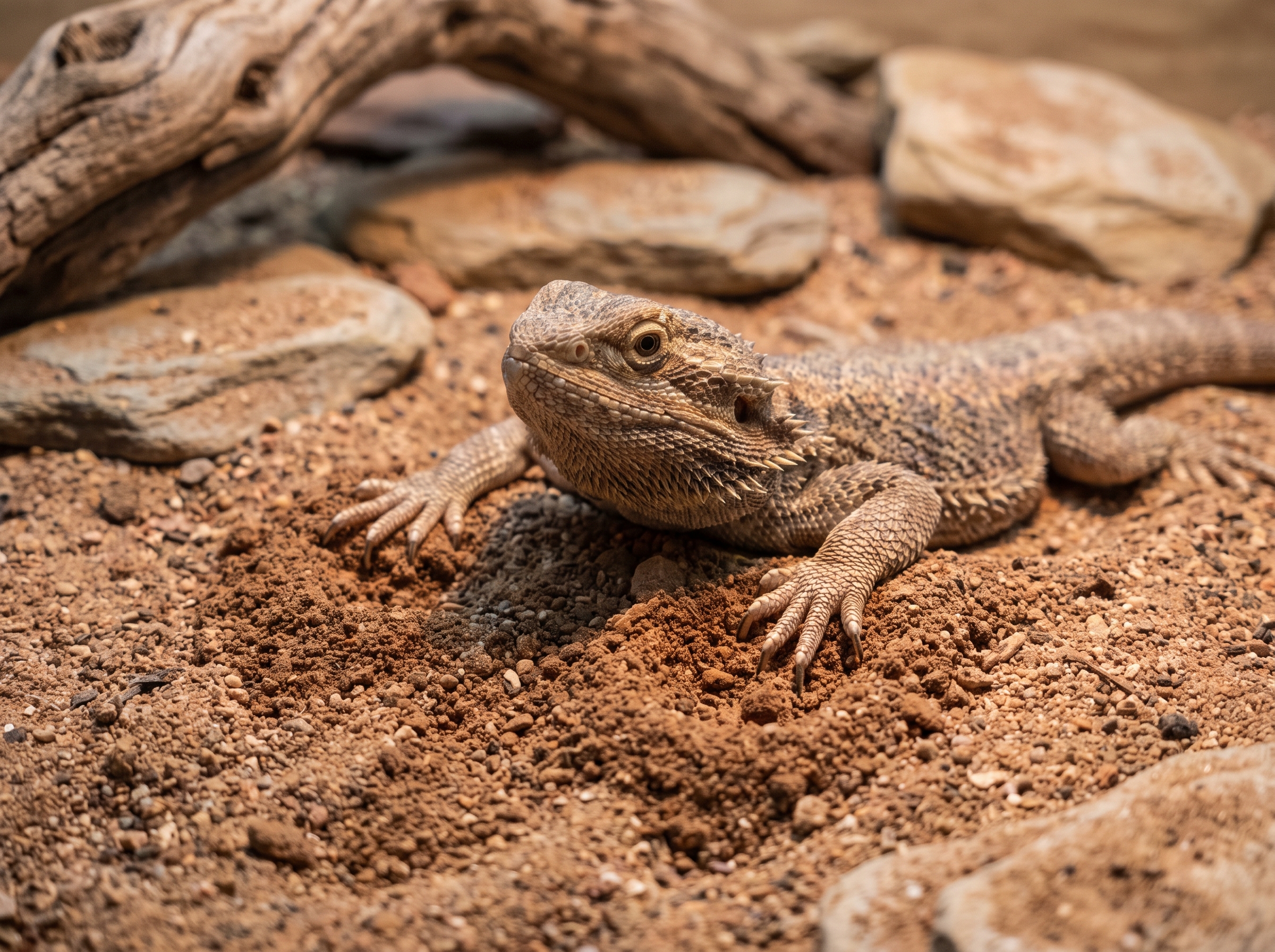
Calcium sand and walnut shell should be avoided outright — calcium sand clumps when it contacts moisture and is a documented impaction risk, and walnut shell is sharp-edged and does not break down safely if ingested. Substrate depth should support the one significant digging behaviour this species shows in captivity: a gravid female needs a dedicated lay box with moist digging substrate at least 12 in (30 cm) deep, provided continuously once eggs or follicles are palpable or restlessness and digging behaviour appear; the general enclosure floor does not need comparable depth outside that context.
Furnish with sturdy basking branches and flat rock positioned directly under the basking lamp, a visual barrier or dense planting at one end so the dragon can break line of sight, and at least one climbing structure to support the semi-arboreal basking behaviour described earlier. Bioactive setups are workable for this species with a suitable substrate depth, drainage layer and hardy, non-toxic live plants, provided ventilation and humidity stay within the arid targets above. Rotate enrichment — reposition branches, swap in new climbing or digging opportunities, vary feeding presentation — rather than treating the enclosure as a static box; this is a habitat the animal spends its entire life in, not storage between handling sessions.
Feeding, Supplements and Hydration
Staple feeder insects are gut-loaded crickets or dubia roaches, and staple greens are collard, mustard or turnip greens, forming the daily-offered bulk of an adult's diet. Size insects, at every life stage, no wider than the space between the dragon's eyes — a measurable rule, not a guess — and for an adult, a feeding session typically means 10–20 insects of that size. Gut-load feeder insects for at least 24 hours before offering them so the nutritional value passes on to the dragon rather than being wasted on an empty-gut insect.
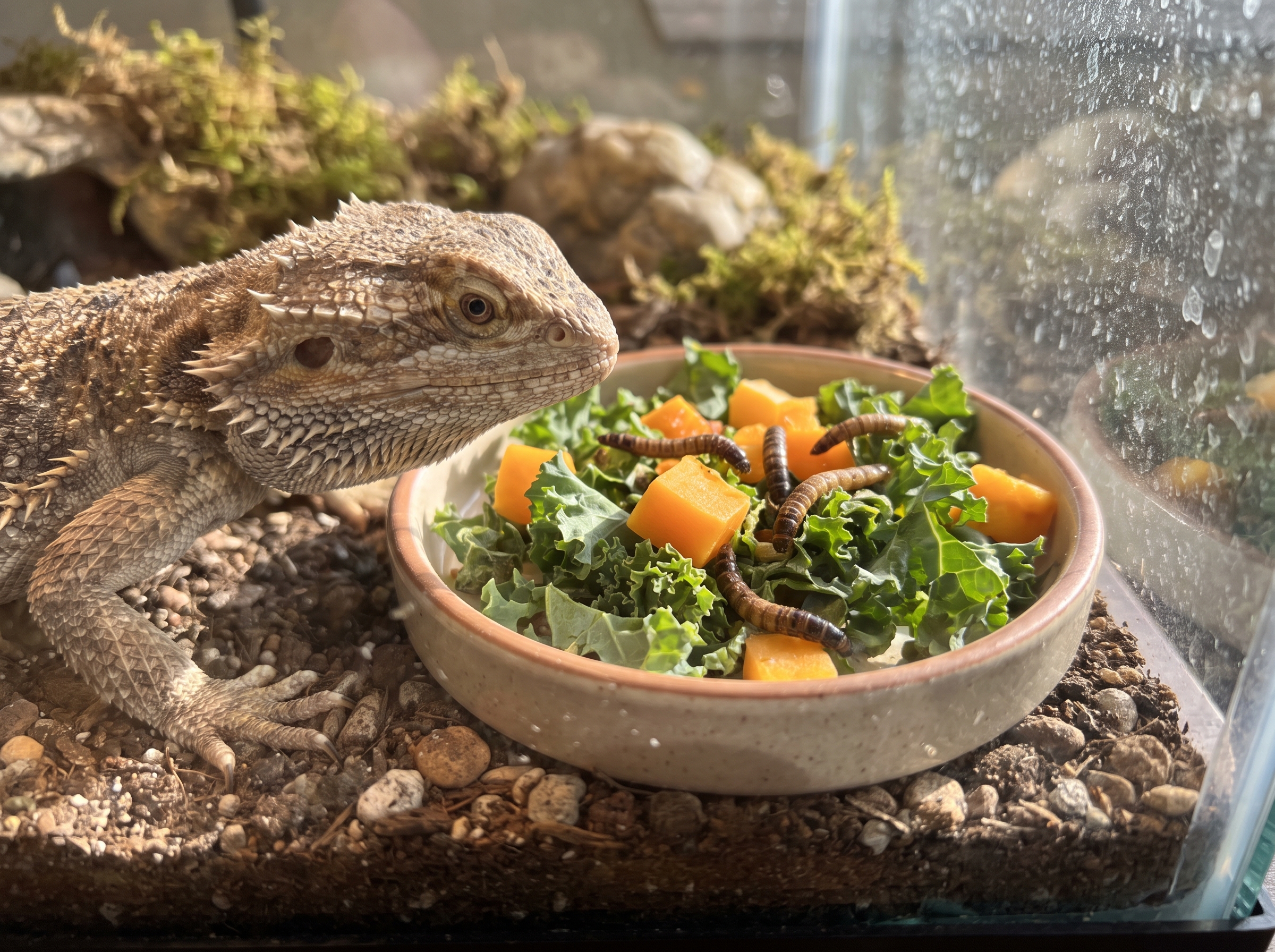
Dusting frequency shifts with age and is set out fully in the life-stage table, but as a reference point for an adult: dust insects with calcium (no D3) 2–3 times per week and with calcium plus D3 and a multivitamin once weekly. Offer water in a shallow, stable dish; most bearded dragons drink little standing water and take more moisture from food and occasional light misting or soaking, so a water dish that stays clean matters more than one that stays full.
Judge body condition by looking at the base of the tail and the area just behind the head and along the sides of the body. A lean, healthy adult has a modest fat pad without pronounced bulging; an overweight dragon shows visibly swollen fat pads at the tail base and behind the skull, a rounded rather than oval body outline from above, and reduced activity — a pattern that develops from feeding insects too frequently or in excess volume relative to the greens portion, not from any single meal.
Daily, Weekly and Monthly Care
The routine cost of keeping this species is a few minutes daily and a slightly longer session weekly, and it is precisely this low daily burden that makes the two things worth naming explicitly: temperature checks and UVB bulb age. A basking spot or cool side that has drifted outside its target range is easy to miss for weeks if it is never rechecked, and a UVB tube can keep producing visible light long after its UV output has fallen below a useful dose — the bulb does not announce its own decline. Building the temperature check and the UVB-output or bulb-age check into an existing habit, such as feeding, is more reliable than trying to remember them separately. The weekly weigh-in matters for the same reason: a slow decline over several weeks is far easier to catch on a logged trend than by eye.
Handling and Behaviour
Give a newly acquired dragon a settling-in period with minimal handling — feeding and husbandry access only — before starting regular handling sessions, so the animal associates the enclosure with safety before it is asked to tolerate being lifted out of it. Pick the animal up by sliding a hand under the chest and forelimbs and supporting the rest of the body along your forearm, rather than grabbing from directly above, which reads as a predator strike to the animal.
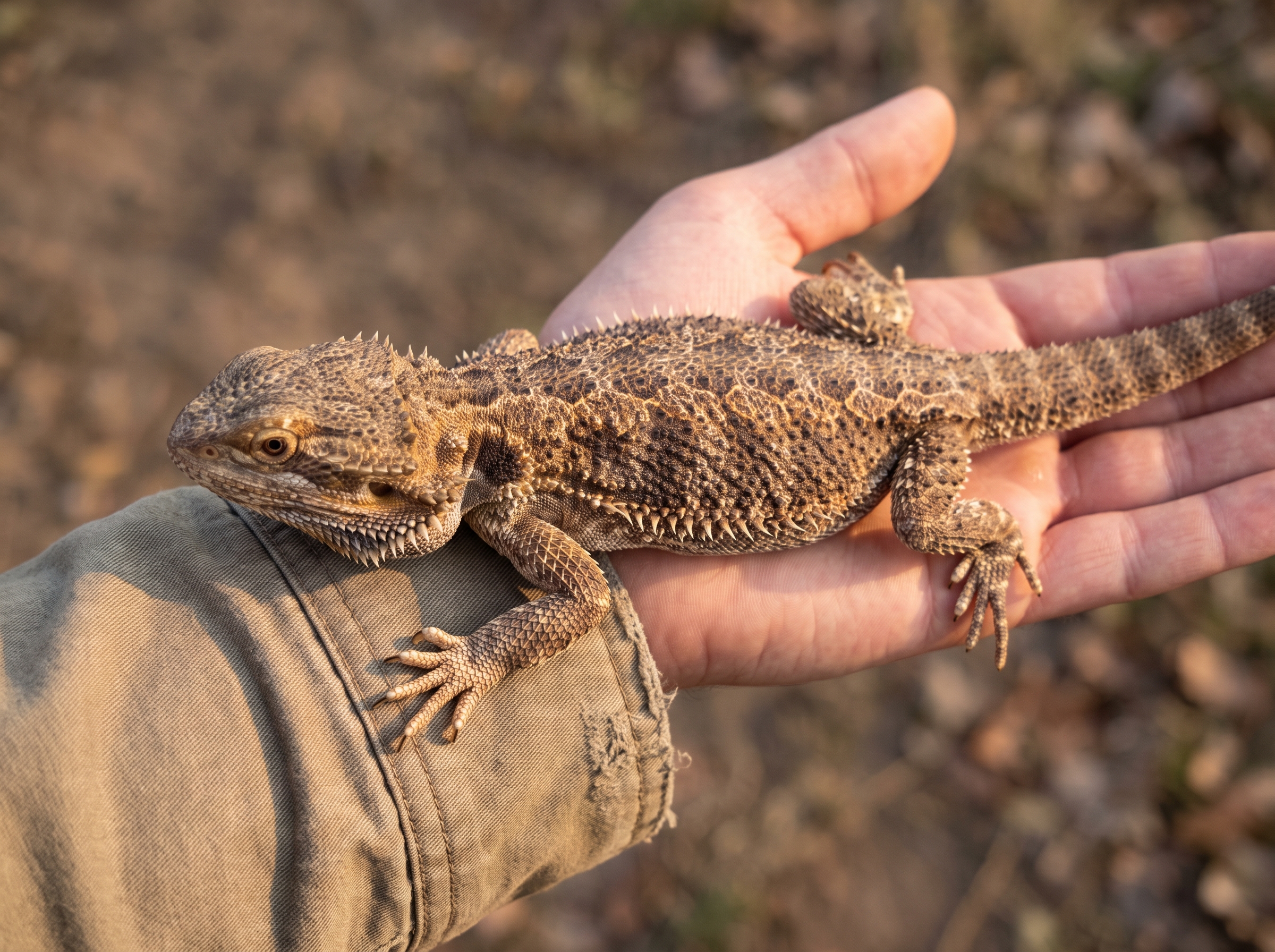
Handling tolerance in this species is high, and most captive-bred individuals settle into 15–30 minute sessions once acclimated, though individual temperament varies and some animals never fully warm to it. Normal body language includes head-bobbing, arm-waving (a submissive display, often toward other dragons or reflections), and a black beard display during handling, feeding excitement, or on seeing another dragon — this is normal communication and stress signalling, not illness, and needs no intervention on its own. Glass-surfing, persistent digging at corners, or repeated attempts to flee toward the enclosure edge indicate stress and are worth addressing by reviewing hide placement and handling frequency rather than pushing through them.
Bites are uncommon in captive-bred, acclimated animals and when they occur are usually a startle response rather than aggression; scratches from claws during a grab-and-hold are more common than bites and are a normal hazard of handling any active lizard. Supervise children directly during handling — support technique and session length both need adult judgement — and always handle over a low surface or seated position to prevent falls, since these are not arboreal specialists and a fall carries real injury risk despite their climbing ability.
Health and Veterinary Care
Any newly acquired dragon should get a hands-off visual check on arrival — clear eyes, no discharge, straight limbs, an even gait, and a body weight appropriate to size — followed by a quarantine period in a separate enclosure before any introduction to an existing collection or handling routine shared with other reptiles. Normal stool is formed and dark with a white-to-cream urate cap; watery stool, an absent urate portion, or visible parasites in a fresh sample are all worth documenting and bringing to a vet visit rather than assessed alone.
Sheds should come away in reasonably large pieces without leaving retained skin at the toes, tail tip or eyelids for more than a few days — retained shed on its own is a husbandry sign, not an emergency. Weigh regularly and compare against the logged trend rather than a single number; a dragon that is eating normally but losing weight steadily is a stronger signal than a single low reading.
The husbandry-linked conditions this species actually presents with are worth knowing by cause, not just by symptom: metabolic bone disease traces back to inadequate UVB or calcium relative to the animal's growth rate; respiratory infection traces back to chronic humidity above the arid target range or a cool-end temperature that never lets the animal warm up fully; and impaction traces back to oversized prey items or loose substrate ingested during feeding. None of these are treated at home — if a sign in the triage table points toward a vet visit, that means an exotics vet, not a home remedy, and the guides on ReptileAds care guides or general reptile-keeping reading on ReptileAds resources are useful for prevention, not for treating an animal that is already unwell.
Buying This Species
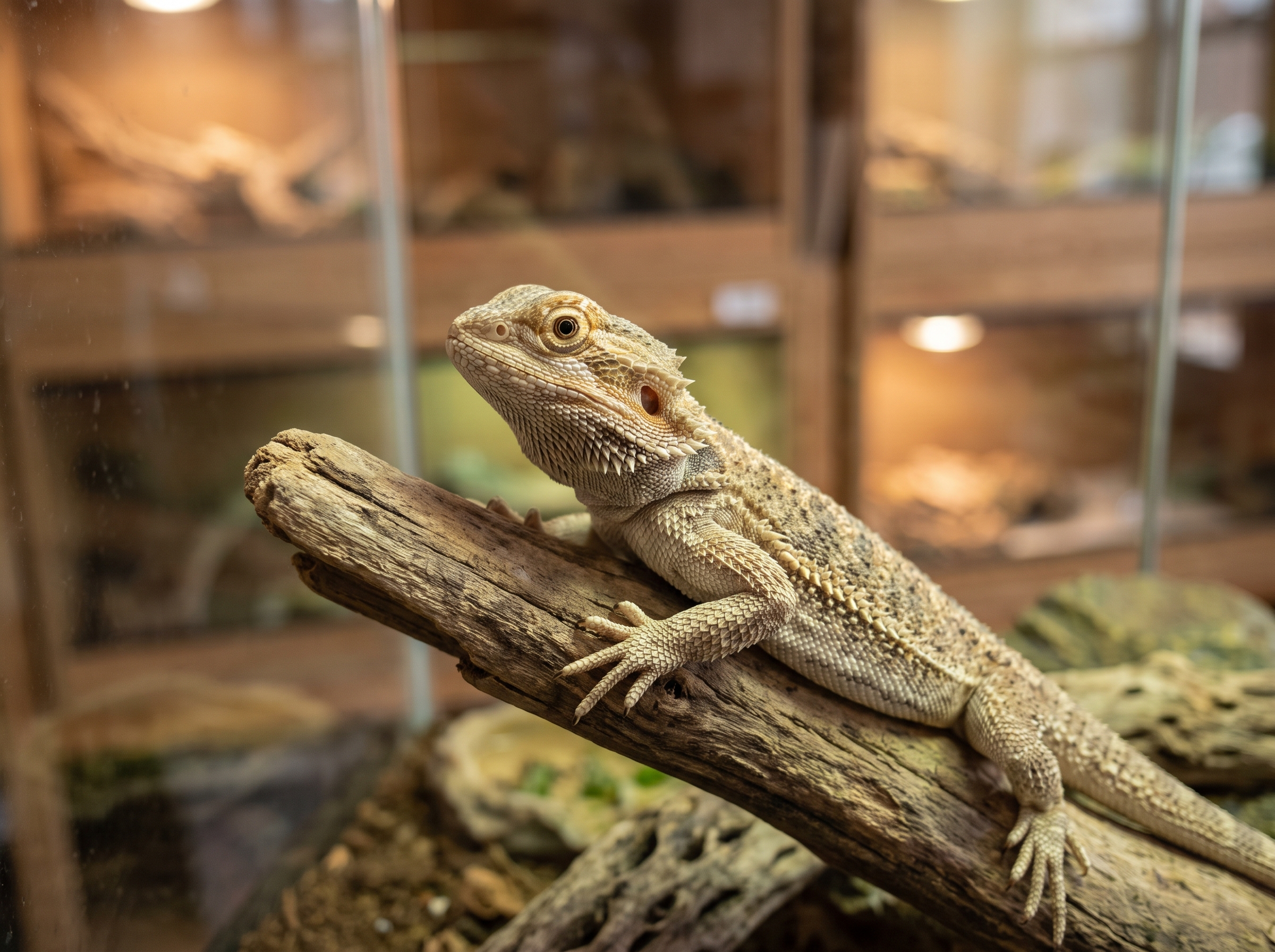
Every Pogona vitticeps available through the ReptileAds marketplace and comparable outlets is captive bred — wild-caught animals are effectively absent from the trade because Australia has banned reptile export since the 1960s, so there is no wild-caught option to weigh against captive-bred here, only the question of which breeder or seller to buy from. Look for a dragon that is alert and responsive to movement, with clear open eyes, no retained shed patches, straight limbs and toes, a rounded but not swollen tail base, and even weight distribution along the body; in the hand it should feel solid rather than limp, with normal muscle tone in the limbs and tail.
One morph-linked welfare issue is worth naming directly rather than treating as a catalogue item: the silkback variant, which lacks normal scalation, has documented skin, thermoregulation and shortened-lifespan problems tied directly to that missing scale layer, and reputable sellers are generally transparent about it rather than marketing it as a purely cosmetic trait. If you're evaluating how a specific morph pairing might affect a clutch's traits before buying breeding stock, the genetic calculator is a useful planning tool, though that is a separate consideration from evaluating the health of an individual animal for sale.
Arrange transport for the shortest reasonable duration, insulated against temperature extremes, and have the quarantine enclosure fully set up and holding its target temperatures and humidity before the animal arrives, so it goes straight into a stable environment rather than a cold or unfinished setup. When comparing sellers, checking a store's track record through ReptileAds stores alongside asking for feeding and weight records on the specific animal gives a clearer picture than photos alone.
- IUCN Red List
- Not evaluated by the IUCN Red List as a distinct assessment for Pogona vitticeps (genus Pogona has no full modern IUCN assessment on record); check the IUCN Red List directly before relying on this, as listings change.
- CITES
- Not listed in the CITES Appendices as of the latest published appendices; check the CITES Species+ database directly before relying on this, as listings change.
- Ownership restrictions
- Widely legal to keep in most US states, the UK and much of Europe with no federal-level restriction known, but buyers must check their own state, county/council, or country rules, since some municipalities restrict reptiles generally or require permits.
- Wild-caught in trade
- Wild-caught animals are essentially absent from the pet trade; Australia has banned reptile export since the 1960s, so all Pogona vitticeps in trade outside Australia descend from earlier captive lines.
- Captive-bred availability
- Extremely widely captive bred, with an enormous range of morphs (hypo, translucent, leatherback, silkback, zero, dunner, and many combinations) readily available from hobbyist breeders and stores.
Ownership rules vary by country, state and even city, and they change. Check what applies where you live before you buy.
Feeding by Life Stage
What changes as the animal grows. Portions are measurable rules, not estimates.
- Food
- Small gut-loaded crickets, dubia roach nymphs and black soldier fly larvae; finely chopped collard, mustard and turnip greens
- Portion
- Insects no wider than the space between the dragon's eyes, offered in a shallow dish or feeding tub to reduce substrate ingestion
- Frequency
- Small insect meals 2–3 times daily; finely chopped greens offered daily even if barely touched
- Supplements
- Calcium (no D3) dusted on insects at every feeding; calcium with D3 and a multivitamin each 2–3 times per week
- Enclosure
- Minimum 20 × 10 × 12 in (50 × 25 × 30 cm) grow-out tub, upgraded quickly as growth is rapid
- Food
- Gut-loaded crickets and dubia roaches, occasional black soldier fly larvae; collard, mustard and turnip greens with squash or bell pepper
- Portion
- Insects no wider than the space between the eyes; as much finely chopped salad as will be eaten in 10 minutes
- Frequency
- Insects 2 times daily; greens offered daily
- Supplements
- Calcium (no D3) dusted at every feeding; calcium with D3 and multivitamin 2 times per week
- Enclosure
- Minimum 36 × 18 × 18 in (90 × 45 × 45 cm)
- Food
- Gut-loaded crickets and dubia roaches; collard, mustard and turnip greens plus squash and bell pepper
- Portion
- Insects no wider than the space between the dragon's eyes; salad portion sized to fill roughly a quarter of the body length in volume
- Frequency
- Insects 4–5 times per week; greens daily
- Supplements
- Calcium (no D3) dusted at most feedings; calcium with D3 and multivitamin 1–2 times per week
- Enclosure
- Minimum 48 × 24 × 24 in (120 × 60 × 60 cm)
- Food
- Gut-loaded crickets and dubia roaches as staples, hornworms or silkworms occasionally; collard, mustard and turnip greens as the bulk of the diet, with squash and bell pepper
- Portion
- Insects no wider than the space between the dragon's eyes, roughly 10–20 insects per feeding session; salad forming the majority of diet volume daily
- Frequency
- Insects 2–4 times per week; fresh greens/vegetables offered daily
- Supplements
- Calcium (no D3) dusted on insects 2–3 times per week; calcium with D3 and multivitamin once weekly
- Enclosure
- Minimum 48 × 24 × 24 in (120 × 60 × 60 cm)
- Food
- Gut-loaded crickets and dubia roaches offered more frequently than for a non-gravid adult; calcium-rich greens such as collard, mustard and turnip greens
- Portion
- Increase insect and calcium-rich food volume; offer as much appropriately-sized food as consumed in a session, since gravid females often show reduced appetite in the days before laying
- Frequency
- Insects offered daily during gravidity even if refused; laying box (moist digging substrate at least 12 in / 30 cm deep) provided continuously once follicles/eggs are palpable or behavior (restlessness, digging) is seen
- Supplements
- Calcium (no D3) daily during gravidity to offset egg-laying calcium demand; calcium with D3 and multivitamin 1–2 times per week
- Enclosure
- Minimum 48 × 24 × 24 in (120 × 60 × 60 cm) plus a dedicated lay box at least 12 in (30 cm) deep
- Food
- Gut-loaded crickets and dubia roaches; collard, mustard and turnip greens as the bulk of the diet
- Portion
- Insects no wider than the space between the dragon's eyes, portion reduced if activity drops; greens remain the bulk of diet
- Frequency
- Insects 2–3 times per week, reduced from adult frequency if weight gain or reduced activity is noted
- Supplements
- Calcium (no D3) dusted 2–3 times per week; calcium with D3 and multivitamin once weekly, adjusted with vet input if health issues arise
- Enclosure
- Minimum 48 × 24 × 24 in (120 × 60 × 60 cm), same as adult
Daily, Weekly and Monthly Care
What keeping this animal actually costs you in time, week to week.
- Check basking surface temperature with a temp gun or probe and confirm it is within 95–110°F (35–43°C)
- Check cool-side air temperature is within 75–85°F (24–29°C)
- Offer fresh chopped greens/vegetables and remove any uneaten salad from the day before
- Spot-clean feces and shed skin from substrate and decor
- Confirm the UVB bulb is on and within its rated lifespan (visually check timer/output if using a UVI meter)
- Feed and dust insects on the scheduled feeding days per the life-stage table
- Wipe down water dish and any misted surfaces to prevent bacterial buildup
- Weigh the dragon and log the weight to catch slow declines early
- Check UVB output with a UV index meter if available, or note bulb age against the replacement schedule
- Deep-clean the enclosure: replace substrate as needed, disinfect decor and dishes
- Inspect basking bulb and UVB bulb for wear, flicker, or reduced output, and replace UVB on schedule (every 6–12 months depending on bulb type)
- Trim or replace live plants/decor and check hides and climbing branches for stability
- Review feeding and weight logs for trends indicating over- or under-feeding
When to Call a Vet
What you can see, and how quickly it needs acting on.
| What you see | Urgency | What to do |
|---|---|---|
| Brief loss of appetite and dark beard/lethargy for 1–2 days before a shed | Normal | No action needed beyond ensuring humidity and basking access are normal; resume monitoring once shed completes |
| Black beard display during handling, feeding excitement, or when seeing another dragon | Normal | No action needed; this is a normal communication/stress display, not illness |
| Brief brumation-like slowdown (reduced appetite and activity) in cooler months in an otherwise healthy adult | Check the setup | Confirm temperatures and UVB are still correct; monitor weight weekly and consult a vet if weight loss continues beyond a few weeks |
| Retained shed on toes, tail tip, or eyelids | Check the setup | Raise humidity slightly and offer a shallow soak; gently work loose skin only where it is already lifting, and see a vet if it does not resolve within a few days |
| Soft, rubbery, or bowed lower jaw or limbs | See a vet | See an exotics vet promptly — this is a hallmark sign of metabolic bone disease from inadequate calcium/UVB; review and correct UVB and supplementation immediately while awaiting the appointment |
| Persistent loss of appetite lasting more than 2 weeks with no known brumation trigger | See a vet | See an exotics vet; bring a fecal sample and recent weight/feeding log |
| Swollen or discolored toes or tail tip | See a vet | See an exotics vet to assess for constriction injury or infection (tail/toe necrosis); do not attempt to treat at home |
| Sudden weight loss with normal or increased appetite | See a vet | See an exotics vet; bring a fresh fecal sample to check for parasites |
| Gaping (open-mouth breathing) at rest with normal temperatures | Urgent | See an exotics vet urgently; this can indicate respiratory infection or overheating — check and lower basking temp if too hot, but do not delay the visit if temps are normal |
| Mucus or bubbles from the nose or mouth, or audible clicking/wheezing when breathing | Urgent | See an exotics vet urgently; keep the animal warm during transport and stop feeding until seen |
| Limp limbs, inability to lift the body off the ground, or tremors/twitching | Urgent | See an exotics vet immediately; this can indicate severe metabolic bone disease or calcium crisis — keep the animal warm and handle minimally during transport |
| Prolapse of tissue from the vent or hemipenal area | Urgent | See an exotics vet immediately; keep the tissue moist and clean with a damp, clean cloth if possible and transport promptly, do not attempt to push tissue back in |
| Sunken eyes, wrinkled skin, and thick stringy saliva | Urgent | See an exotics vet urgently for suspected severe dehydration; offer a lukewarm shallow soak while arranging transport |
This guide does not diagnose and does not replace a veterinarian. Nothing here is a treatment or a dose. If you are unsure, an exotics vet is always the right call.
Buying Checklist
What to check, what to ask, and what to have ready.
Quarantine every newly acquired dragon for a minimum of 60 days in a separate enclosure with its own thermostat, hide, dishes and cleaning tools, in a different room from any existing collection, serviced last and with hands washed afterwards. Use paper towel substrate so stool is easy to assess. The animal should feed normally, hold or gain weight against a weekly log, and pass formed stool with a white-to-cream urate cap before it joins the collection room; a fecal screen by an exotics vet during the quarantine period is strongly advised, since adenovirus and coccidia are both documented in captive Pogona vitticeps lines.
$900–$2,100 in year one: a $350–$900 correct first setup, roughly $480–$960 of monthly running costs at $40–$80 per month, one UVB bulb replacement at $35–$70, and $60–$150 for an initial exotics-vet check with a fecal screen.
Frequently Asked Questions
How big of an enclosure does a bearded dragon need?
An adult needs a minimum 48 × 24 × 24 in (120 × 60 × 60 cm) enclosure, roughly a 120–150 gallon (450–570 L) footprint. This is a floor, not a target — bigger is always better for an animal this active and basking-driven. Younger dragons can start smaller, but enclosures should scale up quickly as they grow.
Do bearded dragons need UVB lighting?
Yes. Bearded dragons need a UV index of 3.0–6.0 at the basking site (Ferguson Zone 3), with the gradient falling toward near 0 at the cool end. Measure the actual UVI with a meter rather than trusting bulb wattage, since distance, mesh and lamp age all change what reaches the animal. Insufficient UVB combined with low calcium is the leading cause of metabolic bone disease.
How long do bearded dragons live?
Bearded dragons typically live 8–12 years in captivity, with well-kept individuals sometimes reaching 14–15. Lifespan is closely tied to consistent basking, UVB and calcium provision over the animal's lifetime, so early husbandry mistakes can shorten it even if the dragon appears healthy for years.
Can two bearded dragons live together?
No, bearded dragons should be housed alone. Adults are territorial and often intolerant of cage-mates, and resource guarding, stress and injury are common even in pairings that look compatible at first. Cohabitation risk applies to same-sex and mixed-sex pairs alike.
What temperature should a bearded dragon's basking spot be?
The basking surface should read 95–110°F (35–43°C), measured with a temp gun or probe directly on the basking rock or branch, not the surrounding air. Warm-side air should sit at 88–92°F (31–33°C) and the cool side at 75–85°F (24–29°C), letting the dragon move between zones to regulate its own body temperature.
What do bearded dragons eat?
Bearded dragons are omnivores: staple feeder insects are gut-loaded crickets or dubia roaches, and staple greens are collard, mustard or turnip greens. Juveniles eat more insects proportionally, while adults shift toward greens forming the majority of diet volume, with insects offered 2–4 times per week and fresh greens daily.
Is a bearded dragon a good beginner reptile?
Bearded dragons are hardy, food-motivated and tolerant of minor husbandry mistakes, which is why they're widely sold as beginner reptiles. But correct UVB and heat gradients are genuinely non-negotiable for preventing metabolic bone disease, which is why this species is better described as intermediate-difficulty rather than true beginner-level.
Why is my bearded dragon's beard turning black?
A black beard display during handling, feeding excitement, or when seeing another dragon is a normal communication and stress signal, not a sign of illness. No action is needed beyond noting the context it happened in; it becomes a concern only if paired with other signs like lethargy or appetite loss lasting more than a couple of days.
References and Revision History
September 30, 2026
- 1.
Supports: the UVI 3.0–6.0 basking target, the practice of specifying UVB by measured UV index rather than bulb wattage, and the requirement for a measured thermal gradient between basking surface and cool-side air
- 2.
Merck Veterinary Manual — Bearded Dragons and Lizard Husbandry
Supports: metabolic bone disease signs and the vet-triage guidance for jaw/limb softness, plus the 48 × 24 × 24 in (120 × 60 × 60 cm) adult enclosure minimum and the adult feeding frequency of insects 2–4 times weekly with daily greens
- 3.
IUCN Red List — search database for Pogona vitticeps / genus Pogona
Supports: the IUCN status statement and instruction to verify current listing
- 4.
Supports: the CITES listing status statement
- 5.
Supports: the Ferguson Zone 3 classification and UVI-at-basking-site target
- 6.
San Diego Zoo Wildlife Alliance — Bearded Dragon animal fact sheet
Supports: the captive lifespan range and general diet/activity pattern description
- September 29, 2026First draft generated and reviewed.
Was this guide helpful?
Rate this guide
Questions & Answers
0 questions from the community
Comments
0 comments