Ask most people to name a prehistoric reptile and they will describe a dinosaur, but that reflects a persistent mix-up rather than the actual fossil record. Many of the most successful prehistoric reptiles that were not dinosaurs belonged to entirely separate lineages with their own body plans, respiratory adaptations, and evolutionary dead ends. This matters to keepers because modern reptile groups descend from some of these non-dinosaur lines, not from dinosaurs at all, and understanding the split clarifies why your monitor, tortoise, and gecko are built the way they are.
What is the difference between a dinosaur and other prehistoric reptiles?
Dinosaurs are a specific clade defined by hip and ankle structure, and the term should not be used as a catch-all for anything large and extinct. The broader group Reptilia during the Mesozoic era included pterosaurs, marine reptiles, crocodylomorphs, and early relatives of modern lizards and turtles, none of which are dinosaurs despite sharing habitats and time periods with them. A common misconception is that anything scaly and ancient qualifies as a dinosaur; in practical terms, the label applies only to members of Dinosauria, a group defined by cladistic analysis of skeletal traits, not by size or age.
Were pterosaurs dinosaurs, and how did they actually fly?
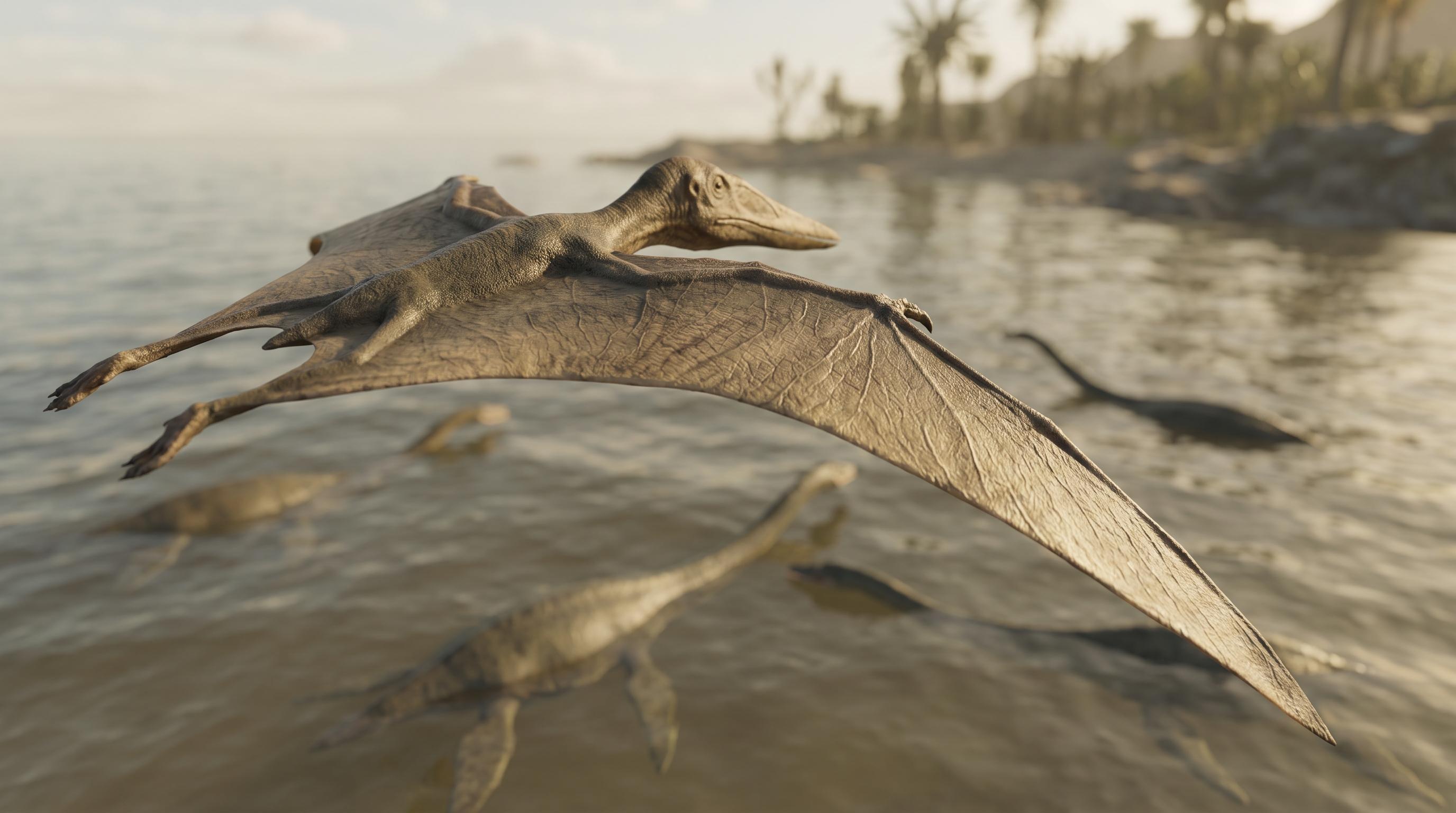
Pterosaurs were not dinosaurs; they were a distinct order of flying reptiles (Pterosauria) that evolved a wing membrane supported by a single elongated fourth finger, unlike bat wings which stretch membrane across four elongated fingers or bird wings built from feathers. Species ranged from sparrow-sized forms to Quetzalcoatlus, with a wingspan estimated near 10 to 11 metres, making it one of the largest flying animals known. Their bones were hollow and air-filled, an adaptation convergent with birds but achieved independently, and their skeletons lack the hip and ankle traits that define Dinosauria.
What were plesiosaurs and ichthyosaurs, and are they related to modern reptiles?
Plesiosaurs and ichthyosaurs were marine reptiles, not dinosaurs, and neither group left direct descendants among today's reptiles. Plesiosaurs had four paddle-like limbs and, in many species, an elongated neck; ichthyosaurs converged on a dolphin-like body shape with a vertical tail fluke, a striking example of how unrelated reptile lineages can evolve similar solutions to life in open water. Neither group is closely related to living marine reptiles. Sea turtles were already swimming in Cretaceous seas alongside plesiosaurs without being close relatives of them, and marine iguanas are a far more recent development from a completely separate terrestrial lizard ancestry. The resemblance is convergence, not kinship.
What are synapsids, and why do keepers sometimes call them reptiles by mistake?
Synapsids are not reptiles at all, though they are frequently miscategorised as such because early synapsids like Dimetrodon looked superficially lizard-like with a sprawling gait and a sail-like structure on the back. Synapsids are instead the lineage that eventually gave rise to mammals, distinguished by a single temporal opening behind the eye socket, while the reptile (sauropsid) line is diapsid, with two such openings in its ancestral skull pattern. If a source calls Dimetrodon a dinosaur or even a reptile, treat that as a red flag about the source's accuracy generally.
Which prehistoric reptile groups actually gave rise to living reptiles?
Modern lizards, snakes, turtles, and crocodilians descend from Mesozoic sauropsid lineages that ran parallel to dinosaurs rather than through them. Living crocodilians are the closest living relatives of birds, and birds are the surviving dinosaurs, so the two sit on opposite halves of the archosaur split; the crocodilian line diversified alongside other dinosaurs rather than out of them. Turtles took decades to place: genomic data now consistently group them with the archosaurs rather than with lizards and snakes, while the relationships among the earliest fossil turtles are still being worked out.
| Group | Dinosaur? | Defining feature | Living relatives |
|---|---|---|---|
| Pterosaurs | No | Membrane wing on one finger | None survive |
| Plesiosaurs | No | Four flipper-like limbs | None survive |
| Ichthyosaurs | No | Dolphin-shaped body, tail fluke | None survive |
| Synapsids (e.g. Dimetrodon) | No, not even reptiles | Single temporal skull opening | Mammals |
| Crocodylomorphs | No | Croc-line ankle and skull traits; semi-erect gait in living forms | Modern crocodilians |
Why does knowing your animal's lineage help you keep it better?
Lineage is a shortcut to physiology. Every crocodilian lays eggs, with no live-bearing species anywhere in the group, whereas live birth has evolved repeatedly among squamates, so breeding expectations for a boa and for a monitor are not interchangeable. Lung design splits along the same lines: varanids move air through their lungs largely in one direction, closer to the bird and crocodilian pattern than to the simpler sac-like lungs of many smaller lizards, which is part of why large monitors are such sustained, active foragers and do best in enclosures that make them work for food. Chelonians have ribs fused into the shell, so they ventilate with body-wall muscles rather than rib movement; the practical consequence is that a tortoise wedged under a heavy hide, or gripped firmly around the shell, can struggle to breathe properly.
If you keep animals from several of these branches, the species care guides set out what each lineage needs day to day, and the genetic calculator is the tool to reach for when you are planning a pairing and want inherited traits worked out rather than guessed at. To see how much of that ancient sauropsid diversity is represented in the hobby right now, from monitors to chelonians, it is worth browsing the animals currently listed for sale.
Frequently asked
Were pterosaurs a type of dinosaur?
No. Pterosaurs belong to a separate reptile order, Pterosauria, distinguished by a wing membrane supported by one elongated finger. Dinosaurs are defined by specific hip and limb traits that pterosaurs never had, so despite living alongside dinosaurs throughout the Mesozoic, pterosaurs represent an entirely independent evolutionary experiment in flight.
Are plesiosaurs related to any reptile alive today?
Not directly. Plesiosaurs went extinct at the end of the Cretaceous without leaving descendants. Sea turtles shared those Cretaceous seas with them but come from a completely different branch of the reptile tree, and marine iguanas evolved their aquatic habits far more recently from terrestrial lizard ancestors. Any resemblance to living marine reptiles is convergent evolution, not shared ancestry.
Is Dimetrodon a dinosaur?
No, and it is not even a reptile. Dimetrodon is a synapsid, part of the lineage that eventually produced mammals, identifiable by a single temporal opening in the skull rather than the two-opening pattern ancestral to reptiles. It predates the earliest dinosaurs by tens of millions of years.
What prehistoric reptiles actually gave rise to reptiles alive today?
Modern lizards, snakes, turtles, and crocodilians descend from Mesozoic sauropsid lineages that existed alongside dinosaurs rather than descending from them. Living crocodilians are the closest living relatives of birds, which are the surviving dinosaurs, so the crocodilian line sits on the other half of the archosaur split and diversified in parallel.