If your hygrometer won't climb out of the 40s and your ball python is coming up with patchy stuck shed or retained eye caps, you have a humidity problem. The answer usually isn't to start spraying the enclosure twice a day or buy a fogger. If the enclosure can't hold humidity in the first place, temporarily adding moisture to the air isn't going to fix what's wrong underneath.
For ball pythons, a good target is generally around 60-80% ambient humidity. You don't need to chase an exact number every hour of the day, and a temporary dip isn't an emergency. The problem is an enclosure that stays chronically dry.
An incomplete or stuck shed is a sign that something in the snake's husbandry needs attention. Start by checking the basics: humidity, substrate, ventilation and temperatures, then make the necessary adjustments instead of treating the stuck shed itself as the problem.
If incomplete sheds continue, that's a pretty clear indication that whatever you've changed isn't working and you need to reevaluate the setup. Talk to experienced ball python keepers or breeders, compare your enclosure to established husbandry recommendations and keep troubleshooting until you identify what's causing the problem.
Don't ignore repeated shedding problems. Failing to correct the underlying husbandry can eventually lead to more serious issues that may require veterinary care. The goal is to fix the environment before a husbandry problem becomes a medical problem.
If your enclosure consistently struggles to maintain humidity, look at four things: ventilation, substrate, hygrometer placement and enclosure type. Work through those before throwing more equipment at the problem.
Is your screen lid the reason humidity keeps escaping?
A full-mesh screen lid is one of the most common reasons an otherwise decent setup won't hold humidity. You add water, humidity climbs, and then all that warm, humid air escapes through an entire ceiling made out of screen.
That doesn't mean you can't keep a ball python successfully in a glass enclosure. It means you have to account for how much ventilation that enclosure has.
How to modify a screen lid without eliminating ventilation
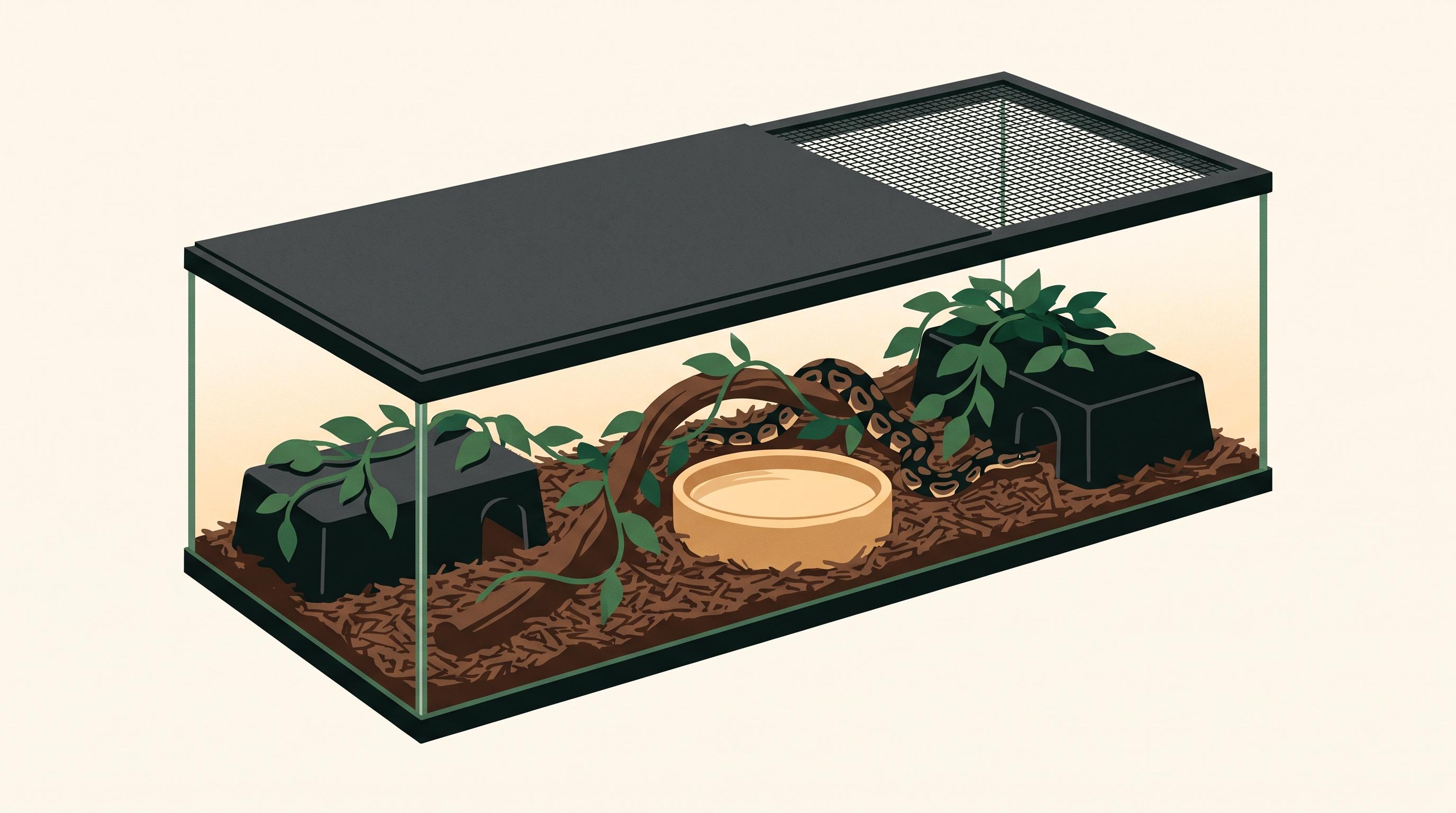
Partially covering the screen reduces moisture loss while still allowing air exchange. Aluminum flashing or another rigid, heat-tolerant material works well as long as it is installed safely and kept clear of heat lamps and other high-temperature equipment.
Don't seal the entire top. You're trying to slow down moisture loss, not make the enclosure airtight.
Start by covering a substantial portion of the screen and watch what the enclosure actually does over the next couple of days. If humidity is still disappearing too quickly, you may need to reduce ventilation further. If you're getting constant heavy condensation or surfaces that never dry, you've probably gone too far in the other direction.
Avoid plastic wrap, cling film or other materials that can melt or deform around heat fixtures.
Is your substrate actually holding enough water?
Substrate is one of the biggest tools you have for maintaining stable humidity because it acts as a moisture reservoir.
For ball pythons, coco-based substrate and cypress mulch are both good options. Both can absorb and hold a substantial amount of water and then release that moisture gradually into the enclosure.
Depth matters too. A thin layer doesn't give you much of a moisture reservoir and dries quickly. A deeper layer gives you considerably more material to hydrate and allows moisture to remain throughout the substrate instead of disappearing shortly after you add it.
And this is where a lot of people get ball python humidity wrong: don't mist the enclosure.
Misting primarily wets the surface and temporarily raises the humidity of the air. Once that small amount of water evaporates, humidity falls again and you're right back where you started. Repeating that process several times a day creates short humidity spikes instead of fixing the reason the enclosure can't maintain humidity.
What you want is stable ambient humidity, and the substrate is one of the best places to store the water necessary to produce it.
Pour water directly into the substrate and mix or stir the bedding thoroughly. The goal is to distribute moisture through the substrate rather than leaving all of the water sitting on the surface.
How much water you need depends on the size of the enclosure, substrate depth, ventilation and conditions in the room. There isn't a universal number of cups that works for every setup. Add water, mix the substrate, give the enclosure time to stabilize and check your humidity.
You want hydrated substrate, not standing water. The bedding can hold plenty of moisture underneath without requiring your snake to spend its time sitting on a soaking-wet surface. If water is pooling at the bottom or the entire enclosure remains saturated, you've added too much.
Properly hydrated substrate releases moisture gradually as the enclosure warms and air moves through it. That's what gives you stable humidity instead of the constant spike-and-crash cycle created by misting.
Where should the hygrometer actually be placed?
Before you change the entire setup, make sure the number you're reacting to is real.
A hygrometer only measures the humidity where its sensor is located. Put it directly under a heat source, beside a vent or against an open screen top and you can get a very different reading than you would down where the snake actually spends its time.
Use a reliable digital hygrometer and measure around snake level. In a larger enclosure, using a second digital hygrometer can help you see how conditions differ between areas of the enclosure instead of assuming the entire enclosure has identical humidity.
Cheap analogue dial hygrometers can also be inaccurate enough to send you chasing a humidity problem that isn't actually there. If a reading doesn't make sense, confirm it with another reliable digital unit before making major changes.
Does enclosure type make a difference for ball python humidity?
Absolutely.
Glass tanks with screen tops, PVC or ABS enclosures, and plastic tubs or rack systems can all maintain appropriate humidity, but they don't do it equally easily.
The enclosure material matters, but ventilation is usually the bigger issue. An enclosure with a huge amount of open ventilation is going to lose moisture faster than one designed to limit and control airflow.
Glass tanks and screen-top enclosures
Glass itself isn't the enemy. The giant screen on top usually is.
A typical aquarium-style setup may have nearly the entire top open to airflow. In a dry or air-conditioned room, that can dump moisture faster than your substrate can replace it.
These enclosures can work for ball pythons, but you'll usually need to control how much of that screen remains open, use a good moisture-retentive substrate such as coco or cypress mulch, and pay closer attention to how quickly the enclosure dries.
If you're constantly adding water and the humidity immediately falls again, look at the screen before assuming the substrate isn't working.
PVC and ABS enclosures
PVC and ABS enclosures generally make humidity management easier because they are relatively well insulated and usually have controlled ventilation instead of an entire screen ceiling.
That means the moisture stored in your substrate stays in the enclosure longer, which makes maintaining stable humidity considerably easier.
But easier humidity retention doesn't mean more moisture is always better. A PVC enclosure with excessively wet substrate and inadequate airflow can stay too wet just as easily as a screen-top enclosure can stay too dry.
If you're seeing persistent heavy condensation, standing water or surfaces that remain soaking wet, don't keep adding water just because you're trying to hit a humidity number. Let the substrate lose some moisture and increase ventilation if necessary.
Tubs and rack systems
Plastic tubs and rack systems are very efficient at retaining humidity, which is one reason they've been widely used for ball pythons.
They generally have much less open ventilation than a screen-top enclosure, and the plastic itself doesn't absorb water. With an appropriate amount of ventilation and properly hydrated substrate, maintaining humidity can be relatively straightforward.
The same balance still applies. Too much ventilation and the tub dries quickly. Too little ventilation combined with overly saturated substrate can leave the enclosure excessively wet.
The goal isn't to make the enclosure airtight. It's to retain enough moisture to maintain appropriate humidity while still providing adequate air exchange.
Which enclosure type is best for maintaining humidity?
There isn't one enclosure type that automatically gives you perfect humidity.
A properly configured glass enclosure can work. A PVC or ABS enclosure can work. A tub or rack can work. The difference is how much adjustment each one requires based on its ventilation, heat source, substrate and the conditions in the room where you're keeping it.
If you're fighting your current setup or considering a different enclosure style, you can browse available options in the ReptileAds enclosure section.
For the rest of your species-specific setup, including temperatures and other husbandry requirements, see the ball python care guides, or browse ball pythons currently for sale on ReptileAds.
The single most important takeaway is that humidity is a system, not something you spray into an enclosure.
Before buying a fogger, humidifier or another gadget, look at how much air your enclosure exchanges, whether your substrate can actually store enough water, whether that substrate is properly hydrated throughout, and whether you're measuring humidity in the right place.
Fix those fundamentals and maintaining proper ball python humidity gets a whole lot easier.
Frequently asked
What humidity level is too low for a ball python?
Ambient humidity consistently below 40-45% is too low for a ball python and increases the risk of retained shed, particularly around the eye caps and tail tip. Day-to-day humidity should sit around 50-60%, rising to 70-80% during a shed cycle. Occasional short dips aren't harmful; it's weeks of chronic low readings that cause problems.
Why won't my ball python enclosure hold humidity?
The most common causes are a full-mesh screen lid venting moisture out, a substrate too thin or too dry to hold water, and a hygrometer placed near a vent or the glass front where readings run artificially low. Address ventilation and substrate depth first before assuming you need a humidifier.
Where should I place a hygrometer in a ball python enclosure?
Place it at mid-level near where the snake spends most of its time, away from direct airflow from vents. Using two digital hygrometers — one near the hide and one at the warm end — gives a more honest picture than a single reading, since humidity can vary by 15-20 percentage points across the enclosure.
Are PVC enclosures better than glass for ball python humidity?
Yes, generally. PVC and melamine enclosures with front-opening doors and minimal venting retain humidity far more easily than glass tanks with full screen tops. Glass is cheaper and offers better visibility, but usually needs a partially covered lid and deep, moisture-retentive substrate to reach the same stability.
Can too much misting cause problems for a ball python?
Yes — heavy misting followed by long dry stretches creates humidity spikes and crashes, which are harder on shedding than a stable, slightly low reading. Waterlogged substrate can also lead to bacterial or mould growth. Aim for consistent, moderate moisture rather than infrequent heavy soakings.