If you're staring at a listing for a gecko or ball python and wondering whether you can just set things up after you bring it home, don't. I've made that mistake myself with an early bearded dragon purchase, and I spent the first week scrambling for the right bulb while the animal sat in a tub that was nowhere near ready. A proper reptile starter kit checklist means everything is running, tested, and holding stable temperatures for at least 24 to 48 hours before the animal ever arrives. Here's the order I work through, and why each step matters.
What size enclosure do you actually need before buying a reptile?
Buy the adult-size enclosure first, not a smaller one you plan to upgrade later. Buying twice is one of the most avoidable costs in the hobby, and a juvenile in a correctly furnished adult enclosure with enough cover does fine — it is bare, open space that stresses young animals, not floor area itself.
| Species | Adult enclosure minimum | Notes |
|---|---|---|
| Leopard gecko | 36x18x18 inches | 30x12x12 (20-gallon long) is an absolute floor, not a target |
| Ball python | 36x18x18 inches | Large adult females are better served by a 48-inch enclosure |
| Bearded dragon | 48x24x24 inches | Bigger is better; 36x18x18 is a temporary juvenile setup only |
| Crested gecko | 18x18x24 inches | Arboreal — prioritise height and dense climbing cover |
Species-specific footprints vary more than beginners expect, so check the species care guides for whatever you are actually planning to buy before you order glass or PVC.
Glass, PVC, or screen?
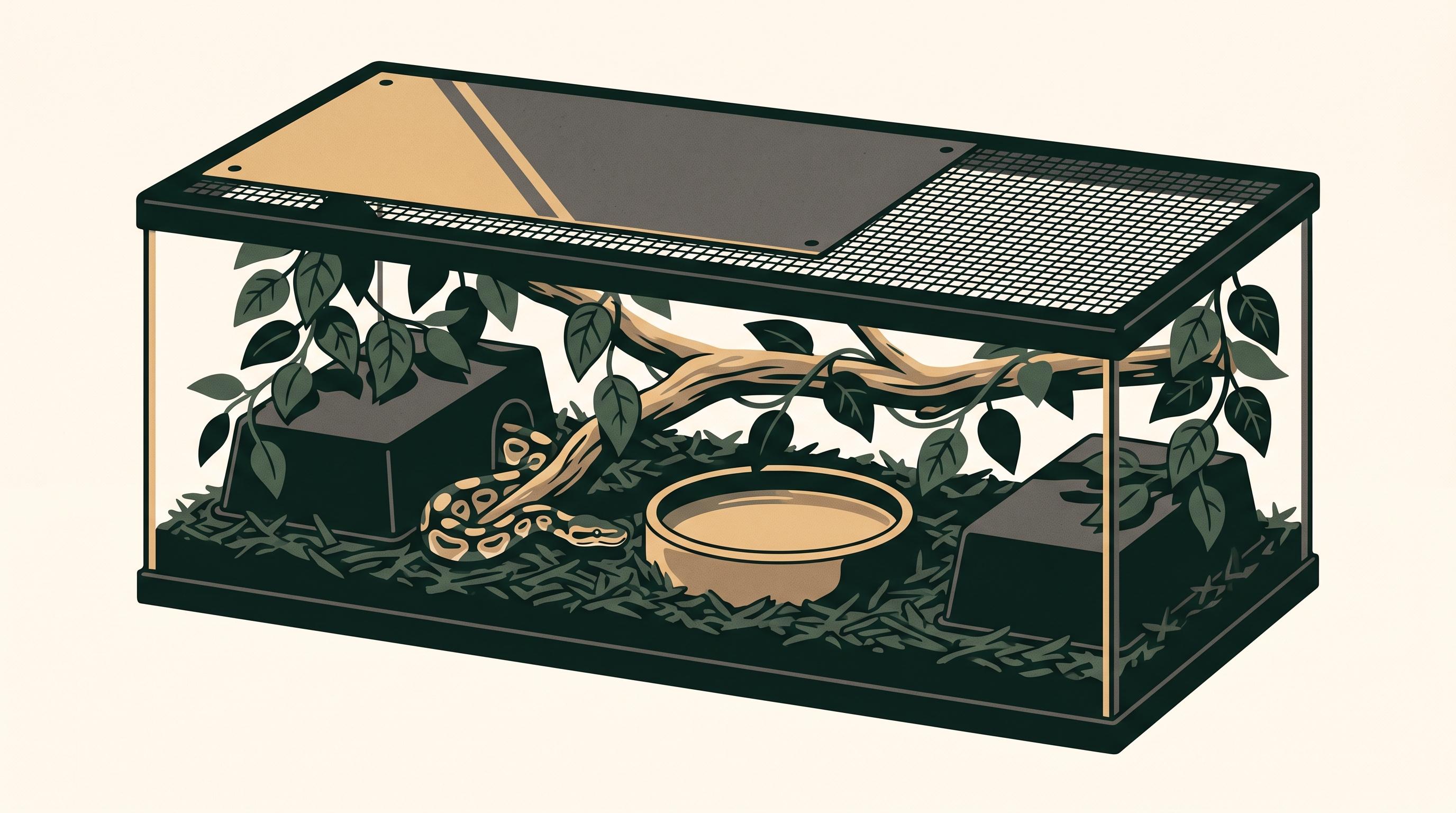
Glass terrariums lose humidity quickly through a mesh lid unless you partially cover it, PVC enclosures hold both heat and humidity well and are my personal preference for anything tropical, and screen cages are really only appropriate for chameleons and some arboreal species that need heavy airflow. The failure mode to watch for is a fully screen-topped glass tank sold as a "tropical" kit: it will sit at room humidity no matter how often you mist, and the first sign of trouble is usually a stuck shed on the toes or tail tip.
How do you set up heating and know it's actually working?
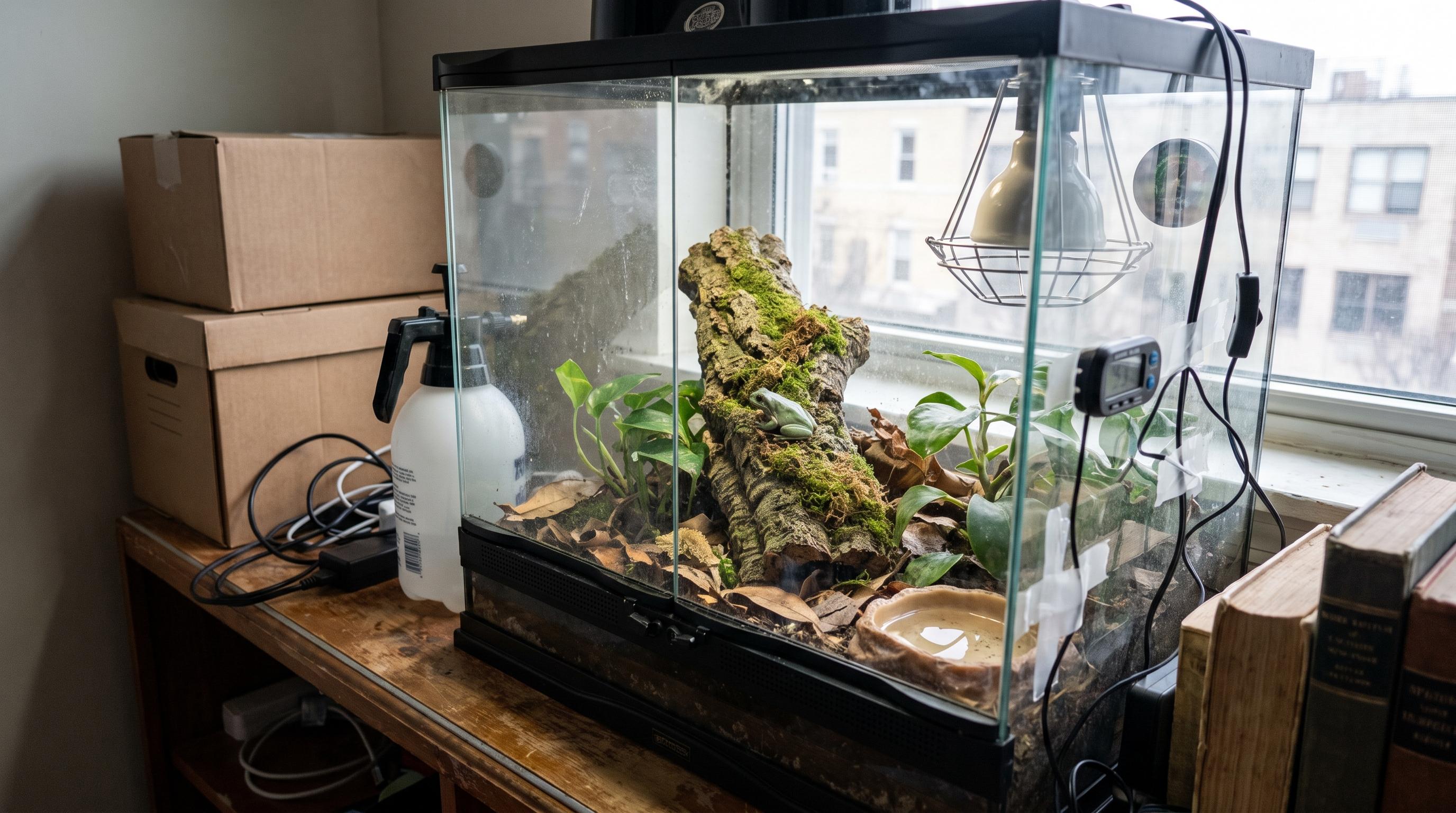
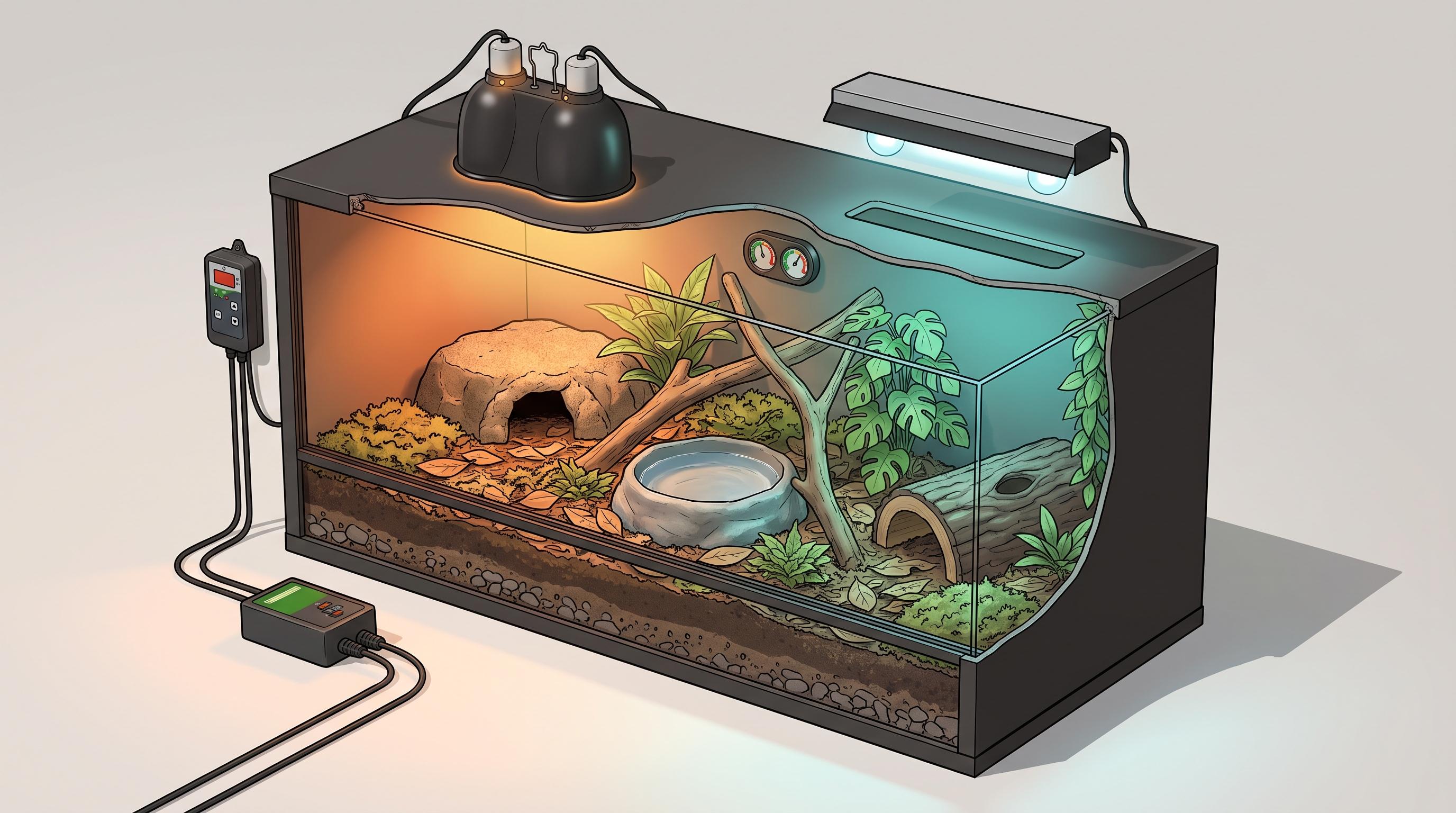
You need a thermostat-controlled heat source with a digital thermometer verifying both the warm and cool ends before the animal goes in, not a heat lamp on a timer and a guess. Cheap stick-on dial thermometers are notoriously inaccurate — I have had them read well off a digital probe placed in the same spot. Buy a digital thermometer with a probe, place the probe exactly where the animal will sit to warm up, and run the setup for a full day watching how the temperature holds through the coldest part of the night. An infrared temperature gun is the other tool worth owning, because it reads surface temperature at the basking site, which is what the animal actually experiences.
| Species | Basking spot | Cool end | Night drop |
|---|---|---|---|
| Leopard gecko | 88-92°F (belly heat, under-tank) | 75-80°F | 65-70°F acceptable |
| Bearded dragon | 100-110°F juveniles, 95-105°F adults | 80-85°F | 70-75°F |
| Ball python | 88-92°F | 78-80°F | Around 75°F |
| Crested gecko | No basking spot needed | 72-78°F | 65-72°F |
Every heat source needs a controller. Heat mats and ceramic heat emitters run on a standard on/off thermostat; basking and halogen bulbs need a dimming thermostat, because switching them on and off repeatedly shortens bulb life and gives the animal a flickering, unstable basking site. Running any heater uncontrolled risks a stuck-on element overnight, which is one of the most preventable losses in the hobby.
Does my reptile actually need UVB lighting?
Diurnal species — bearded dragons, day geckos, uromastyx, many skinks — need UVB. For nocturnal and crepuscular species like leopard geckos and crested geckos, the hobby genuinely disagrees: they can be and long have been kept successfully without it, while a growing number of keepers offer low-level UVB because it appears to support better bone density and general condition. The tradeoff is real. Low-level UVB adds cost and another bulb to replace, and a poorly placed tube with no shaded retreat is worse than none at all. I lean toward offering a low-output tube (2.0-5.0) to geckos, positioned so the animal can get completely out of it whenever it wants.
For bearded dragons and uromastyx, a 10.0-12% T5 HO tube spanning roughly two-thirds to three-quarters of the enclosure length is the standard, mounted at the manufacturer's stated distance and replaced every 6 to 12 months regardless of whether it still lights up — UVB output falls away long before the visible light does. Note the replacement date somewhere you will actually see it; keepers who log husbandry events in a tool like Husbandry.Pro tend to catch expired bulbs, missed feeds and shed dates far more reliably than those relying on memory.
What substrate suits your species, and what should you avoid?
Choose substrate based on your species' natural environment and humidity needs, not on what looks nicest in the shop. For arid species such as leopard geckos and bearded dragons, a loose mix of roughly 60-70% organic topsoil to 30-40% washed play sand holds a burrow and is widely used; the alternative is a solid surface such as tile or sealed slate, which is easier to keep clean and completely rules out substrate ingestion. Both are defensible, and keepers argue about it constantly — the practical dividing line is whether you are confident about your temperatures and feeding hygiene, because well-heated animals fed off a dish or by tongs are the ones doing well on loose substrate.
For humid species, cypress mulch, coconut husk chips or a soil-based bioactive mix hold moisture without going sour quickly. What to avoid is easier to be firm about: calcium carbonate "calci-sand", crushed walnut shell, aquarium gravel and cedar or pine shavings all cause problems, from ingestion to respiratory irritation. Plain paper towel is the right answer for the first few weeks of quarantine, because it lets you see every dropping clearly.
Which hides, water and decor need to be in place on day one?
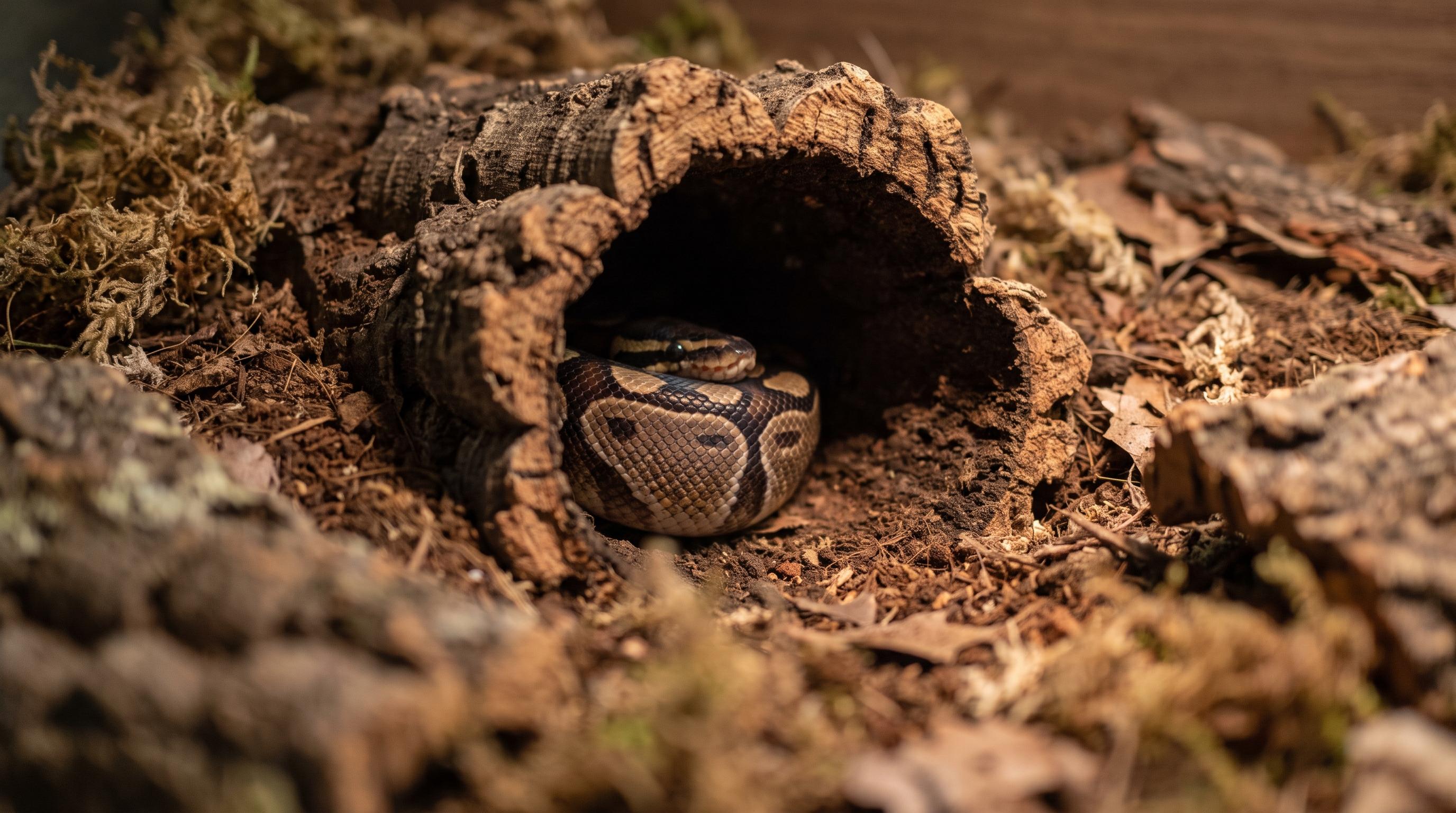
An enclosure that is thermally perfect but empty will still produce a stressed, hiding-in-the-corner animal that refuses food. Before the animal arrives you want at least two hides — one on the warm end and one on the cool end so it never has to choose between security and correct temperature — plus a humid hide packed with damp sphagnum moss for anything that sheds in one piece, which for a leopard gecko is the difference between a clean shed and retained skin on the toes. Add clutter: cork bark, branches, leaf litter, artificial or live plants. Ground-dwelling species use hard cover, arboreal species use vertical routes, and both eat better when they can cross the enclosure without being exposed.
A shallow water dish goes in for every species, including desert ones. Fill it before the animal arrives so the humidity has time to settle rather than spiking on day one.
What should be on your shopping list before you buy the animal?
- Adult-size enclosure with a secure, lockable lid or doors
- Correct heat source plus a matching thermostat
- Digital probe thermometer for each end, and a hygrometer for humid species
- UVB tube and fixture where the species needs it, plus a reflector
- Substrate, and paper towel for the quarantine period
- Two hides, a humid hide, water dish and enough clutter to fill the space
- Feeding kit: tongs, food dish, calcium with D3, plain calcium and a multivitamin
- Insect supply or frozen feeders already sourced, plus somewhere to store them
- Contact details for an exotics vet within reasonable travelling distance
That last item matters more than people expect. Find the vet before you need one, not during a weekend emergency.
How do you choose a seller and settle a new reptile in?
Once the setup has been holding steady for a day or two, you can start looking properly. Ask a seller for recent weights, a feeding record and shed history, and ask what the animal was kept on and fed — matching that for the first couple of weeks reduces the number of changes it has to absorb at once. Browsing reptiles currently listed for sale and the breeder and shop profiles behind those listings is a good way to compare how much information different sellers volunteer without being asked.
For the first week, leave the animal alone beyond checking water and spot-cleaning. Offer food after about five to seven days and do not be alarmed if the first meal or two is refused; a settling reptile often skips a feed. Weigh it on arrival and weekly after that, because weight is the earliest honest signal you have. If you see sustained weight loss, laboured or open-mouthed breathing, discharge from the eyes or nose, or an animal that stays hidden and refuses food for weeks, that is a call to an exotics vet rather than something to work through with enclosure tweaks or home remedies.
Get these steps done in this order and the animal walks into a finished home instead of a work in progress — which is the whole point of setting up first.
Frequently asked
What do I need to buy before getting a reptile?
At minimum: an adult-size enclosure with a secure lid, a heat source with a matching thermostat, digital probe thermometers for the warm and cool ends, a UVB tube and fixture if the species needs one, substrate, two hides plus a humid hide, a water dish, climbing or ground cover, feeding tongs and dishes, calcium and multivitamin supplements, a food supply, and the contact details of an exotics vet. Everything should be assembled and holding stable temperatures for 24 to 48 hours before the animal arrives.
Should I buy a small enclosure for a baby reptile and upgrade later?
Usually no. Buying the adult-size enclosure first avoids paying twice, and a young animal does fine in a large enclosure as long as it is densely furnished with hides, branches and clutter so it is never crossing open space. It is bare, exposed room that stresses juveniles rather than floor area itself.
Do nocturnal geckos need UVB lighting?
This one is genuinely debated. Leopard geckos and crested geckos have been kept successfully for decades without UVB, and many keepers still do. Others provide a low-output tube (around 2.0 to 5.0) because it appears to support bone density and general condition. If you do offer it, position it so the animal can move completely out of the light whenever it chooses.
How long should I wait before handling a new reptile?
Leave a new reptile alone for roughly the first week, doing only water changes and spot-cleaning. Offer food after five to seven days, and expect the first meal or two to be refused while it settles. Once it is eating reliably, start with short handling sessions of a minute or two and build up gradually.