

Is This Species Right for You?
I'll say it straight: the veiled chameleon is the one chameleon most likely to forgive a mistake, and that is a low bar. It is a display animal that needs a precise, measured setup, and it punishes guesswork slowly and then quickly. The husbandry sources behind this guide, including the species-specific ReptiFiles veiled guide, treat it as an advanced-leaning animal. The hardiest of the commonly kept chameleons, yes. A first reptile, no.
Space
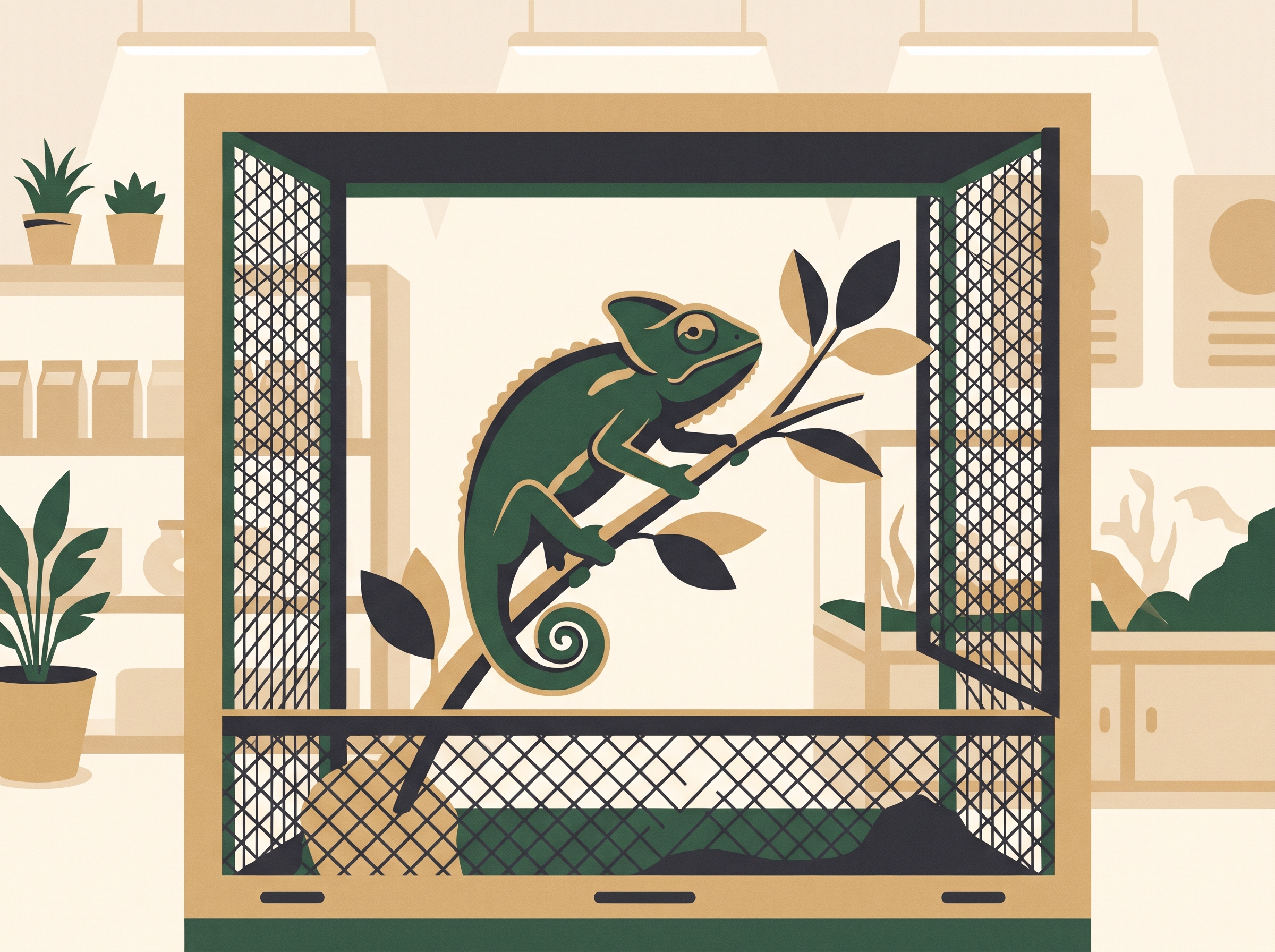
One adult needs a screen or heavily ventilated enclosure with a MINIMUM of 24 × 24 × 48 in (61 × 61 × 122 cm). That is roughly 120 US gal / 450 L equivalent, though these are sold by dimensions, not gallons. It is a minimum, not a target. Males in particular do better with more room, and a cage this tall is a piece of furniture. If you do not have a spot for it, that settles the question.
Money
A correct first setup runs about $400–900 USD. The top end comes from automatic misting, a large custom enclosure and a UVI meter. Running costs are about $40–80 USD a month for feeders, gut-load, supplements, plants and electricity. Year one totals about $900–1,800 USD including a UVB tube replacement and one vet check. I have watched people try to save by skipping the UVI meter or the proper tube, and that is the saving that costs the most later.
Handling expectations
Veileds are not cuddly. Handling is a stressor and is not needed for good care. If you want a lizard to sit on your shoulder while you watch television, choose a different animal.
Length of commitment
Females live about 4–6 years in captivity and males about 5–8 years. Egg-laying shortens female lifespan, which is why females are typically shorter-lived than males. Either way you are signing up for several years of daily checks.
Households with children
I would not buy one as a child's pet. The animal needs an adult to manage UVB, hydration and feeding, and it does not tolerate being picked up. A child can enjoy watching it and help with a feeding, with an adult responsible for everything else.
The main challenge
Hydration and light. A chameleon drinks only from dripping water or mist, and its UVB must be measured, not assumed. Both problems are invisible for weeks, then show up as a sick animal.
Shared basics versus veiled specifics
Some chameleon advice applies across species, but numbers do not travel. Every figure in this guide is for the veiled chameleon only. The comparison below is deliberately qualitative. It is based on the species-specific ReptiFiles panther and Jackson's chameleon guides and shows how those species differ from the veiled. Take their actual parameters from their own guides, never from this one.
| Topic | Veiled (Chamaeleo calyptratus) | Panther (Furcifer pardalis) | Jackson's (Trioceros jacksonii) |
|---|---|---|---|
| Temperature | Warm basking site; values in this guide | Warm basking site; values in its own guide | Cooler than the veiled and heat-sensitive; a veiled setup can overheat it |
| Humidity and hydration | Drier daytime humidity; drip or mist | Higher humidity than the veiled; drip or mist | Higher humidity than the veiled, with cool, humid nights; drip or mist |
| Enclosure | Tall, screen or heavily ventilated, solitary | Tall, screen or heavily ventilated, solitary | Tall, screen or heavily ventilated, solitary |
| Diet and supplements | Gut-loaded insects plus some leaf-eating; dusted feeders | Gut-loaded insects; dusted feeders | Gut-loaded insects; dusted feeders |
| Reproduction | Egg-laying; females lay without a male | Egg-laying; females can lay without a male | Live-bearing |
| Relative difficulty | Hardiest of the three, still advanced-leaning | Advanced; less forgiving than the veiled | Advanced, mainly because of its cooler requirements |
| Topic | Shared basics across chameleons | In this guide (veiled only) |
|---|---|---|
| Hydration | Drip or mist water; humidity alone does not hydrate | Section 6 for presentation; daytime humidity 40–60% |
| UVB | A linear tube and a measured UVI, not a guess | UVI 3–6 at the basking site (Ferguson Zone 3) |
| Housing | Screen or heavily ventilated, tall, solitary | Minimum 24 × 24 × 48 in (61 × 61 × 122 cm) |
| Temperature | Each species has its own ranges; do not transfer them | Section 4 gives the veiled values |
| Difficulty | All need precise husbandry | Hardiest of the commonly kept species, still advanced-leaning |
If you are weighing species, read the other pages in our species care guides and compare each species against its own parameters.
Natural History and Wild Behaviour
Chamaeleo calyptratus comes from the southwestern Arabian Peninsula, with wild-caught animals historically exported from Yemen and Saudi Arabia. The Reptile Database is the reference for range and size. Rather than a rainforest animal, think of a lizard living in shrubs and trees in a region with a distinct climate, where rain and morning dew are the water supply. That matters for you, because a captive chameleon is wired to lick droplets off leaves, not to find a dish.

Activity and climbing
Veileds are diurnal and arboreal. They spend the day moving between a basking perch and shaded foliage, regulating temperature and UV exposure by position. This is the logic of the whole setup: you are not heating the animal, you are building a gradient it can move through. A cage with one perch under the lamp and nothing else removes its ability to choose, which is the common mistake.
Solitary behaviour
Chameleons are solitary, and males fight. In practice that means the sight of another chameleon is a chronic stressor, even through glass or mesh. Wild animals can simply walk away from each other. Captive animals cannot, so you must keep them apart and visually separated.
Wild diet and water
Adults are insectivores that also eat some leafy plant matter. Veileds are known for chewing leaves in captivity, and I keep a few leaves in every enclosure. Whether they do it for fibre, moisture or both is not well settled; keepers report that most will browse, and some never do. Do not worry if yours ignores the greens.
Conservation and trade status
The species is assessed as Least Concern on the IUCN Red List; check iucnredlist.org for the current assessment. Chameleonidae are listed on CITES Appendix II, which covers C. calyptratus as an international trade species, so verify the current listing on Species+ (speciesplus.net). Other chameleons have different listings. Veileds have also established feral populations in Florida and Hawaii, and some places treat them as invasive. Never release one.
Enclosure Size and Setup
All sizes below are MINIMUMS. For this species bigger is better, and males especially benefit from more space.
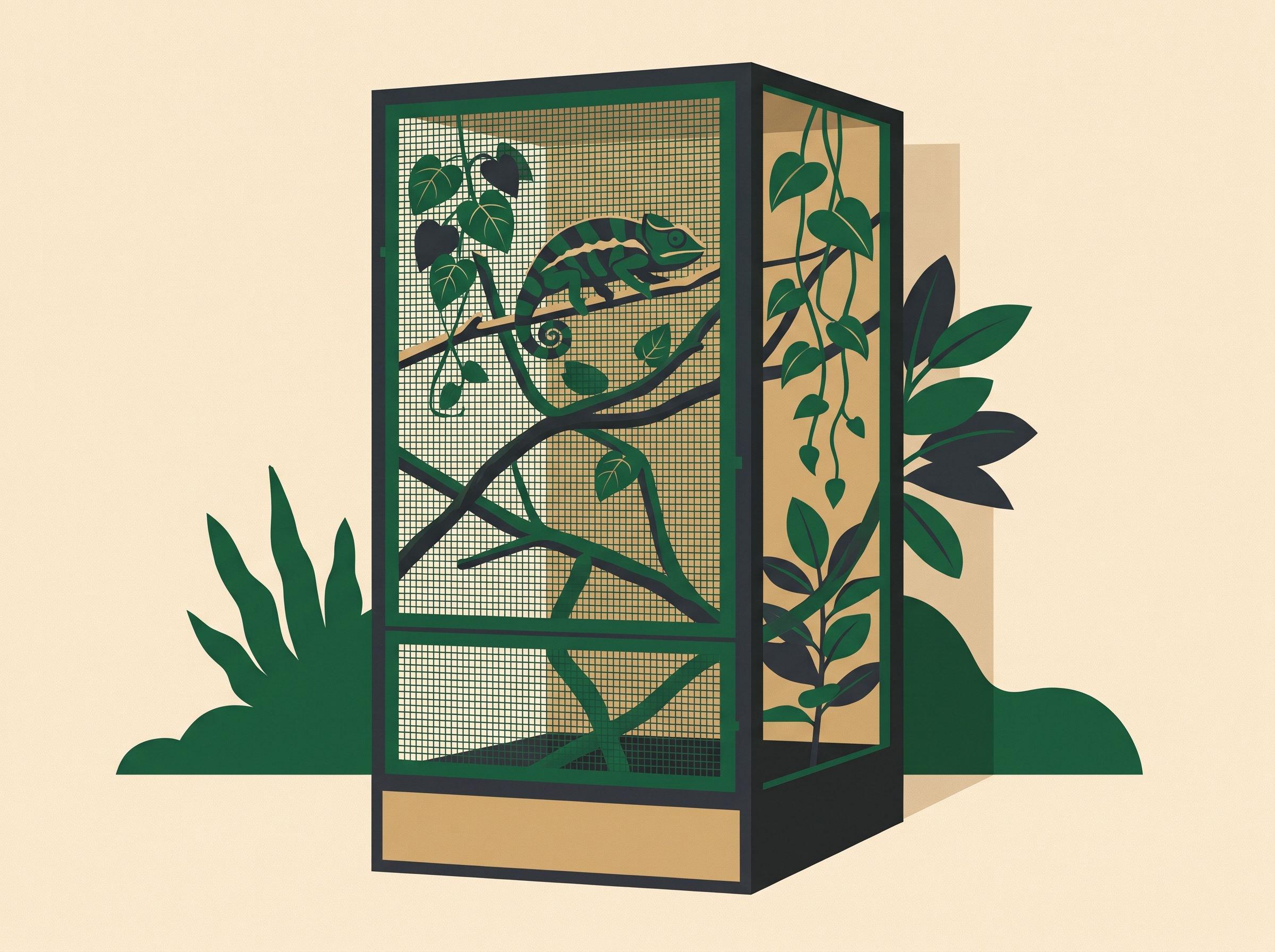
Minimum, recommended, excellent
The minimum for one adult is 24 × 24 × 48 in (61 × 61 × 122 cm). Hatchlings and young juveniles can start in a minimum of 16 × 16 × 30 in (41 × 41 × 76 cm), screen, with dense foliage near the lights and drip access, until about 4–6 months, then move to the adult size. The ladder works like this: minimum is a cage that meets the numbers and nothing more; recommended is an enclosure noticeably larger than the minimum, especially in height and width for a male, so the gradient is longer; excellent is a large custom screen enclosure with automatic misting and a drain, where the animal can move several body lengths from basking to deep shade. I have not seen evidence of a precise size where welfare jumps, so I am not giving one.
Material, ventilation and orientation
Choose screen or a heavily ventilated enclosure, oriented tall. Poor airflow with high humidity is a classic route to respiratory problems and eye irritation. Screen also lets you dry the cage out between mistings, which the species needs. Glass tanks hold stale air and invite a chameleon to stare at its own reflection.
One caution on mesh: coarse screen can wear toenails and snouts as the animal climbs, and the animal may rub its nose raw on the sides. If you see rubbing, add foliage to break the sight lines and consider finer-coated mesh.
Escape-proofing
Chameleons are slow, but not lazy at escaping. Make sure doors latch, and keep the door closed while you work. Check that the mesh has no gaps near the lights.
Cohabitation
House alone. No exceptions for roommates, and no neighbouring cages where animals can see each other. Visual barriers between enclosures are a requirement, not a nicety.
Hides and foliage
Chameleons do not use hides like a snake does; foliage is the hide. Provide dense leaf cover in the upper third of the enclosure near the lights and a second dense zone at lower levels. Thick cover near the basking branch matters most for juveniles. The animal should be able to retreat out of sight and out of the light at any time.
Water and drainage
You need a drip system or reliable misting, and drainage for runoff. The floor should not stay wet. Soggy floors are a source of bacteria and fungus, and a wet base mixed with stale air does most of the damage.
Quarantine setup
A new arrival gets a simple enclosure, the adult minimum or the juvenile size above, that is easy to clean, in a separate room from other reptiles. Use plain branches and artificial or easily disinfected foliage, with its own tools and equipment.
Heating, Lighting and Humidity
This is the most structured part of the guide. Every number below is labelled as SURFACE or AIR, because mixing them up is the fastest way to a sick chameleon.
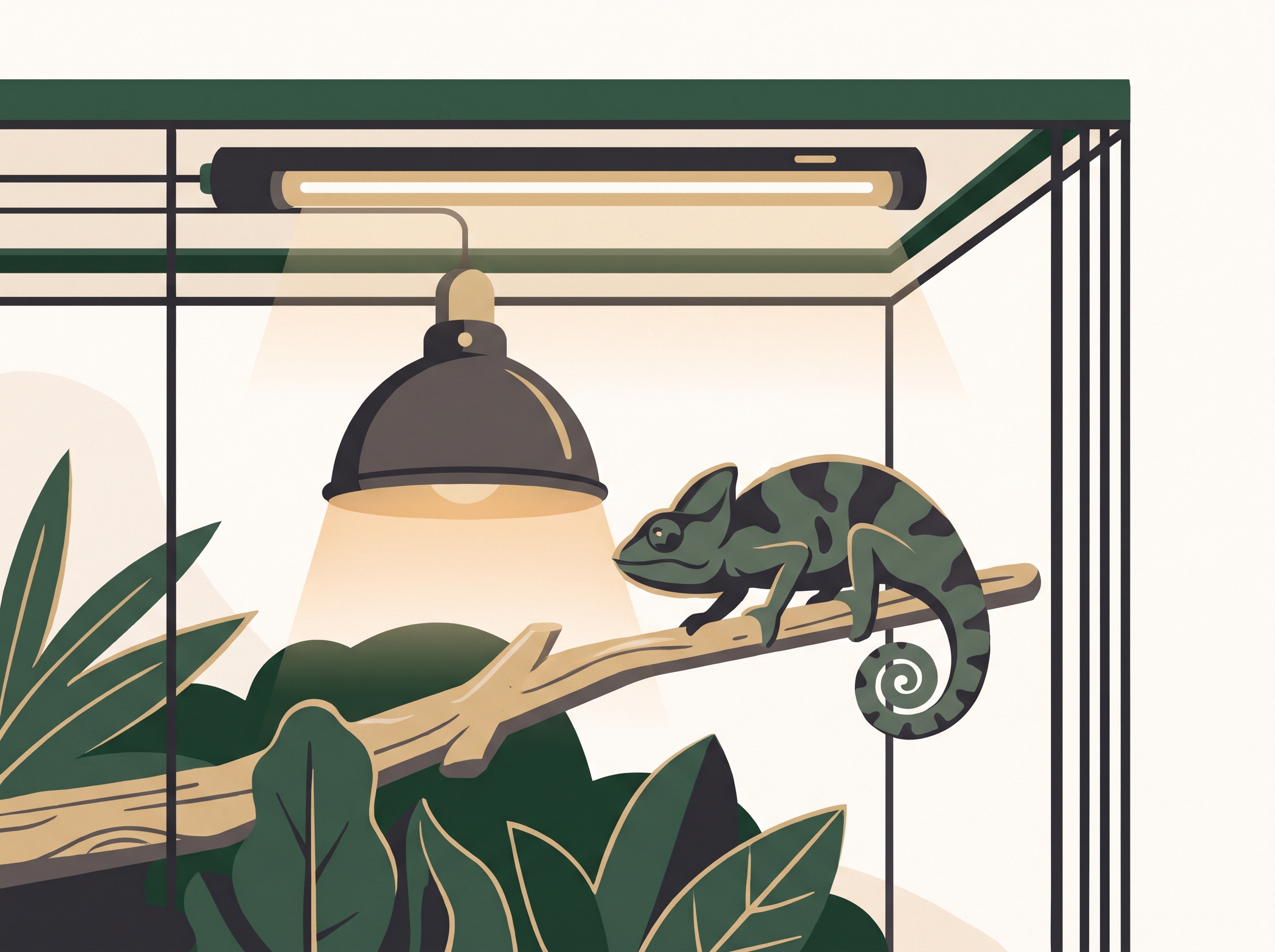
Temperature targets
- Basking SURFACE (the branch under the lamp): about 90–100°F (32–38°C). Keep females toward the lower end and males toward the upper end.
- Warm-side AIR: about 80–85°F (27–29°C).
- Cool-side AIR: about 72–78°F (22–26°C), at the bottom or far end of the enclosure.
- Night AIR: minimum 60°F (16°C); aim for about 65–72°F (18–22°C).
A modest night drop is beneficial and should be provided. Do not leave light-emitting heat lamps on overnight; if the room falls below 60°F (16°C), use a non-light heat source such as a ceramic heat emitter on a thermostat.
How to measure
Surface temperature needs an infrared thermometer pointed at the branch where the animal actually sits. Air temperature needs a probe at the right level: one on the warm side near the animal's perch height, one low on the cool side. Do not trust a dial gauge on the wall; they can be well off, and they measure air near the glass, not the branch. I check surface and air every day, because a lamp that has drifted looks identical to a working one until you measure.
Heating method and control
Use an overhead basking lamp on a dimmer or thermostat, with the probe placed at the basking site, not up against the lamp. A thermostat reading the wrong place will happily overheat the surface. Overhead heat matters because chameleons bask by exposing their sides to a lamp above them. Keep the lamp out of reach, so the animal cannot climb onto it. With a basking surface this warm, burns are a real risk.
UVB
The target is UVI about 3–6 at the basking site (Ferguson Zone 3), with the animal able to reach lower UVI in the shade. Use a linear T5 HO UVB tube, and set its distance by measuring with a handheld UVI meter intended for reptile UVB, not by trusting the box. Screen mesh absorbs a share of UV, so a tube mounted above mesh reads lower at the branch than the same tube inside the cage. Dense foliage between lamp and animal also cuts UV, so measure at the actual perch, with the plants in place. This is why I never quote a bulb wattage: the right output depends on room temperature, mesh, mounting and distance, and the meter tells you the answer.
Tubes lose output before they stop glowing, so replace them on the manufacturer's schedule, typically about every 12 months. Write the install date on the fixture.
Photoperiod and seasons
Run the UVB tube and basking lamp on a 10–12 hour schedule using a timer. A modest night temperature drop is part of the cycle. Whether to add seasonal variation is debated among keepers, and the evidence is thin. I keep a steady day length, and I would not change anything seasonally without advice from an exotics vet.
Humidity
Daytime humidity is about 40–60%. At night it rises naturally to about 60–80% with the temperature drop. Humidity alone does not hydrate a chameleon, so drip or mist water must be offered, and the enclosure should dry out between mistings. Measure with a digital hygrometer in the middle of the cage, not near the drip. To raise humidity, add live plants and a bit more misting; to lower it, increase airflow and mist less. A cage that never dries out is the more common problem than one that is too dry.
Substrate, Decor and Enrichment
A veiled chameleon lives off the ground, so substrate matters less than in a ground-dwelling species, but the floor still affects hygiene and plant health. Because this species is arboreal, there is no digging depth to set for general housing.
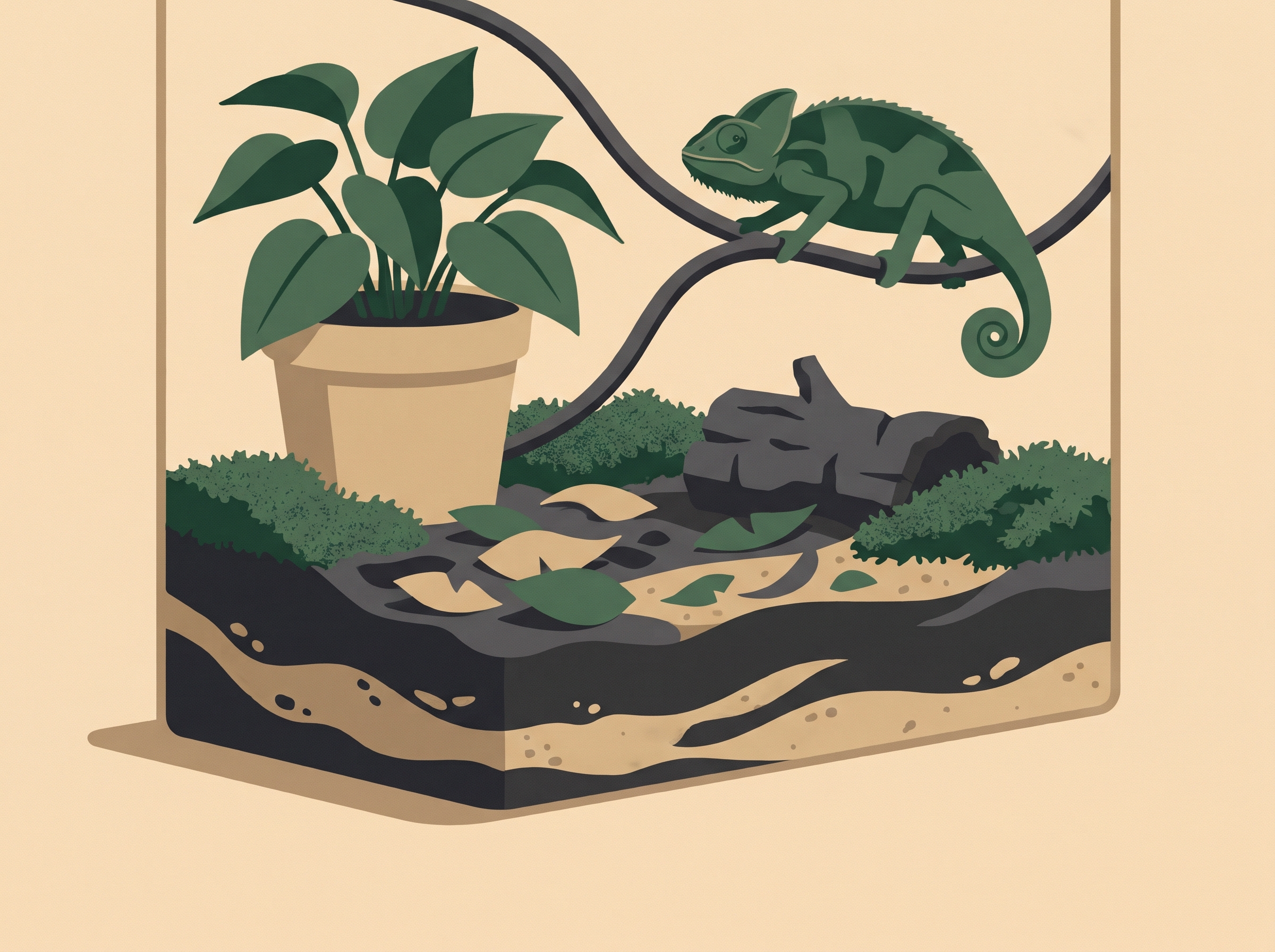
Recommended and acceptable
Many keepers use no substrate at all, with a drainage tray, because it is the easiest to clean and the safest. Others use a simple bioactive-style floor beneath live plants. Paper towel is a fine option in quarantine. If you use a soil mix, keep it clean and replace it as part of the monthly deep-clean.
Unsafe substrates
Avoid loose, small-particle substrates a chameleon might swallow when its tongue strikes a feeder on the floor, because that risks impaction. Avoid anything that stays soggy or dusty. Treat sharp bark chunks and any scented or treated materials as unsuitable, since irritated eyes and respiratory trouble follow from dust and damp.
Live plants
Plants do three jobs: they provide cover, add humidity, and give leaves to drink from and chew. Check each plant for toxicity before it goes in, and check weekly for dying leaves and sharp or toxic material. A poor choice of plant is a bigger risk than no plant at all. If you cannot confirm a species is safe, leave it out.
Branches and climbing
Provide a web of branches at varied diameters, so the grip changes as the animal moves, including a firm basking branch in the right place and diagonal routes to the shade. Everything should be stable enough to hold an adult male. Check for rubbing on the tail tip and toes as well.
Visual barriers and enrichment
Put a solid panel or foliage wall on the sides facing other animals or busy doors. For enrichment, rearrange a few branches and plants every few weeks, which gives a new route without disturbing the whole cage. Change one thing at a time, and watch that the animal still finds its basking site and drip. Over-enriching is possible; if the animal goes dark or stops eating after a rearrange, put things back.
Bioactive suitability
A bioactive floor can work in a large screen enclosure with good drainage, but a screen cage with proper airflow dries out more than a classic bioactive setup likes. It is workable, not required, and keepers disagree on whether the benefit is worth the extra moisture near the floor.
Feeding, Supplements and Hydration
The life-stage table gives frequencies and portions; this section explains how to apply them. The veiled is an insectivore, and the staple should be gut-loaded crickets, roaches such as dubia, and similar feeders, varied with other insects. Adults also eat some leafy plant matter.
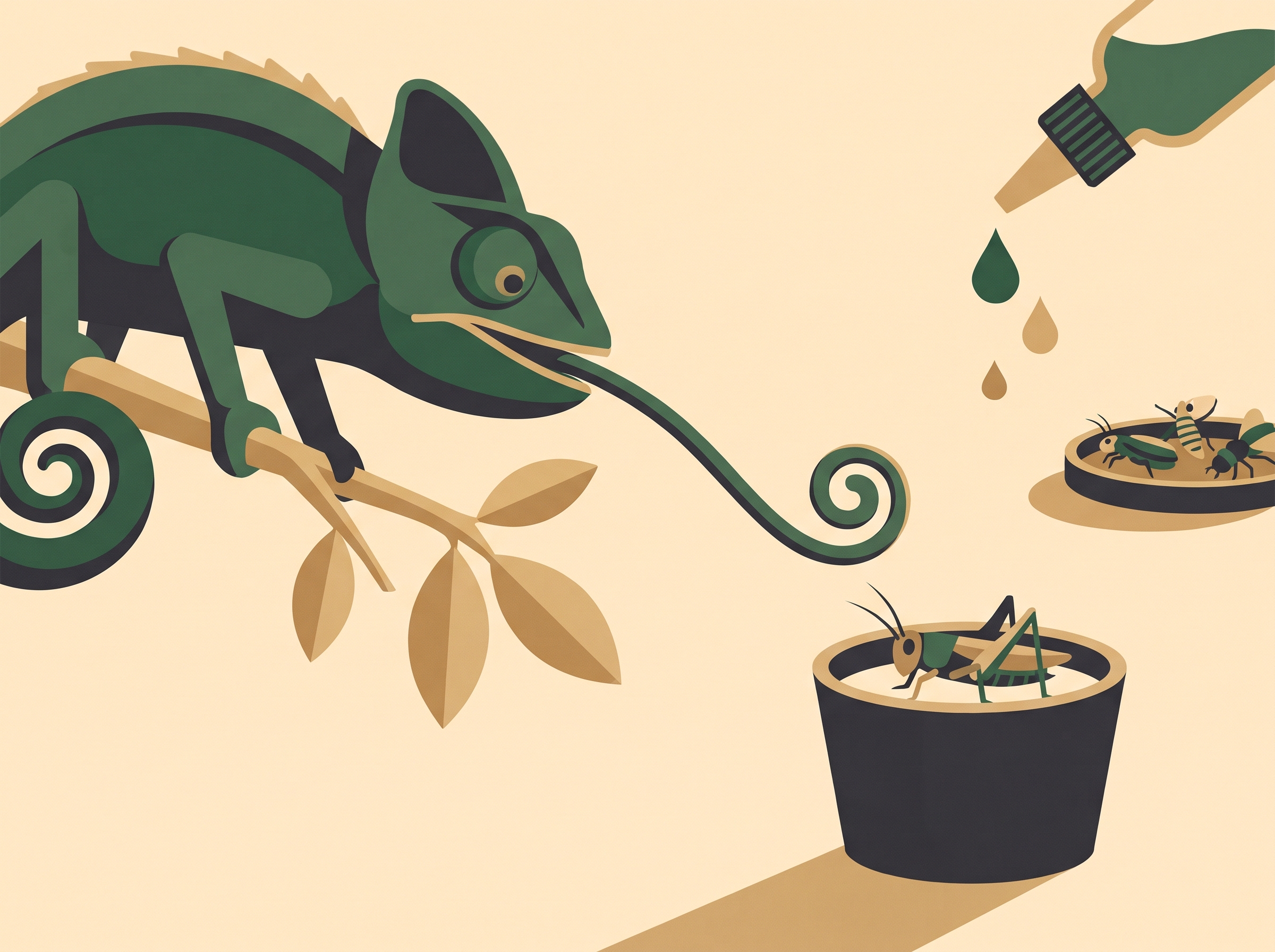
Staples, rotation and foods to avoid
Rotate several insect types so the diet is not one species. Offer a few leaves of dark leafy greens in the enclosure for adults. Use high-fat feeders sparingly, because veileds become obese easily. Avoid wild-caught insects, which may carry pesticides and parasites, and avoid anything large, hard or that bites back. I have had good results with a roach colony because it is clean and quiet, but crickets work too.
A measurable sizing rule
Feeders should be no longer than the space between the eyes for hatchlings and juveniles (for a hatchling about 1/4 in / 6 mm), and no wider than the space between the eyes for adults and gravid females. If a feeder looks borderline, go smaller. Oversized prey is a common cause of refusal, choking and regurgitation.
Gut-loading
Feed the insects nutritious greens and a quality gut-load for at least a day before they are offered. An insect that has been sitting in an empty tub is mostly empty calories. Keep the feeder colony clean.
Dusting schedule
For adults: calcium without D3 at about 2–3 feeds a week, calcium with D3 about every 2–4 weeks on correct UVB, and a multivitamin about every 2–4 weeks. Juveniles get calcium without D3 at most feeds, calcium with D3 about every 1–2 weeks on correct UVB, and a multivitamin about every 2 weeks. Follow the specific product label and exotics vet guidance, because products differ. The multivitamin should contain preformed vitamin A, and too much D3 or vitamin A is a real risk, so more is not better.
Water presentation
Chameleons drink from droplets. Use a drip system or mist, and watch the animal drink so you know it works. A bowl of water is not an answer for this species. Replace the drip reservoir water weekly and clean the container. In practice the animal often drinks at the lights-on misting session, so schedule one then.
Body condition
You want a lean animal with no fat pads. An overweight veiled shows fat pads on the casque, flanks and around the hind legs, and may look rounded rather than lean. Obesity is linked to liver disease and egg-binding problems. Weigh weekly on a gram scale and record it; a slow upward drift is easy to miss by eye. If you see pads, cut the portion and frequency and ask your vet.
Daily, Weekly and Monthly Care
Routine care takes me about fifteen to twenty minutes a day, plus a longer weekly session. Most of it is looking: at the animal, the thermometers and the drip. The checklists are in the care schedule table next to this text; here is what actually slips.
The first thing to go is the infrared thermometer check. People check the lamp is on, not what the branch reads, and the surface drifts out of range as bulbs age or plants grow over the lamp. The second is the weekly weigh-in. It feels optional, until you notice a month of loss you could have caught in week two. The third is the UVB tube date, which is invisible: a tube can still look bright long after its output has dropped.
The easy habit to build is attaching each task to something you already do. Check temperatures when you turn the lamp on, watch the drink after the morning mist, and weigh on the same day you change the reservoir water. Keep a simple notebook or spreadsheet with weight, feeders eaten, and droppings. When something goes wrong, that record is the first thing your vet will ask for, and it turns a vague worry into an answer.
Handling and Behaviour
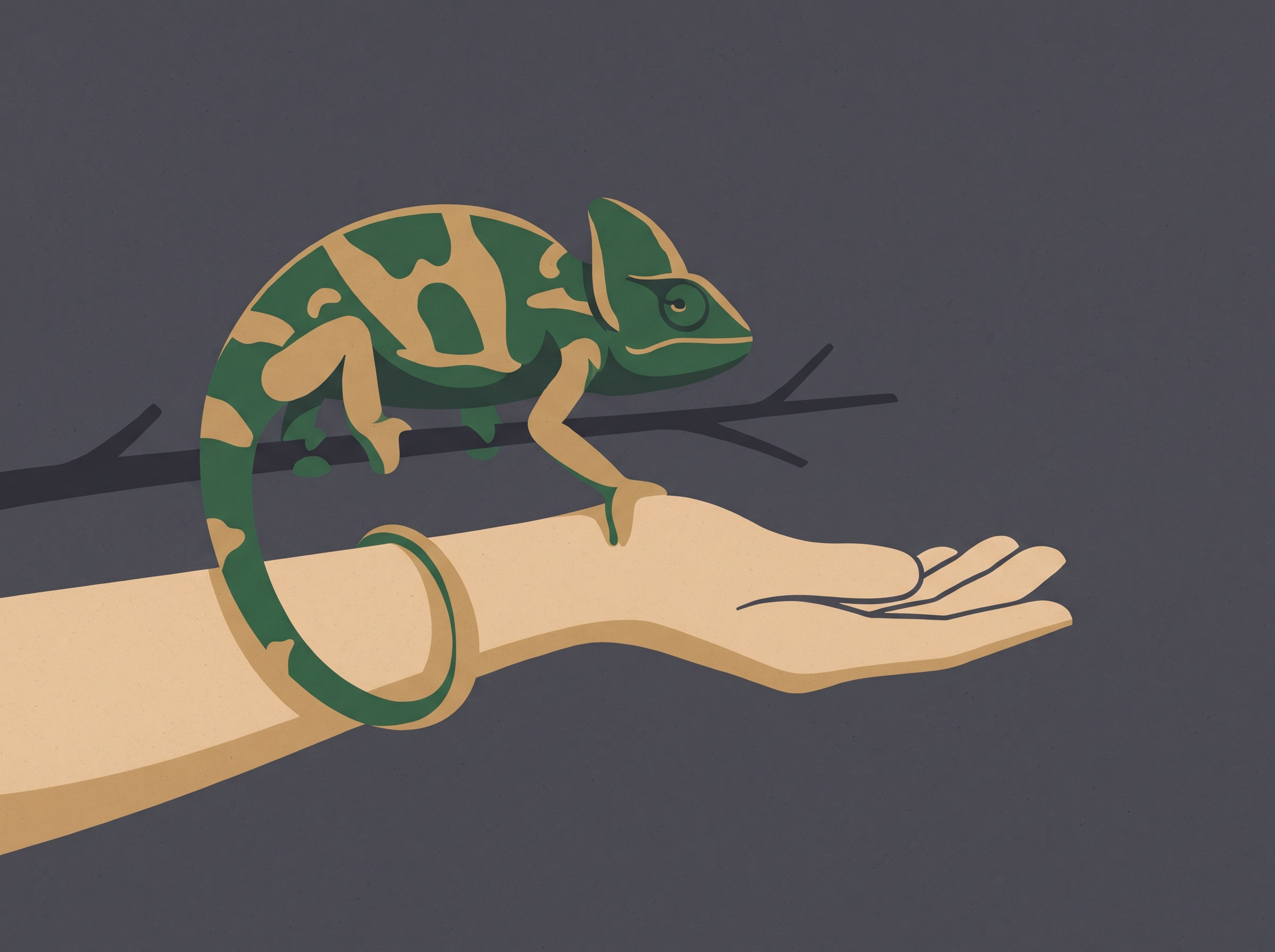
Handling is low priority. It is a stressor and is not needed for good care. Keep any necessary session to a few minutes, and avoid it entirely during shed, illness or gravid periods.
Settling in
After arrival, leave the animal alone beyond feeding and cleaning. Offer water from day one, and do not try to handle it during quarantine. A chameleon that is still adjusting often hides in foliage, eats less and shows dark colour.
How to pick up
Approach from the side, not from above, and let the animal step onto your hand by placing it in front of the chest. Do not grab or pull it off a branch; the grip is strong and the toes and tail are delicate. Support the body and let it move hand over hand. Then return it to the same perch.
Session length and frequency
A few minutes, and not daily. There is no evidence that frequent handling improves the animal's temperament; some individuals tolerate it and many never do.
Body language and stress
Colour change is normal and reflects mood, temperature and health. Learn the animal's usual calm colours. Stress shows as dark colours, gaping, hissing, inflating the body, and swaying away from you. Defensive males may gape and lunge. A bite is rarely dangerous but can break skin; clean it well, and see a doctor if you are concerned. Dark colour that does not recover is a health warning, not a mood.
Children and escape prevention
An adult must supervise every interaction with a child, and children should not carry the animal around. Handle it in a closed room, low to the ground, and never outdoors untethered. Chameleons climb curtains and bookshelves quickly when they are scared, so close the door first.
Health and Veterinary Care
This section explains how to look. The triage table tells you what a given sign may mean and how urgent it is. I am not a vet, and I will not give a treatment, a dose or a home remedy here; for anything wrong, find an exotics vet.
New-animal check and quarantine
Keep a new animal alone for at least 60–90 days, in a quiet room away from other reptiles, with its own equipment and cleaning tools, handled last. A faecal test and an exotics vet check should happen in this period. Chameleons commonly carry parasites and stress-related disease that may not show for weeks, so a longer period is safer. Weigh on day one as your baseline.
Normal droppings, urates and sheds
Normal droppings are a formed brown or dark portion with a separate urate. Learn the usual urate colour and consistency for your animal, because a change is often the first sign of dehydration or a diet problem. Shed shows as dulling, patchy flaking and rubbing on branches. Do not pull skin; the drip and misting keep it moving. Stuck shed on the toes or tail tip is worth a look and a vet if it persists.
Weight monitoring
Weigh weekly and review the chart monthly. Steady gain in a juvenile is normal; loss over several weeks in an adult is not. Take the weight records to the vet.
Conditions and the husbandry error behind each
- Metabolic bone disease: linked to inadequate UVB or calcium. The usual error is an unmeasured or old tube, or a UVI that never reaches the animal through mesh and foliage.
- Dehydration: usually no real drip or mist, or a cage that never gets a chance to be drunk from. Humidity is not hydration.
- Respiratory infection: often poor ventilation, cool temperatures or both.
- Obesity and liver trouble: overfeeding, high-fat feeders, and too many feeds.
- Egg-binding: in females, linked to poor laying conditions, obesity and calcium status. It is life-threatening, and failure to lay is an emergency.
- Eye problems: dusty, irritating or poorly ventilated conditions and UVB setup.
- Mouth rot: infection, often after stress or injury.
When you look at the animal each day, you are comparing it to its own normal. Sunken eyes, a soft jaw, open-mouth breathing, or a gravid female digging for days all have rows in the triage table. If you are unsure, call an exotics vet, and the ARAV directory is a place to start finding one. Do not use over-the-counter parasite treatments.
Buying This Species
Veileds are widely available, and captive-bred animals are the norm. Buy only captive-bred.
Captive-bred versus wild-caught
Wild-caught veileds from Yemen and Saudi Arabia have been exported historically, and wild-caught chameleons generally carry heavy parasite loads and do poorly. Avoid them. If an animal is not clearly captive-bred, ask for documentation, and walk away if the seller cannot give a straight answer. I would rather lose a sale on a nice-looking animal than take on a parasite-laden one.
What healthy looks like in a photo and in the hand
In photos, look for open, rounded, alert eyes, even colour for the mood, a straight jaw and limbs, and a body with no visible ribs or hip bones. Ask for a video of the animal eating and drinking, because a still photo hides a lot. In the hand, a healthy animal grips strongly with feet and tail, and the jaw feels firm. Sunken eyes, a soft or bent jaw, tremors and poor grip suggest metabolic bone disease. The buying checklists are in their own tables; use them as a script, not a skim.
What to do with the answers
Ask how the animal drinks and what UVB it has lived under. A seller who says a bowl and a heat bulb is telling you the animal has been kept wrong. Compare the answers against this guide, and ask for hatch date, feeding record, weights and any faecal result. Browsing seller profiles in the seller stores lets you see who keeps records and posts clear photos. When you are ready to look, current veiled chameleon listings are one search away, and the wider marketplace covers everything else.
Transport and arrival
Prepare the enclosure at least 1 week before arrival, run the UVB tube and lamp for 3–7 days to confirm surface and air temperatures and UVI, and have feeders, supplements, a gram scale, an infrared thermometer and a vet contact ready. Transport should be warm and quiet, and the animal should not sit in a sealed box for long. Shipping across borders may need CITES paperwork, and some places restrict or prohibit chameleons. Verify your local rules before buying; I cannot promise what applies to you.
Lines and welfare
I am not aware of a documented veiled colour line that I can name as a welfare problem, so I will not invent one. The real welfare issue in this species is not a morph but husbandry in the first months. Ask where the animal was raised and how it was fed, since fast growth from over-supplementing is a known concern. For more reading, see our other ReptileAds articles.
- IUCN Red List
- Chamaeleo calyptratus is assessed as Least Concern on the IUCN Red List (verify the current assessment at iucnredlist.org).
- CITES
- Chamaeleonidae are listed on CITES Appendix II, which covers C. calyptratus as an international trade species. Verify the current listing on Species+ (speciesplus.net). Some other chameleon species have different listings.
- Ownership restrictions
- The buyer must check their own state, country and local council or municipality rules. Some jurisdictions restrict, license or prohibit keeping chameleons, and some treat veileds as invasive (they have established feral populations in Florida and Hawaii). Import and export, and shipping across borders, may need CITES paperwork. Verify before buying.
- Wild-caught in trade
- Wild-caught veileds from Yemen and Saudi Arabia have been exported historically. Wild-caught chameleons of many species generally carry heavy parasite loads and do poorly. Avoid wild-caught animals, and ask for documentation if an animal is not clearly captive-bred.
- Captive-bred availability
- Widely available. Veileds are bred in large numbers by hobbyists and commercial breeders, so captive-bred animals are the norm and should be the only ones bought.
Ownership rules vary by country, state and even city, and they change. Check what applies where you live before you buy.
Feeding by Life Stage
What changes as the animal grows. Portions are measurable rules, not estimates.
- Food
- Gut-loaded small crickets, small roach nymphs and similar feeders
- Portion
- As many appropriately small feeders (no longer than the space between the eyes, about 1/4 in / 6 mm) as are eaten in about 10–15 minutes
- Frequency
- Daily
- Supplements
- Calcium without D3 lightly dusted at most feeds; calcium with D3 about once every 1–2 weeks while on correct UVB; multivitamin with preformed vitamin A about every 2 weeks or per vet advice. Follow the specific product schedule.
- Enclosure
- Minimum 16 × 16 × 30 in (41 × 41 × 76 cm), screen, with dense foliage near the lights and drip access
- Food
- Gut-loaded crickets, roach nymphs and similar feeders, rotated
- Portion
- As many feeders (no longer than the space between the eyes) as are eaten in about 10–15 minutes; roughly 6–10 insects per feed depending on size
- Frequency
- Daily until about 6 months, then every other day
- Supplements
- Calcium without D3 at most feeds, calcium with D3 about every 1–2 weeks on correct UVB, multivitamin about every 2 weeks. Reduce supplements on the advice of an exotics vet if growth is too fast.
- Enclosure
- Minimum 16 × 16 × 30 in (41 × 41 × 76 cm) until about 4–6 months, then the minimum 24 × 24 × 48 in (61 × 61 × 122 cm) adult enclosure
- Food
- Gut-loaded crickets, roaches (e.g. dubia) and other feeders in rotation, plus a few dark leafy greens
- Portion
- A measured portion of about 5–8 appropriately sized feeders (no wider than the space between the eyes), adjusted to keep body condition lean with no fat pads. Offer a few leaves of dark leafy greens in the enclosure.
- Frequency
- Every other day, or 3–4 times a week for overweight animals
- Supplements
- Calcium without D3 at about 2–3 feeds a week, calcium with D3 about every 2–4 weeks on correct UVB, multivitamin about every 2–4 weeks. Follow the label and vet guidance.
- Enclosure
- Minimum 24 × 24 × 48 in (61 × 61 × 122 cm); larger is better, especially for males
- Food
- Gut-loaded crickets, roaches and other feeders in rotation, plus a few dark leafy greens
- Portion
- Feed to appetite in slightly larger and more frequent portions while appetite is up, with feeders no wider than the space between the eyes. Stop when she refuses food before laying.
- Frequency
- Daily to every other day while eating; she often stops eating shortly before laying
- Supplements
- Calcium without D3 at most feeds during follicle development and gravidity, plus correct UVB. Egg-laying is a calcium drain; follow exotics vet guidance on the schedule.
- Enclosure
- Same minimum 24 × 24 × 48 in (61 × 61 × 122 cm) plus a deep laying bin (about 12 in / 30 cm of moist, diggable substrate). Veiled females produce eggs whether or not they have been with a male, so every female from about 4–6 months old needs a laying bin available once she shows signs of being gravid. The female will dig for days if the bin is wrong, and a failure to lay is an emergency.
- Food
- The same feeder types the animal was eating before arrival
- Portion
- Offer the same feeders the animal was eating before, as many as eaten in about 10 minutes, with water by drip or mist from day one
- Frequency
- Daily for juveniles; every other day for adults
- Supplements
- Calcium without D3 as normal; hold off on extra multivitamin until the animal is eating and drinking normally
- Enclosure
- Minimum 24 × 24 × 48 in (61 × 61 × 122 cm) for an adult (or the juvenile size above), simple and easy to clean, in a separate room from other reptiles
Daily, Weekly and Monthly Care
What keeping this animal actually costs you in time, week to week.
- Check the basking-surface temperature with an infrared thermometer and the warm- and cool-side air temperatures against the probe readouts
- Confirm the UVB tube and basking lamp come on and go off on the 10–12 hour schedule
- Offer a measured portion of gut-loaded feeders (per the life-stage table) and note how many were eaten
- Mist the enclosure at least twice a day (including at lights-on) and run or refill the drip, then watch the chameleon drink, and note eye position, colour and droppings
- Remove uneaten insects, fallen leaves and faeces
- Weigh the chameleon on a gram scale and record it
- Wipe down the glass and screen, and replace the drip reservoir water and clean the container
- Check live plants for dying leaves and for any toxic or sharp material; replace as needed
- Check faeces for the urate colour and consistency and for abnormal stool
- Re-measure the UVI at the basking position with a UVI meter if one is available
- Deep-clean the enclosure, branches and drainage; replace substrate if used
- Check the date on the UVB tube and note when it will need replacement
- Review the weight chart for slow gain, loss or rapid growth, and adjust the feeding portion
- Check the feeder colony and gut-load supplies, and replace supplements that are out of date
- Examine the chameleon in good light for swollen joints, mouth lesions, a bent jaw, eye issues and retained shed
When to Call a Vet
What you can see, and how quickly it needs acting on.
| What you see | Urgency | What to do |
|---|---|---|
| Skin dulling, flaking in patches, and rubbing on branches before a shed | Normal | This is normal shedding. Keep the drip and misting going and do not pull the skin. See a vet if shed stays stuck on toes or tail tip or the animal is lethargic. |
| Colour change between calm and excited tones, or darker colour at night | Normal | Normal. Colour reflects mood, temperature and health, so learn the animal's usual colours. Persistent dark or dull colours that do not recover are a warning sign. |
| Female refuses food for a few days before laying eggs | Normal | Common in gravid females for a few days before laying. Provide a proper laying bin and keep hydration up. Call an exotics vet if she has not laid within a few days of starting to dig or refusing food, or straight away if she shows any distress, straining or lethargy. |
| Staying on the bottom or in the cool shade, with pale or dark colour and reduced appetite | Check the setup | Check basking and ambient temperatures and the UVB tube immediately. Correct any fault. If not improving within a day or two, see an exotics vet. |
| Obesity: visible fat pads, particularly on the casque, flanks or around the hind legs | Check the setup | Cut the feeding portion and frequency, and use lower-fat feeders. Discuss body condition with an exotics vet at the next check. |
| Sunken eyes, wrinkled skin, thick sticky saliva or orange urates | See a vet | Signs of dehydration. Raise hydration: add drip or mist several times a day and check the animal drinks. Sunken eyes mean dehydration is already significant, so book an exotics vet promptly, and see one urgently if there is no improvement within 24 hours. |
| Eye closed for long periods, swollen eyes or a bulging eyelid | See a vet | See an exotics vet. Check humidity, dust and the UVB setup, and avoid anything irritating near the eyes. |
| Weight loss over several weeks, or worms or blood in the droppings | See a vet | Book an exotics vet visit and bring a fresh faecal sample and the weight records. Do not use over-the-counter parasite treatments. |
| Soft or rubbery jaw, tremors or twitching, bent limbs, or trouble climbing | Urgent | Possible metabolic bone disease or calcium deficiency. See an exotics vet urgently. Handle as little as possible and check the UVB source and supplements in the meantime. |
| Open-mouth breathing, bubbles or wheezing, or mucus at the nostrils | Urgent | Possible respiratory infection. Take the animal to an exotics vet urgently. Keep it at the correct temperature and transport it warm. |
| Gravid female digging for days, straining, or lethargic with a swollen abdomen and not laying | Urgent | Possible egg-binding, which is life-threatening. See an exotics vet urgently. Keep her warm and quiet, and do not massage her abdomen. |
| Yellow or white lesions, or swelling or cheesy deposits in the mouth | Urgent | Possible mouth rot or infection. See an exotics vet urgently and avoid feeding until seen. |
| Swollen limb or joint, or a drooping tongue that will not retract after feeding | Urgent | See an exotics vet urgently, especially for a tongue that will not retract, which can be injured and stops the animal feeding. Make sure UVB and calcium are correct and the animal is not stressed. |
This guide does not diagnose and does not replace a veterinarian. Nothing here is a treatment or a dose. If you are unsure, an exotics vet is always the right call.
Buying Checklist
What to check, what to ask, and what to have ready.
Keep the animal alone for at least 60–90 days, in a quiet room away from other reptiles, with its own equipment and cleaning tools and handled last. A faecal test and an exotics vet check should be done during this period. Chameleons commonly carry parasites and stress-related disease that may not show for weeks, so a longer period is safer.
About $900–1,800 USD for year one, including the setup ($400–900) and 12 months of running costs ($40–80 a month), plus UVB tube replacement and one vet check. The top of the range reflects a large enclosure, automatic misting and an exotics vet visit.
- Is this animal captive-bred, and from which breeder, with what hatch date?
- What does it eat, how often, and what was it last fed and when? Did it take the food voluntarily?
- How does it drink: from drip, from misting, or from a bowl? Have you seen it drink?
- What UVB tube and what basking temperature has it been kept under, and what are the enclosure dimensions?
- Was it raised where it could see other chameleons, and how many shared the room or rack with it?
- Has it been checked for parasites by faecal test, and what were the results?
- How fast has it grown, and has it been power-fed or heavily supplemented with D3 or vitamin A to push growth?
- For a female: has she been bred or has she laid eggs, and when? Will you guarantee the sex?
- Eyes open, rounded, alert and tracking movement, and not sunken
- Bright, even colour for the animal's mood, without persistent dark or washed-out patches
- Straight, firm limbs and jaw, with no swelling, bends or kinks in the spine or tail
- Gripping branches strongly with feet and tail
- Clean mouth and nostrils with no discharge, bubbles or bumps
- Rounded body with no visible ribs or hip bones, and no excessive fat pads
- Clean vent and no stuck shed on the toes or tail tip
- Visibly drinking and eating when offered
- Sunken eyes, an eye closed for long periods, or lethargy
- Soft or bent jaw or limbs, tremors, or poor grip, which suggest metabolic bone disease
- Wild-caught or unclear origin, or a seller who cannot say how the animal drinks or what it eats
- Listing that says chameleons need only a bowl of water and a heat bulb, or a sale that includes only a small glass tank
- Several chameleons housed together, or crowded, dirty enclosures
- Mouth lesions, wheezing or discharge, or a swollen abdomen in a female
- Seller unwilling to provide photos or video of the animal eating and drinking
- Hatch date and breeder or lineage details
- Feeding record: feeder types, frequency and supplements
- Weight records since hatching
- Faecal test or vet records, if any
- For females, any breeding or laying records
- Enclosure set up with branches, live or artificial foliage and a drip system, at least 1 week before arrival
- T5 HO UVB tube installed at the correct distance and basking lamp running, with surface and air temperatures confirmed, 3–7 days before arrival
- A UVI meter or other check of the UVI at the basking position, 3–7 days before arrival
- Feeder insects (gut-loaded) and supplements purchased and kept ready, at least 2–3 days before arrival
- A gram scale and infrared thermometer ready, plus the contact details of an exotics vet, at least 1 week before arrival
- A quarantine location in a quiet room away from other reptiles, at least 1 week before arrival, when the enclosure is set up
Frequently Asked Questions
How big do veiled chameleons get?
Males reach 17–24 in (43–61 cm) in total length, and females 10–14 in (25–36 cm). Males are larger, with a taller casque and tarsal spurs. Because of this size, one adult needs a screen enclosure of at least 24 × 24 × 48 in (61 × 61 × 122 cm), and bigger is better, especially for males.
How long do veiled chameleons live?
In captivity, females live about 4–6 years and males about 5–8 years. Egg-laying shortens a female's life, which is why females are typically shorter-lived than males. Correct UVB, hydration and a lean body condition all help an animal reach the upper end of its range.
Do veiled chameleons need UVB?
Yes. Aim for UVI about 3–6 at the basking site (Ferguson Zone 3), with lower UVI available in the shade. Use a linear T5 HO UVB tube at a distance confirmed with a UVI meter, and replace it on the manufacturer's schedule, typically about every 12 months.
How do veiled chameleons drink water?
They drink from dripping water or mist, not from a bowl. Offer a drip system or misting several times a day and watch the animal drink. Humidity alone does not hydrate a chameleon, and the enclosure should dry out between mistings so that it does not stay damp.
Can two veiled chameleons live together?
No. Veiled chameleons are solitary, are stressed by the sight of another chameleon, and males fight. House each one alone, and use visual barriers between enclosures so they cannot see each other, even through mesh.
Are veiled chameleons good for beginners?
Not really. Veileds are the hardiest of the commonly kept chameleons, but they still need precise UVB, temperature and hydration management, and they decline fast when husbandry slips. They suit a keeper willing to measure and record, and they are not an animal to learn on.
What temperature does a veiled chameleon need?
The basking surface should be about 90–100°F (32–38°C), warm-side air about 80–85°F (27–29°C), and cool-side air about 72–78°F (22–26°C). Night air should not fall below 60°F (16°C); aim for about 65–72°F (18–22°C). Check surface temperature with an infrared thermometer.
How much does it cost to keep a veiled chameleon?
A correct first setup costs about $400–900 USD, and running costs are about $40–80 USD a month. The first year totals about $900–1,800 USD including a UVB tube replacement and one vet check. Automatic misting, a large enclosure and a UVI meter push costs toward the top.
References and Revision History
Sam Carter
November 4, 2026
- 1.
Supports: The veiled chameleon enclosure minimum, temperature, humidity, hydration, feeding and supplement ranges, captive lifespan, and the qualitative veiled, panther and Jackson's comparison table
- 2.
The Reptile Database — Chamaeleo calyptratus
Supports: The scientific name, native range and adult size range of the veiled chameleon
- 3.
IUCN Red List of Threatened Species — Chamaeleo calyptratus
Supports: The conservation status of the veiled chameleon
- 4.
CITES Species+ database — Chamaeleonidae listing
Supports: The CITES Appendix II listing and trade rules for chameleons
- 5.
Divers SJ, Stahl SJ (eds). Mader's Reptile and Amphibian Medicine and Surgery (Elsevier)
Supports: General veterinary background on metabolic bone disease, dehydration, egg-binding and respiratory disease in chameleons
- 6.
Association of Reptile and Amphibian Veterinarians (ARAV)
Supports: Finding an exotics vet, and the veterinary standard for urgent signs in the triage table
- 7.
UVGuide UK — UVB and UV Index guidance for reptiles (Ferguson zones)
Supports: The UV Index target at the basking site and the Ferguson Zone 3 classification for the veiled chameleon
- November 3, 2026First draft generated and reviewed.
Was this guide helpful?
Rate this guide
Questions & Answers
0 questions from the community
Comments
0 comments