If you have ever stared at two leopard gecko listings wondering why one het Tremper Albino sells for so much less than a visual, or why pairing two Mack Snows didn't give you the ratio you expected, you are running into the same wall almost every new breeder hits: leopard gecko morph genetics looks simple from the outside and gets confusing fast once you are making an actual pairing decision. This article walks through how recessive, dominant and incomplete-dominant traits actually inherit, using Punnett square logic and real morphs, so you can understand the genetics behind an animal and predict possible outcomes before you commit a female to a clutch.
What is the difference between recessive, dominant and incomplete-dominant leopard gecko traits?
A recessive trait needs two copies of the gene to show visually. A dominant trait needs only one copy to be expressed. An incomplete-dominant trait also shows with one copy, but an animal with two copies has a distinct homozygous, or "super," form.
In the reptile hobby, incomplete-dominant traits have historically been called "co-dominant" or simply "co-dom," and you will still see those terms used regularly in listings and breeding discussions. Technically, incomplete dominant is the more accurate term for traits such as Mack Snow.
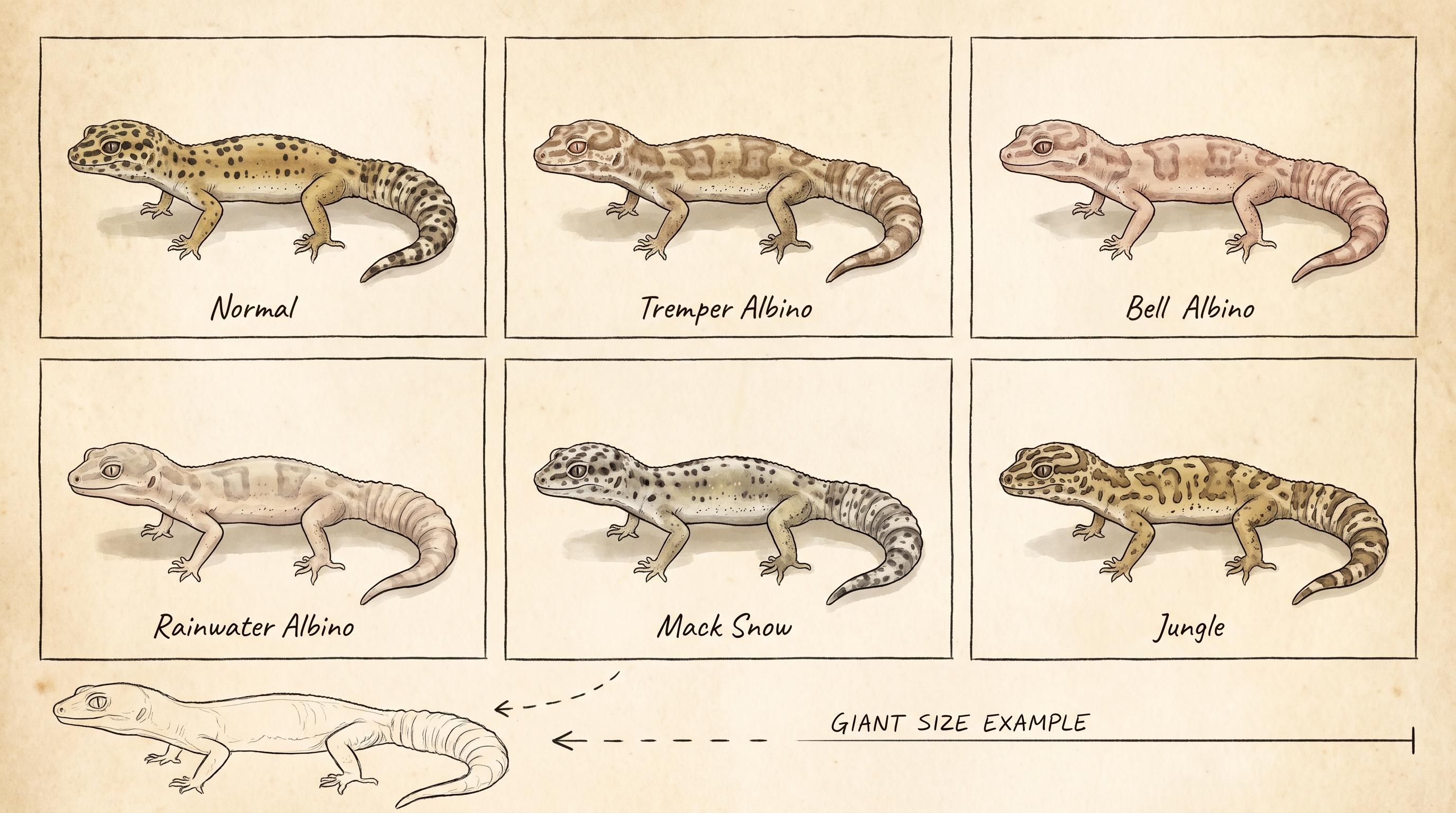
Tremper Albino is the classic recessive example. An animal can carry one copy of the gene without showing it at all — we call that animal a het, short for heterozygous, Tremper. Two copies produce a visual Tremper Albino. One copy produces an animal that carries the trait without visually expressing it.
That is also part of the reason a het Tremper and a visual Tremper can have very different values. With the visual animal, you can see the expressed trait. With a het, part of what you are buying is genetic information that cannot necessarily be determined just by looking at the gecko.
How do you read a leopard gecko Punnett square for a recessive trait?
Draw a two-by-two grid, put one parent's two alleles along the top and the other parent's down the side, then fill in the four possible combinations. Pair two het Trempers and the expected odds are roughly 25 percent visual Tremper Albino, 50 percent het Tremper and 25 percent normal with no Tremper Albino allele.
The normal-looking babies are where things get interesting. Once you remove the visual albinos from the equation, any normal-looking offspring has a two-in-three chance of carrying Tremper Albino. That is why those animals are labelled 66 percent possible het Tremper, rather than proven het Tremper.
Pair a visual Tremper to a het Tremper and the expected odds become roughly 50 percent visual Tremper and 50 percent het Tremper. Every non-visual offspring from that pairing is a known het, so there are no possible hets to sort out later.
One more thing worth knowing: Tremper, Bell and Rainwater are genetically distinct and incompatible albino strains. Crossing one albino strain to another does not produce visual albinos in the first generation. For example, offspring from a visual Tremper Albino crossed to a visual Bell Albino would appear non-albino while carrying both traits. This is exactly why knowing an animal is simply "albino" is not enough if you intend to breed it. You need to know which strain you are working with.
And remember, Punnett-square percentages are probabilities, not quotas. A het-to-het pairing has an expected 25 percent chance of producing a visual albino with each offspring, but that does not mean every four babies will include exactly one visual. A clutch of six can produce no visuals at all, or several of them. Genetics gives you the odds; it does not promise the outcome of an individual clutch.
How does Mack Snow inheritance differ from a recessive morph?
Mack Snow is an incomplete-dominant trait, although you will still commonly hear breeders refer to it as co-dominant or "co-dom." A single copy produces a Mack Snow. Two copies produce the homozygous form, Super Snow, which has its own distinct phenotype and is commonly recognized by its speckled pattern and solid dark eyes.
Pair two Mack Snows and the expected odds are roughly 25 percent Super Snow, 50 percent Mack Snow and 25 percent normal. Pair a Super Snow to a normal and every offspring will inherit one copy of the Mack Snow allele, producing 100 percent Mack Snow offspring.
That is fundamentally different from a recessive trait such as Tremper Albino because you do not have visually normal animals quietly carrying a single copy of Mack Snow. One copy is already expressed.
If you want to test pairings before committing a female to a clutch, run them through the ReptileAds genetic calculator — it handles recessive, incomplete-dominant and dominant traits together, which is where hand-drawn Punnett squares start getting unwieldy.
Why should morph buyers care who bred the gecko?
Because a gecko's appearance does not necessarily tell you its complete genetic story.
A visual trait can tell you what an animal expresses, but it cannot tell you every recessive gene that animal may carry. Line-bred traits such as Tangerine add another layer because they are developed through selective breeding and do not behave like a simple single-gene recessive or incomplete-dominant morph. That makes breeder records, lineage and knowledge important.
A gecko being orange does not automatically establish its lineage or make every label attached to it accurate. Likewise, two animals that look similar in photographs may have very different genetic backgrounds and very different potential in a breeding project. A label on a listing is ultimately a claim about that animal. A knowledgeable breeder should be able to explain where that claim came from.
So ask questions before you buy. How was the morph identified — appearance, lineage, known parent genetics or proven breeding results? Who were the parents, and what were they known or proven to carry? Which traits are genetically established and which are line-bred, suspected or possible? If an animal is listed as a possible het, where did that percentage come from?
A breeder who understands the animals they produce should be able to answer those questions and should also be comfortable telling you when something is unknown or unproven. That does not mean the most expensive gecko is automatically the best gecko. Price alone proves nothing. What matters is that the animal is represented accurately and that the breeder can stand behind the genetics they are selling.
If you are buying an animal specifically because of its morph or future breeding potential, that knowledge has real value. Saving a few dollars on an animal whose genetics are little more than a guess can become considerably more expensive after you have invested a breeding season discovering that the project was not what you thought it was.
You can browse seller profiles and available animals through the ReptileAds store directory and see what is currently available on the ReptileAds marketplace.
If you are only a season or two into breeding leopard geckos, keep the genetics manageable. Start with a straightforward project, understand exactly what each animal contributes, keep good records and learn what the expected outcomes actually mean before stacking several traits together.
The math gets a lot friendlier once you stop treating morph names as labels and start looking at the genetics behind them.
Frequently asked
How do you get a visual Tremper Albino leopard gecko?
Tremper Albino is a recessive trait, so a gecko needs two copies of the gene to look albino. Pairing two het Trempers gives roughly 25 percent visual albinos, 50 percent hets and 25 percent normals. Pairing a visual Tremper to a het raises that to roughly 50 percent visual and 50 percent het. Note that Tremper, Bell and Rainwater albinos are separate strains, so crossing two different strains produces normal-looking double hets rather than albinos.