Anyone who has run a thumbnail along the base of a ball python's tail and felt two small hooks has already found the answer to a question a lot of keepers ask without realising it: do ball pythons have vestigial legs? They do, and those little claw-like projections beside the cloaca are the external evidence of hind-limb bones still buried in the muscle. This article covers what spurs actually are, which species show them, how much weight they carry for sexing, and where keepers get them wrong in practice.
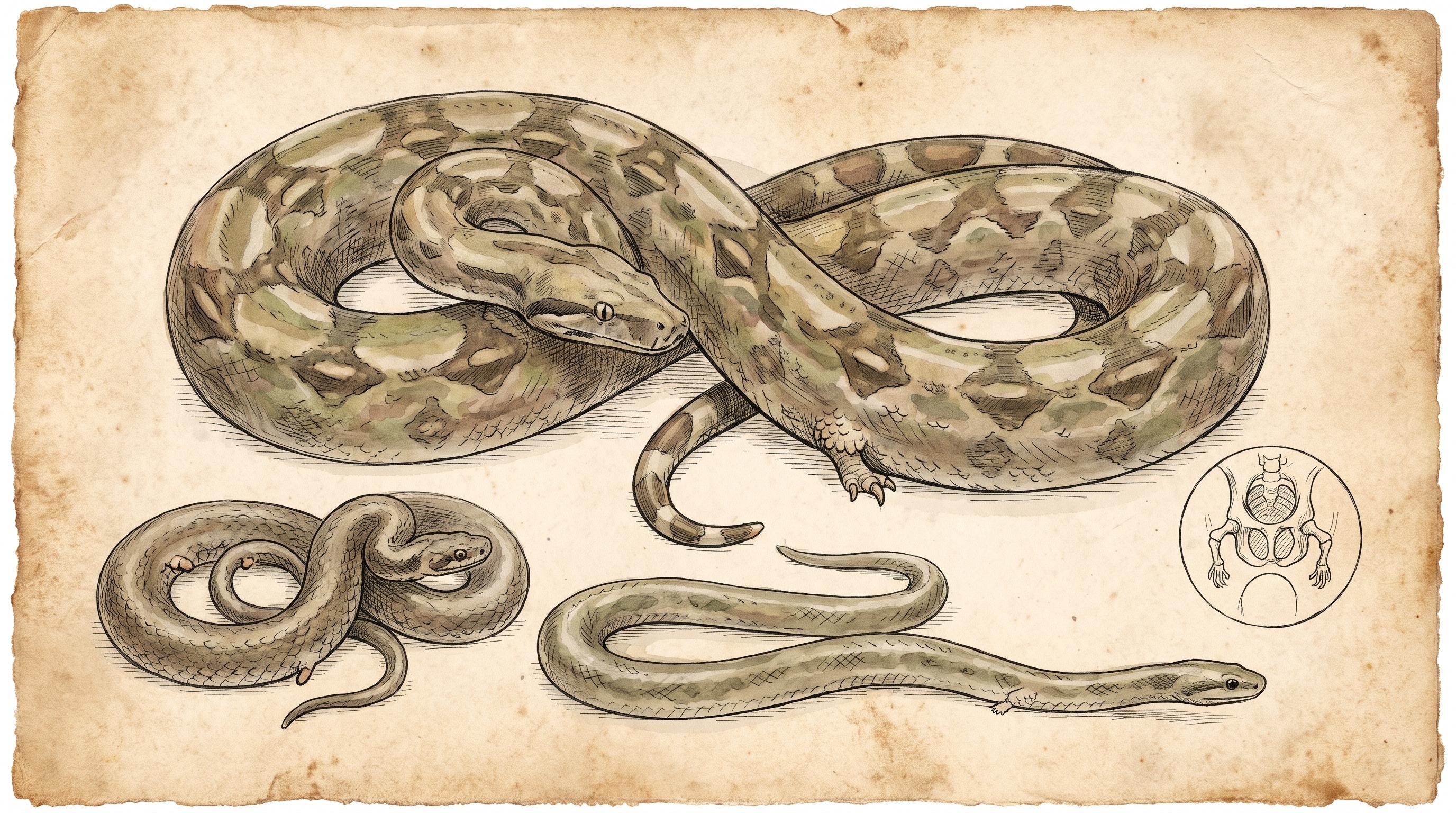
Do ball pythons have vestigial legs? Yes — ball pythons, like other pythons and boas, retain reduced pelvic and femoral bones inherited from limbed ancestors, and the spur is the only part of that skeleton you can see from outside.
What are anal spurs, and what sits underneath them?
An anal spur is a small, curved, keratinised claw on either side of the cloaca. It is not a skin tag or a random outgrowth: it caps a shortened femur, which in turn attaches to a reduced pelvic girdle floating in the body wall with no connection to the spine. Nothing in that assembly has a locomotor role — the snake cannot push against the ground with it — which is precisely what makes it vestigial rather than functional in the original sense.
External spurs are most familiar in pythons and boas, and a handful of other basal lineages retain them too. The advanced snakes most keepers also work with — colubrids such as corn snakes and kingsnakes, elapids, and vipers — show no external spur at all. So a spur is a genuine identification clue: if you can feel one, you are not holding a colubrid.
Which pythons and boas in the hobby actually show spurs?
Spurs are widespread across pythons and boas, but how visible they are varies by species, by sex and by individual. In several small boas the female's spurs are so reduced they cannot be found by touch at all, so a snake with no detectable spur is not evidence that it is not a boa.
| Species | What the spurs are usually like | How much weight to give them for sexing |
|---|---|---|
| Ball python (Python regius) | Small hooks either side of the vent, often more prominent in males | Supporting clue only |
| Boa constrictor | The largest and most obviously hooked spurs of the common species, more so in mature males | Useful in adults, poor in juveniles |
| Burmese and reticulated pythons | Present and easy enough to feel, but modest relative to a big-bodied snake | Weak on its own |
| Rosy boa and sand boas | Small; often obvious in males and effectively absent in females | Suggestive in adults, easy to miss entirely |
The pattern worth taking away is that usefulness does not follow spur size in a straight line. A large-bodied python can have spurs you can feel clearly and still tell you very little, because both sexes present much the same thing; a much smaller boa can be more informative because the difference between the sexes is closer to present-versus-absent.
How to sex a ball python using spurs, and why it is not enough on its own
In ball pythons, longer, more curved, more freely moving spurs lean male, while shorter, stubbier, less mobile spurs lean female. That is a lean, not a verdict. Three things break it in practice:
- Juvenile males often have spurs that sit squarely inside the range you would expect from an adult female, so age has to be part of the judgement.
- Spurs wear. A snake that spends its life pushing through rough substrate or around hard decor can blunt or shorten a spur, and a worn male spur reads as female.
- Individual variation within a clutch is wide enough that comparing two unrelated snakes tells you less than comparing siblings side by side.
For an answer you can act on — pairing decisions, buying decisions, group housing — the reliable methods are popping for hatchlings and small juveniles, and probing for larger animals, both done only by someone with real practice. Neither is a beginner exercise: done clumsily they can injure the hemipenes or the cloaca. If you do not have that experience, ask an established breeder to check, or book an exotics vet, rather than learning on your own animal. Spur comparison earns its keep as a first pass at a show table, not as the final word.
What spurs are for if the legs are gone
Spurs are not purely leftover furniture. Male pythons and boas use them during courtship, hooking and scratching along the female's flanks and back in a rhythmic stroking motion that helps bring her into position, and in some species they come into play when rival males grapple. That is also why males' spurs tend to be the larger and more mobile ones — there is still selection acting on the claw itself, even though the bone beneath it does nothing.
In practice this means an unusually active male in the breeding season can leave visible scratches on a female's sides. Light scuffing is normal; broken skin that stays open, or an area that looks inflamed, is worth having looked at.
Worn, broken and infected spurs: what to watch for
Because a spur is a keratin claw over a bone, it can be damaged like a claw. The things keepers actually run into are a spur snagged and snapped off on cage furniture or a loose piece of substrate, a spur worn flush with the scales, and a swollen, discoloured or weeping base. A snapped spur that has stopped bleeding and looks clean generally just leaves the snake with an asymmetric pair for life. Bleeding that does not stop, swelling, discharge, or heat and puffiness around the base are veterinary matters — an exotics vet should assess it rather than you treating it in the enclosure. Do not pull, trim or file a spur; there is bone directly underneath.
The preventable version of this is enclosure design. Sharp-edged decor, wire mesh at floor level and hides with rough cut edges are the usual culprits, and they are also the things most likely to catch a spur during a hard turn.
Using spurs when you are buying a snake
At a table or on a collection visit, spurs give you two quick reads before you commit. First, identification: feel for the spurs and note whether the animal's overall build, head shape and scalation match the species on the label — a spur confirms you are in python or boa territory, which is a useful sanity check on a mislabelled juvenile. Second, a soft check on stated sex: if a listing says male and the spurs are barely there on an adult boa, that is a fair question to ask the seller, not an accusation. Good sellers expect to be asked how a sex was determined and by whom.
When you are working through reptiles currently listed for sale, treat "sexed by spurs" as provisional and ask whether the animal was probed or popped, and at what age. If you are planning a pairing off the back of that answer, run the pairing through the morph pairing calculator before you commit to buying, and check the species entry in the species care guides so you know what the adult animal will need from you.
Frequently asked
Do ball pythons have vestigial legs?
Yes. Ball pythons retain a small, non-functional pelvic girdle and a shortened femur beneath the skin near the cloaca, inherited from limbed ancestors. The only external sign is the anal spur, a small curved claw on each side of the vent, present in both sexes but usually larger and more mobile in males.
Can you tell a snake's sex just by looking at its spurs?
Not reliably. Spur size is a useful hint in species such as boa constrictors, where mature males often show noticeably larger, more hooked spurs, but juveniles and many python species overlap too much between the sexes for spurs alone to settle it. Spurs also wear down over time. Popping in hatchlings and probing in larger snakes, done by someone experienced or by an exotics vet, are the methods that give an answer you can act on.
Do all snakes have anal spurs?
No. External spurs are found in pythons and boas and in a few other basal snake lineages that still carry vestigial hind-limb bones. The advanced snakes — colubrids such as corn snakes and kingsnakes, elapids and vipers — have no external spur, which makes a spur a quick way to narrow down what you are holding.
What are snake spurs used for if the legs are gone?
Males use them in courtship, hooking and stroking along the female's flanks and back before mating, and in some species they come into play when rival males grapple. The bones underneath play no part in movement and are considered evolutionary remnants rather than working skeletal structures.
What should I do if my snake breaks off a spur?
A spur snapped on cage furniture that has stopped bleeding and looks clean usually just leaves the snake permanently asymmetric. Bleeding that will not stop, swelling, discharge or an inflamed base needs an exotics vet rather than home treatment, because there is bone directly beneath the keratin. Never trim, file or pull at a spur, and check the enclosure for sharp edges, floor-level mesh or rough-cut hides that could have caught it.