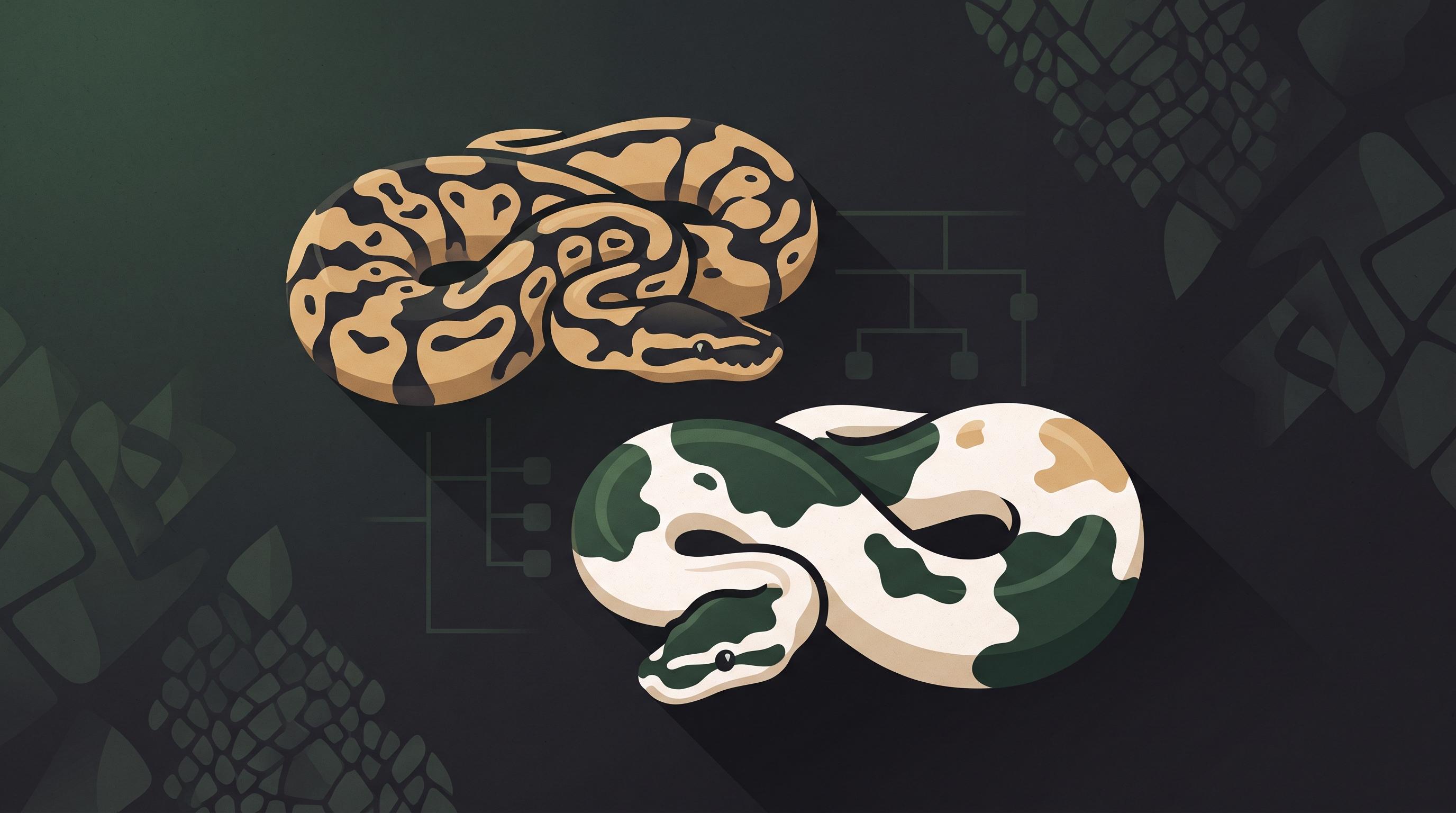
If you have been browsing ball python listings and keep running into terms like het, 66% possible het, or carrier morph, you are not alone in finding it confusing. So let's answer the question plainly: what does het mean in ball pythons, and why does it matter when you are choosing your first snake?
What does het actually mean in a ball python?
Het is short for heterozygous, which means the snake carries one copy of a recessive gene but does not visually express that recessive trait. Ball python genetics work off pairs of genes, one from each parent. A recessive gene only shows up visually when a snake inherits two copies of it, one from each parent. A het animal has just one copy, so the recessive trait itself is not visually expressed, even though the animal still carries it and can pass it to offspring.
This matters for buyers because a het animal is essentially a hidden ingredient. You cannot identify that recessive trait just by looking at the snake, but it can be a valuable breeding tool if you ever pair it with another het or a visual animal of the same gene, something the genetic calculator can help you map out before you commit to a pairing.
How is a het ball python different from a visual morph?
A visual recessive morph shows the physical trait because it has two copies of the recessive gene, while a het carries only one copy and does not visually express that trait. Take the Clown gene as an example, which is recessive. A ball python with two copies of Clown displays the characteristic Clown phenotype. A ball python with only one copy does not visually express Clown, yet it is genetically het Clown and can produce visual Clown offspring when paired appropriately.
This is exactly why het animals are usually sold for less than their visual counterparts of the same gene. You are buying breeding potential rather than the visual expression of that recessive trait. If your goal is simply a striking-looking pet, a visual morph gives you the appearance you're looking for immediately, while het genetics are generally more relevant to a future breeding project.
What is a 100% het ball python and how do you know?
A 100% het ball python is one that is guaranteed to carry the recessive gene because of how it was produced, not just because someone thinks it might. This certainty typically comes from a specific breeding pairing. For example, if you breed a visual Pied ball python to a ball python that does not carry Pied, every single offspring inherits exactly one copy of the Pied gene, because the visual parent carries two copies and must pass one to every offspring.
None of those babies will visually express Pied, but every one of them is a 100% het Pied, guaranteed by the genetics of the pairing itself.
A reputable breeder will explain exactly which pairing produced a 100% het animal, and this is worth asking about directly through their store listing or in a direct message before you buy. Genetics claims without a clear parent pairing behind them should be treated with more caution, especially for pricier het animals.
What does 66% possible het mean, and why is it not a guarantee?
A 66% possible het percentage describes the statistical probability that an individual snake carries the recessive gene, not a partial or diluted version of the gene itself. This number comes from pairing two het animals of the same gene together. Using Pied again: if you pair a het Pied to another het Pied, each offspring has a 25% chance of being visual Pied, a 50% chance of being het Pied, and a 25% chance of not carrying Pied at all.
Once the visual Pied offspring are removed from that group, the remaining non-visual offspring consist statistically of two carriers for every one non-carrier. That is where the 66% possible het label comes from. Each individual non-visual offspring has about a two-in-three chance of carrying Pied, but you cannot determine which ones inherited it simply by looking at them.
It genuinely is a probability, not a certainty. Traditionally, possible hets have been confirmed through breeding results, although genetic testing may also be available for some traits.
What does 50% possible het mean?
A 50% possible het percentage applies when one parent is a confirmed het and the other parent does not carry that recessive trait. In this pairing, each offspring has a 50% chance of inheriting the recessive gene and becoming het, and a 50% chance of not inheriting it. Because neither outcome visually expresses the recessive trait, you cannot determine which offspring inherited it simply by looking at them, so they are labeled 50% possible het.
A simple way to keep these numbers straight: 100% het can result from a visual-to-non-carrier pairing and is a guaranteed carrier, 66% possible het comes from the non-visual offspring of a het-to-het pairing, and 50% possible het can come from a het-to-non-carrier pairing. These percentages describe the probability that the recessive gene is present, never how much of the gene an animal carries or how strongly it would be expressed.
Do you need to worry about het genetics if you just want a pet?
Not really, and this is where new keepers can relax. If you are buying your first ball python purely as a pet, het status by itself does not change the animal's care requirements. A het Clown requires the same husbandry as another ball python, and you can learn more about those requirements in our ball python care guides.
Het terminology becomes practically important once you are thinking about breeding down the line or you want to understand why two similar-looking snakes may be priced differently.
That said, it is genuinely useful to recognize these terms so you are not overpaying for a probability you misunderstand or accidentally passing up a well-priced 100% het animal that would actually suit a future breeding project.
Getting comfortable with ball python genetics terms
The good news is that once you understand the difference between a guarantee and a probability, the rest of ball python genetics terminology starts falling into place fairly quickly. Het simply means one copy of a recessive gene without visual expression of that recessive trait, and the percentages attached to possible hets describe the probability that the animal carries it, never a partial version of the trait.
Whenever a listing's genetics claim feels unclear, it is worth asking the seller directly what pairing produced the animal before you buy. You can also start comparing those terms against real-world listings by browsing ball pythons currently for sale on ReptileAds.
Frequently asked
What does het mean in ball python genetics?
Het is short for heterozygous, meaning the snake carries one copy of a recessive gene but does not visually express that recessive trait. It takes two copies for a recessive trait to be visually expressed, but a het animal can still pass its copy to future offspring.
What is the difference between het and possible het?
Het, or 100% het, means the snake is known to carry the recessive gene based on its genetics or parentage. Possible het means there is only a statistical probability that the animal carries it, commonly expressed as 50% or 66% depending on the pairing that produced it.
Can you tell if a ball python is het just by looking at it?
No. A recessive trait carried by a het ball python is not visually expressed with only one copy, so appearance alone cannot confirm that the animal carries it. Parentage and breeding records can establish guaranteed het status, breeding results can help confirm uncertain genetics, and genetic testing may be available for some specific traits.
Is a het ball python worth buying as a first pet?
If you like the animal and it suits what you're looking for, het status does not change its basic husbandry requirements. Hidden recessive genetics are primarily important if you plan to breed the animal later, so someone choosing a ball python strictly as a pet does not need to prioritize het status.
Frequently asked
What does het mean in ball python genetics?
Het is short for heterozygous, meaning the snake carries one copy of a recessive gene but does not visually show the trait. It takes two copies of a recessive gene for the physical morph pattern to appear, so a het animal looks like a normal ball python even though it can pass that gene to future offspring.
What is the difference between het and possible het?
Het (or 100% het) means the snake is guaranteed to carry the gene because of a proven parent pairing. Possible het means there is only a statistical chance it carries the gene, expressed as a percentage like 50% or 66%, because the pairing that produced it could not guarantee every offspring inherited the trait.
Can you tell if a ball python is het just by looking at it?
No, het ball pythons look identical to normal ball pythons because the recessive gene is not expressed visually with only one copy. The only ways to confirm het status are knowing the exact parent pairing, doing a test breeding, or in some cases using a DNA test where one is available for that specific gene.
Is a het ball python worth buying as a first pet?
Yes, if you like the price and the snake is healthy, since het status does not affect care, temperament, or health at all. Het genetics only matter if you plan to breed later, so as a first pet you can choose based on personality, size, and husbandry needs rather than worrying about hidden genes.