Most keepers assume a chameleon's colour shift is about blending into the background, and that assumption leads to real husbandry mistakes — chasing the wrong tank decor, misreading stress signals, or missing early illness. The evidence supports a different picture: colour change is primarily driven by mood, temperature and social signalling, with camouflage playing only a minor supporting role. Understanding the actual cell biology behind why do chameleons change colour helps you read your animal correctly rather than guessing.
What cells actually control chameleon colour change?
Chameleons change colour using stacked layers of specialised skin cells called chromatophores, not by mixing pigment like a dye. The upper layer contains xanthophores and erythrophores, which hold yellow and red pigments. Below that sits a layer of iridophores, cells packed with nanocrystals of guanine arranged in a lattice. Beneath both lies a layer of melanophores containing dark melanin, which can extend fingerlike projections up through the layers above.
A common misconception is that chameleons change colour the way an octopus does, by expanding sacs of pigment. Chameleons instead rely heavily on structural colour, meaning the visible shift is a physics event as much as a pigment event.
How does light refraction produce a chameleon's colour shift?
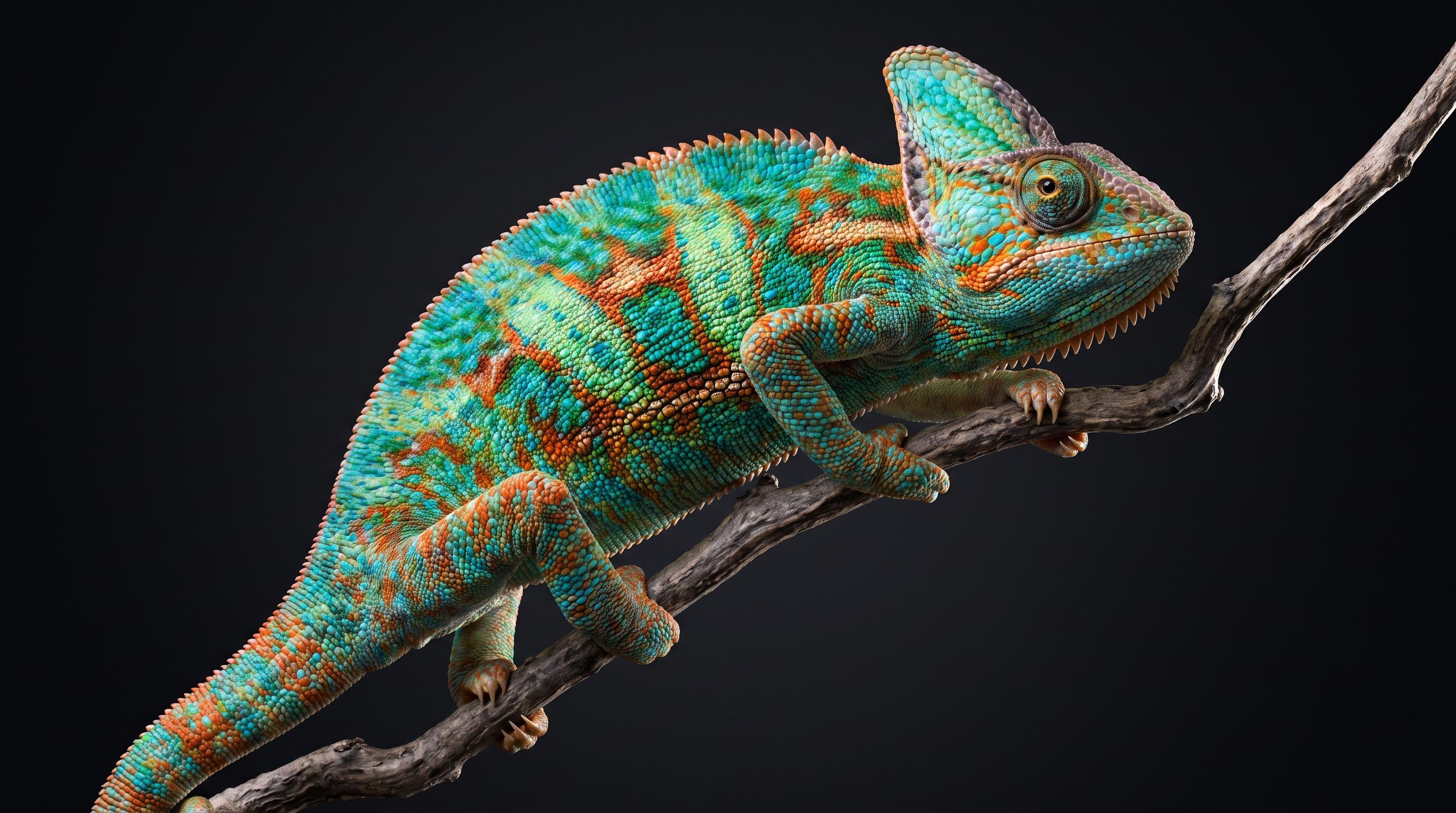
The iridophore layer works like a tunable photonic crystal, and this is the mechanism a 2015 study out of the University of Geneva confirmed using panther chameleons. When the animal is relaxed, the guanine nanocrystals sit close together and reflect short wavelengths, producing blues and greens. When the chameleon becomes excited or agitated, it actively widens the spacing between crystals by adjusting the underlying skin tissue, shifting the reflected light toward yellows, oranges and reds.
This is genuine light refraction and interference, comparable to the effect that produces colour in butterfly wings or opal. In practical terms, a chameleon isn't painting itself a new colour — it's retuning a biological prism.
How do hormones and nerves trigger a chameleon's colour change?
Chromatophore responses run on two timescales. Melanophores are under sympathetic nervous control and respond within seconds, which is why a startled animal darkens almost instantly, while slower baseline shifts track circulating hormones: melanocyte-stimulating hormone and melatonin promote melanin dispersal and darkening, catecholamines such as adrenaline drive rapid aggregation and lightening, and testosterone underpins the saturated display colours of breeding males. Temperature interacts with all of it — a cool chameleon darkens to absorb radiant heat, so an animal that stays dark through the first hours of the photoperiod is more often a basking or gradient problem than a behavioural one. Because baselines differ sharply between species, check targets in the species care guides before judging colour, and the animals listed by breeders are a useful reference for what normal adult colouration looks like in a given locale.
Is colour change really about camouflage?
No, camouflage explains only a small fraction of chameleon colour behaviour. Chameleons already have decent baseline crypsis from their body shape and slow movement; rapid colour shifts happen far too fast and far too dramatically to be primarily about matching a branch or leaf. Field and captive observations consistently show the fastest, most saturated colour changes occurring during territorial disputes, courtship, and defensive displays — not while an animal is sitting still trying to hide.
Camouflage does play a background role through slower, subtler tone shifts tied to ambient light and substrate, and in several dwarf chameleon species that background matching is tuned to the visual systems of specific predators. Keepers who choose enclosure colours purely to encourage a particular display are usually disappointed: a secure panther or veiled chameleon shows its most saturated colours in response to basking, social stimulus and breeding condition, not to background hue. Dense, layered foliage, visual barriers between neighbouring animals and a stable thermal gradient do far more for natural colouration than the colour of the enclosure itself.
The single most important point: chameleon colour is a physiological and social readout, so read it as information about mood, temperature and health rather than as a measure of how well the animal is hidden.
Frequently asked
Do chameleons change colour to match their surroundings?
Only partially. Chameleons have some background camouflage ability through slow, subtle tone shifts, but their fast, dramatic colour changes are driven mainly by mood, temperature and social signals such as territorial disputes or courtship, not by matching a branch or leaf.
What cells let a chameleon change colour?
Chameleons use stacked skin cells called chromatophores. Xanthophores and erythrophores hold yellow and red pigment near the surface, iridophores beneath them contain guanine nanocrystals that reflect light structurally, and melanophores at the base contain dark melanin that can extend upward to darken the skin.
Can a chameleon's colour tell you if it's stressed or sick?
Yes, colour is a useful behavioural signal. Darkening, unusually dull tones, or a refusal to brighten during normal activity can indicate stress, poor thermoregulation, or illness. Persistent dark colouration alongside lethargy or appetite loss warrants a check-up with an exotics-experienced veterinarian.
Why do male chameleons show brighter colours than females?
Bright, saturated colour in males is largely driven by testosterone and is used in territorial and courtship displays to signal dominance or readiness to breed. Females typically show more muted, stable colouration, though many species do brighten temporarily when gravid or rejecting a male.